A Personal/Political/Philosophical Remembrance of Cate Hundleby
by
Letitia Meynell
Dr. Catherine (Cate) Hundleby died suddenly on August 26, 2023 from a pulmonary infection. She was 57. Recently promoted to full professor at the University of Windsor, Cate was known as an expert in feminist epistemology (particularly, standpoint theory) and feminist argumentation theory—an area that she helped to transform from a theme in feminist philosophy to a recognized subdiscipline. Indeed, Cate wrote the Stanford Encyclopedia entry on “Feminist Perspectives on Argumentation.” Among many other accomplishments, she was a co-founder of the Association for Feminist Epistemologies, Methodologies, Metaphysics, and Science Studies (FEMMSS) and instrumental in developing an interdisciplinary PhD program in Argumentation Studies at the University of Windsor, for which she filled the role of graduate director.
Cate studied philosophy and women’s studies as an undergraduate at the University of Toronto. She went on to do an MA at the University of Guelph and a PhD at the University of Western Ontario (now Western University), which she completed under the supervision of Dr. Kathleen Okruhlik. Dr. Phyllis Rooney served as Cate’s external examiner and among Cate’s many publications are two special issues co-edited with her. After a year as a visiting professor in Oregon, Cate went on to a tenure track position at the University of Windsor, where she was the first feminist philosopher appointed to a permanent position in the Philosophy Department.
Cate’s work is characterized by a sensitivity to the epistemic effects of the differences between us and the importance of careful listening and rigorous, fair, and honest argumentation. She was concerned to elucidate how we can critically engage each other to both better understand the world and to make it more just. For my own part, Cate had recently got me thinking about argument repair as a feminist philosophical practice—an idea that treats argument as something that can do more than simply bludgeon your interlocutor into logical submission. When done in the spirit of actually trying to find a solution to a problem or figure things out, argument and argument repair can bring mutual understanding, even between people coming from very different starting points. This is just a flavor of Cate’s approach to philosophy. Her work is readily available and can be found through the University of Windsor’s research repository and philpapers.
As a feminist, and especially as a standpoint theorist, Cate really understood that the personal is political and that one’s commitments to feminist theory mean nothing if they aren’t born out in feminist practice. She went down to Washington D.C. for the Women’s March in 2017, knitted pussyhat on head, and you could often find her at local Pride marches (she had a particular fondness for Windsor’s Pride March), International Women’s Day events, Take Back the Night, and the like. Wherever she was, she would speak up when she thought a point needed to be made. Though she could, at times, be brusque, she was always keenly concerned to promote the interests of students and colleagues, especially those who are members of groups that are underrepresented in our profession. She was a generous and patient colleage, something evidenced by her many collaborations.
Cate and I did our PhD’s together. The first course I ever taught was a feminist philosophy course. Cate had taught it the year before and so I just did what she did. When the Women’s Studies department approached both of us separately about teaching the Lesbian Issues and Theory course (telling us it wouldn’t be taught if we didn’t teach it), neither of us had the guts to go it alone, so we decided to teach it together. Of course, we blew it on the first day. Taken by standpoint theory, concerned about how possible misperceptions of ourselves might create mistrust, having both been read as queer (and not then identifying as such), we came out as straight in the first class. (This was around 2000 when “queer” was narrower than it is now.) This led to half the class starting every question or comment with “I’m not a lesbian, but…” and the other half twitching in irritation and rolling their eyes. We made the most out of it and presented our “findings” to the Canadian Women’s Studies Association the following year. Cate was a great person to make mistakes with. She could acknowledge them, understand them, and then move on.
For me, Cate was that peer who was just a bit ahead so that she was not only a friend but a mentor, passing on philosophy survival tidbits like “Kathleen’s students finish and get jobs” and getting me involved with Western’s Women’s Caucus, who I came to think of as “the women who know.” Not just when we were students, but since then, she has shaped my experience of feminist philosophy and the academy. She helped me understand that if there’s something that needs to be done to make the community function, you just do it. That’s why the listserve for FEMMSS—without any doubt, the beating heart of the organization—is located at Windsor.
[Description of photo below taken at the second meeting of FEMMSS in Tempe, Arizona (2007) of the panel, “Engendering Testimony,” with Cate (centre), Kristie Dotson (right), and Alexa Schriempf (out of frame), and moderated by Margaret Urban Walker (left). Glasses and a water jug sit on the table in front of them (and, in front of that, a table for audience members with an open laptop, water jug, and glasses). Dotson, who has black hair tied in a ponytail, is gesturing and speaking. Walker, who has grey hair in a long bob cut, is listening intently to Dotson. Cate Hundleby, who has short red hair and is looking down, is listening with a quiet smile on her face.]

During the pandemic she helped organize a feminist philosophy of science book club, which met on zoom; this was characteristic of her community building ethos. She has been a fellow feminist traveller, a valued colleague, and a dear friend, not just for me, but for many of us, shaping our paths as we walked them with her.
She also had a great spirit of adventure and a willingness to try things out (of which I was always a little in awe). This extended from her professional life into her personal life. She was not only committed to living justly, but living well and having fun. Her laugh was boistrous and infectious. As a graduate student, she was always game for going to a show, party or the pub, playing poker, or hosting a movie night (like the westerns at Western series) or a scotch tasting party (though in later years her tastes turned to gin).
The paths she walked the most in recent years were with her beloved dog, Chloe. Cate was an enthusiastic gardener and she and Chloe negotiated their shared use of the back yard with mutual respect. Friends and colleagues are all, I know, reeling from this terrible loss, which leaves a gaping hole in our lives and our profession.
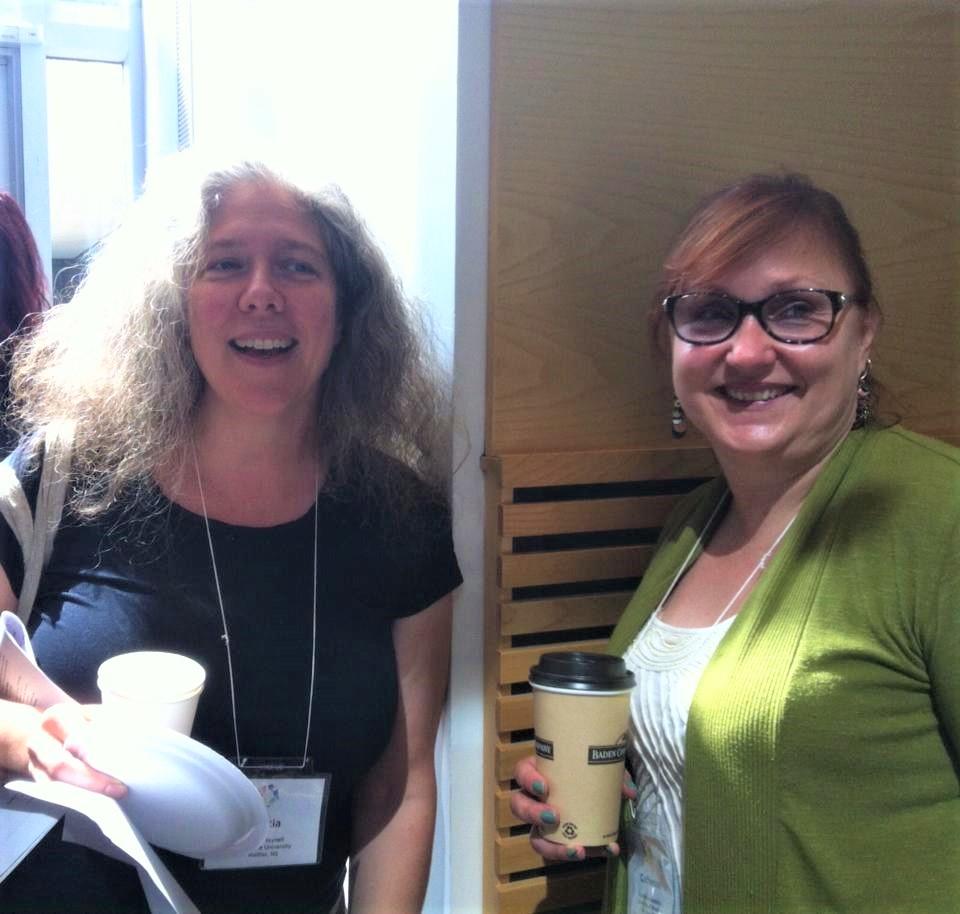
[Description of photo below taken at the fifth meeting of FEMMSS, held at the University of Waterloo (2014). Letitia (left) and Cate (right), lean against a wall during a coffee break, as if conspiring. Letitia, who has grey hair and is smiling, holds a paper cup, paper plate, a piece of paper. Cate, with her signature red hair, is wearing glasses and holding a paper coffee cup. Both of them are looking at something to their left and seem to be sharing a joke.]
 BIOPOLITICAL PHILOSOPHY
[…] it does mark the beginning of my last year of my 50s. And I had a friend die this week. (See more here.) So thoughts of mortality loom large. My birthday also marks the end of summer. So, I am […]
LikeLike