Hello, I’m Shelley Tremain and I would like to welcome you to the one hundred and eighth installment of Dialogues on Disability, the series of interviews that I am conducting with disabled philosophers and post to BIOPOLITICAL PHILOSOPHY on the third Wednesday of each month. The series is designed to provide a public venue for discussion with disabled philosophers about a range of topics, including their philosophical work on disability; the place of philosophy of disability vis-à-vis the discipline and profession; their experiences of institutional discrimination and exclusion, as well as personal and structural gaslighting in philosophy in particular and in academia more generally; resistance to ableism, racism, sexism, and other apparatuses of power; accessibility; and anti-oppressive pedagogy.
The land on which on which I sit to conduct these interviews is the traditional ancestral territory of the Haudenosaunee and Anishinaabeg nations. The territory was the subject of the Dish with One Spoon Wampum Belt Covenant, an agreement between the Iroquois Confederacy and the Ojibwe and allied nations around the Great Lakes. As a settler, I offer these interviews with respect for and in solidarity with Indigenous peoples of so-called Canada and other settler states who, for thousands of years, have held sacred the land, water, air, and sky, as well as their inhabitants, and who, for centuries, have struggled to protect them from the ravages and degradation of colonization and expropriation.
My guest today is Kate Manne. Kate is associate professor at the Sage School of philosophy at Cornell University. She specializes in moral, social, and feminist philosophy, and has written three books: DOWN GIRL: The Logic of Misogyny (OUP, 2018), ENTITLED: How Male Privilege Hurts Women (Crown, 2020) and UNSHRINKING: How to Face Fatphobia (Crown, 2024). She regularly writes opinion pieces and essays for non-academic audiences, including in The New York Times, The Cut, The Washington Post, The Atlantic, The Nation, Time, and more. She also writes a Substack newsletter, More to Hate, which explores misogyny, fatphobia, and their intersection. In her spare time, Kate enjoys cooking, reading, and hanging out with her husband, four year-old daughter, and elder cat.
Welcome to Dialogues on Disability, Kate! As many of our readers and listeners know, you began your education in Australia and then migrated to North America. Please tell us some of the details of this migration and how it led you to the work that you currently do in philosophy.
I identified as a feminist from a young age and began studying philosophy in my first year at Melbourne University. I was initially drawn to the “big questions” of philosophy, such as the existence of free will and the nature of morality. Soon afterward, I became enamored of logic, and then began to study mathematics and computer science to complement that interest. I knew that I wanted to go to graduate school and pursue a career in philosophy; but it was not until I heard a talk by Sally Haslanger, in the final year of my undergraduate degree, that my interest in social philosophy was ignited. Sally was discussing the concept of parenthood and the possibility of ameliorative analyses that did not downgrade adoptive parenthood or privilege biological relationships. I was captivated by the possibility of using philosophical tools to make our concepts more precise, more helpful, or just as we navigate the social world. I found myself desperate to study with her. When I got into graduate school at MIT, well, the rest is history. Sally remains a key influence for me now, as well as a very dear friend.
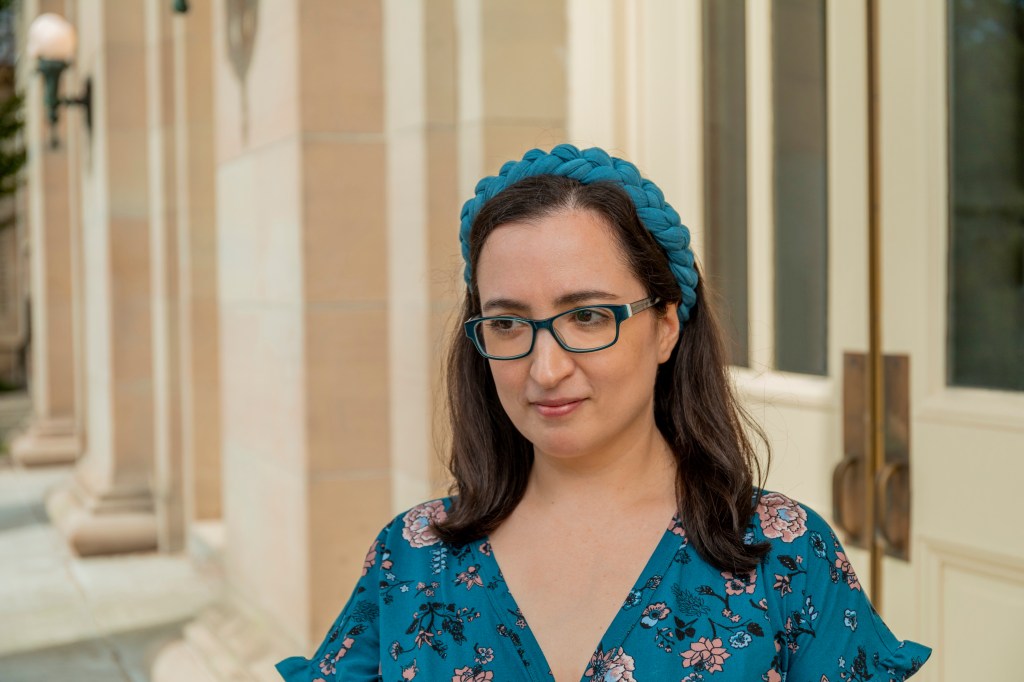
[Description of photo below: Kate, a white, small fat, cis woman, stands in a hallway in front of large doors. She is wearing a flowered dress, a braided hairband, and glasses, and smiling.]
Admittedly, I was initially unclear in graduate school about whether I wanted to continue studying logic, or whether I should shift entirely to other topics. I remember Sally remarking casually over lunch in the lounge one day that women in philosophy are sometimes drawn to logic or history of philosophy so that they have something to point to—a proof or a text—to back up their claims and arguments. That resonated with me: I felt that I might be doing logic for partly bad reasons, to avoid the risk that I would be proven wrong. I began to focus on moral, social, and feminist philosophy shortly thereafter.
The move from Australia was a big and wrenching one for me—I had never been overseas before that plane ride to Boston! But it was also terribly exciting to be able to devote myself to philosophy in such a stimulating environment.
Kate, each of the three books that you have written—Down Girl, Entitled, and Unshrinking—was designed for a broad audience, that is, designed for a general readership rather than philosophers and other academics alone. The books are, I believe, quintessential examples of public philosophy. Yet, many philosophers would disagree, arguing that the books, their subject matter, and the claims therein do not constitute philosophy at all. How would you respond to an interlocutor who challenged you with the question, “How is this philosophy?”
I remember the late, great Ken Taylor remarking that “philosophy is what philosophers do.” I am a philosopher, I take it—I am trained as one, employed as one, teach subjects that go under that heading. So, it seems to me that the work I do has a reasonable claim to be considered philosophy, among other things. I am happy to admit that it does indeed involve several other things—sociology, psychology, cultural criticism—too.
More broadly, I do not put much stock in gatekeeping in the discipline. The question “Is it philosophy?” is frequently, as Kristie Dotson has so brilliantly brought out, a way of asking whether a piece of work deserves a kind of tacit honorific, not whether it meets an―as far as I can tell―non-existent set of necessary and sufficient conditions to be a philosophical contribution. Even looser characterizations of philosophy are notoriously elusive. I would much rather ask, “Is this interesting?” or “Is this interesting to me?” in a way that invites engagement from people who feel that they have something to gain or learn from a conversation into which a philosopher enters.
Your latest book, Unshrinking: How to Face Fatphobia, examines the nature of fatphobia; its entanglement with other forms of oppression such as ableism and racism; and the relationship between fat, fatphobia, and discourses on health. Please explain the central arguments and aims of the book.
I wrote this book to wrestle with the internalized fatphobia that has dogged me in my life, as a fat woman, and which is the piece of misogyny that I think that I have imbibed the most deeply. Since I wrote my first two books on misogyny, people would often ask me how I came to be interested in the topic. And the truth is, I could not tell that story without telling a story about fatphobia too—the way I was bullied and belittled for my size as a girl in high school, attending an all-boys’ school in the year that it became integrated, as one of three girls that first year.
In researching this book, I was deeply influenced by the work of Sabrina Strings, who has argued that fatphobia–unlike misogyny–is a relatively recent historical invention. Strings does not deny that elements of fatphobia existed before the mid eighteenth century; but she shows that fatphobia was not really systemic until this historical moment, the moment when white colonists began to use the supposed fatness of the Black body as a pretext to justify the burgeoning trans-Atlantic slave trade. Essentially, white colonists needed a way to distinguish white bodies from the increasing numbers of Black bodies that were so brutally enslaved. The supposed fatness of Africans was used as an ad hoc basis for making this distinction: not based on fact, it should be noted, but rather on speculation—by white racist pseudo-scientists who had typically never been to the relevant parts of Africa.
In other words, it is not that fatness was derogated, and then associated with Blackness; rather, fatness and Blackness were associated with each other, and then, consequently, fatness fell into disrepute.
Today, we see fatphobia continuing to work as a powerful weapon of oppression, to marginalize people who are already marginalized, often multiply so, including non-white, poor, and disabled people. It is not necessarily that people who belong to these social categories are fatter in reality, as I have explained elsewhere; rather, fatness is a powerful marker or proxy for lowly social status. And fatphobia thus allows powerful, often thin, white elites to dress up their racism, classism, and ableism by sneering, as Paul Campos puts it, not at a poor Mexican-American woman using a mobility aid at Walmart, but at a morbidly obese person who is presumed to be unhealthy. For a slightly subtler example, some such elites will engage in concern trolling about fat bodies, affecting to be terribly worried about the health of people whose health status they in fact know very little about—and care about very little, in most cases. Again, classism, racism, and ableism often gets dressed up in the (in some circles somewhat more acceptable) garb of fatphobia.
The connection between fatness and health is, in reality, complex—it can be captured in important outline by a U-shaped curve that shows people in the “overweight” category—according to the (hugely problematic) BMI charts, to have the lowest all-cause mortality of any category. People who are “moderately obese” and “normal” weight have similar mortality risks, with a clear correlation between being either underweight or more than moderately obese and having increased mortality risks. But we do not yet know whether being very heavy causes ill health in and of itself, since the correlation can also be accounted for by the fact that fat people receive inadequate health care, avoid health care altogether, are subject to weight stigma—which is demonstrably bad for our health—and often undergo weight cycling. This last holds because fatter people are the ones advised to go on diets most often, losing weight in the short term, and then regaining it almost inevitably over a longer time period. And, as I delve into in my book, substantial fluctuations in weight turn out to have independent health ill effects, including cardiovascular disease, metabolic “problems,” immune “dysfunction,” and mental health harms.
But even if it turns out to be true that simply being very heavy is the definitive cause of some health problems—which, again, is certainly possible—this does not change the fact that fat people deserve respect, compassion, and adequate health care. It does not change the fact that we do not yet have ways to reduce people’s weight in a reliable, safe, humane, long-term manner. Nor does it follow that weight loss would do more good than harm for most people in larger bodies, given the costs (including health costs) of shrinking.
From the perspective of the discourse though, these complex arguments and vital nuances often hardly matter. Simple, blanket assumptions that fat people are automatically unhealthy or even doomed to die of our fatness are a way to weaponize faux health concerns against people who, more than anything, are the subjects of bigotry and bias and pernicious disgust reactions.
Although, again, this is complicated: I do not want to naturalize the disgust toward fat bodies, remembering it is a historically recent phenomenon; nor do I want to obscure the fact that fat people are also often regarded as sexually attractive, at least if porn consumption is any indication. Fat women in particular are often deemed fuckable but not loveable, cognized not as unsexy so much as lacking in social-cum-sexual status. I have written more about this idea, in what is surely the most personal piece I will ever publish.
Nuances aside, that these disgust reactions toward fat bodies proliferate has a powerful impact on the unjust moralization of fatness. A wealth of research in social psychology shows that, often, when people feel artificially heightened or induced visceral disgust, they come to feel moral disgust and devise post hoc explanations for their morally disgusted reactions. For example, in a 2005 study by Thalia Wheatley and Jonathan Haidt, participants susceptible to posthypnotic suggestion were hypnotized to feel a pang of disgust upon reading a random word: either “often” or “take.” The experimenters then had participants read a vignette featuring people depicted as committing a moral transgression. For instance:
Congressman Arnold Paxton frequently gives speeches condemning corruption and arguing for campaign finance reform. But he is just trying to cover up the fact that he himself [will take bribes from/is often bribed by] the tobacco lobby, and other special interests, to promote their legislation.
Participants who read a version of the vignette featuring the word that matched their posthypnotic suggestion—and thus would have felt a pang of disgust upon reading it—tended to judge the transgression significantly more harshly. This example shows that feeling artificially heightened disgust can make us more morally judgmental.
In a follow-up experiment, the researchers included another vignette as a control, in which a student council representative named Dan was described as either “trying to take up” or “often picking” topics of widespread mutual interest for discussion at their meetings. Obviously, this is a perfectly fine, even good, thing to do. Nevertheless, participants who read the version of the vignette that matched their posthypnotic suggestion, and thus elicited a pang of disgust, tended to condemn Dan for his innocent behavior. “It just seems like he’s up to something,” said one of the participants. Dan came across as a “popularity-seeking snob” to another. His behavior “seemed so weird and disgusting” to someone else. “I don’t know [why it’s wrong], it just is,” they insisted, somewhat helplessly.
The lessons of this study are twofold: first, people routinely misinterpret their visceral disgust reactions as moral disgust, leading them to judge morally bad actions more harshly, and even to deem neutral actions morally problematic; second, when this occurs, people reach for reasons to justify their moral ill feelings, engaging in post hoc rationalization of a moral verdict already rendered.
It is hence telling that disgust has been shown to be heavily implicated in negative judgments about fat people. In a 2010 study, disgust toward fat bodies was the strongest predictor of these fatphobic judgments. Fat people were also among the social groups that elicited the most disgusted reactions: we are on a par with politicians and unhoused people, and second only to smokers and drug users, in eliciting revulsion.
Because fat people are routinely regarded with visceral disgust, our bodies are liable to be moralized, even though we have not done anything wrong by simply existing. Fat people, rather than being taken simply as people, tend to be regarded as moral failures; and fat bodies, rather than being taken simply as bodies, are deemed moral problems—urgently in need of solutions, whether cruel or ostensibly concerned and well meaning.
It is also telling that a lot of disgust toward fat bodies seems driven by the idea that a person’s weight is under their tight, deliberate, long-term control—which, again, I argue in my book, simply is not the case. Weight is highly heritable, estimated at >0.7, meaning that upward of 70% of the variation in the human population in body mass is due to genetics. To put this in perspective, height is just a bit more heritable, with an estimated value of around 0.79. And other factors that affect weight—common illnesses, disability, medications, trauma, pregnancy, food environments, and so on—are typically unchosen too.
I make an argument, involving a weakened version of an “ought implies can” principle, that because weight is largely out of individuals’ long-term control, we are not under a general moral obligation not to be fat. But this argument is also followed by what I think is a vital double “even if” clause: even if some people are effectively choosing to be fatter via their food choices, and even if they do run certain health risks as the result of this, I am still not convinced that this is a serious moral issue. People run health risks all the time—everything from tanning skin (to use A.W. Eaton’s example) to bungee jumping to Grand Prix racing—and we rarely object to these risks if they are taken by presumptively thin, fit, nondisabled people. Some big exceptions where we do shame people taking health risks are smoking and drug use, due in part to the public-health campaigns against them, and also in part due to the fact that they are coded behaviors in terms of race and class. In these cases, and fatness, too, I think the moralization is largely counter-productive and wrongheaded.
Many philosophers and theorists of disability think that the apparatuses of disability and ableism constitute and encompass “fatness” and fatphobia, that is, that fatness and fatphobia should be situated under the rubric of the apparatuses of disability and ableism. How do you understand the relation of fatness and fatphobia to the apparatuses of disability and ableism? What states of affairs do fat and fatphobia raise with respect to inaccessibility and exclusion?
Without thinking that fatness is a disability per se (though of course there’s an important intersection), I nevertheless think there’s a very deep relationship between fatphobia and ableism. I am tempted to put it like this: people who belong to these categories are often not perceived as human beings—who are entitled to take up space, to navigate the world freely, and to be listened to, among many other things—but rather, as human failures—who need to be fixed, cured, drugged, cut up, corrected. Our non-normative bodies require appropriate access and accommodation and liberation, in the name of social justice; but instead of changing the world to adequately work for us, we are prevailed upon to make our bodies more normatively acceptable, whatever our own desires or needs or values.
Eli Clare’s book, Brilliant Imperfection: Grappling with Cure, has been a big recent influence on me in trying to think through this; so much of what he wrote resonated with me as someone whose fat body has often made me the subject for pitying and sometimes even cruel interventions. “If only we could cure you” and “If only we could shrink you” feel like very similar thoughts—perhaps one and the same?—in the age of Ozempic, where drug manufacturers like Novo Nordisk are making an enormous profit by medicalizing fatness. (I resist pathologizing words like obesity and overweight, partly for these very reasons; like most people in the body liberation space, the word fat is my preference.) They then market an expensive “cure” for what is, in many cases, a bodily non-problem. And, of course, fat activists are resisting this, in ways reminiscent of how many brilliant disabled activists, scholars, and thinkers have resisted the idea that their ways of being in the world should be pathologized and then “cured.”
My brilliant graduate student, Bianca Waked, who has devised the notion of a “counterfactual body” in relation to disability as well as fatness, has also influenced me on this topic. She is arguing that, for both disabled and fat folks, we are haunted by the specter of the body that could have or should have been, according to ableist and fatphobic logics. Rather than working for freedom and community and joy for the bodies we have, we are viewed as a lesser shadow of the bodies or selves the world projects onto us, whispering “if only.”
What are you plans for future work?
I am fascinated by the idea of dehumanization and the rhetoric surrounding it. I am on the record as worrying that, for oppressors and their apologists, the ideology of dehumanization can suggest that, e.g., white supremacists and misogynists only mistreat non-white people and white women because they somehow do not realize that we are fully human. To which I am tempted to ask, how much more evidence of our humanity do they need, at this point in human history? I am not saying that dehumanization has never been a historical and social force driving grave human evils. But, nowadays, I worry that this way of thinking about things obscures from us the fact that dominantly situated people can treat others terribly even when they fully recognize our humanity, but feel that we have wronged them in some way. For example, in the case of women, we are often perceived as inadequately giving in our characteristically human, and feminine-coded, duties of loving, serving, and performing emotional, sexual, reproductive, and material labor. This explanation of misogyny is, I argue, typically a better fit for the data, which shows that women who err according to patriarchal norms and expectations are often subject to characteristically human, interpersonal reactive attitudes (in P.F. Strawson’s sense), such as resentment, blame, and indignation.
Still, I do not want to ignore the fact that, often, people who are marginalized in some ways will say they feel dehumanized, and I want to listen to them and respect that. What is really at stake in such assertions? Is it that people feel, often rightly, flattened, vilified, cartoonified, or reduced to a trope? Or perhaps it is that, as I have begun to think, some of us are perceived as human—again, all too human—failures, who are not allowed to simply be in social and epistemic space without correction, policing, punishment. Much as in my first book, Down Girl, I contrasted human beings and human givers, I wonder whether there is more action in the second half of the term than we have credited; so exploring the human being versus human failure distinction will be the subject of at least an academic paper, maybe more. Probably more, because I am also interested in the question: what happens when a human giver is also a human failure? Her failures to give visual satisfaction or social-cum-sexual status to the dominant cultural consumers of women—cis het white nondisabled men—may make her failure, well, unforgiveable in a way that explains how potent is the intersection between misogyny and fatphobia.
Kate, how would you like to end this interview? Are there topics or concerns that we have not discussed that you would like to address? Would you like to recommend some books, articles, blogs, or videos that readers and listeners can seek out for more information about the issues that you have addressed?
One thing that I have been grappling with in my work is that fatphobia is often not something we are discussing or resisting strongly enough in the academy. From the implicit fatphobia of calling bad prose “flabby,” to the explicit fatphobia of the “fat man” version of the trolley case, I think philosophers in particular can do a lot better in thinking more humanely and justly about those of us in larger bodies. So, I would love to close by offering just a few further resources in the body liberation/fat justice space that have inspired me in Unshrinking:
- Kate Harding and Marianne Kirby, Lessons from the Fat-o-Sphere: Quit Dieting and Declare a Truce with Your Body
- Marilyn Wann, Fat! So?
- J Aprileo, Comfy Fat blog
- Linda Gerhardt, Fluffy Kitten Party blog
- Aubrey Gordon, What We Don’t Talk About When We Talk about Fat and “You Just Need to Lose Weight”: And 19 Other Myths About Fat People
- Da’Shaun L. Harrison, Belly of the Beast: The Politics of Anti-fatness as Anti-Blackness
- Marquisele Mercedes, Da’Shaun Harrison, Caleb Luna, Bryan Guffey, and Jordan Underwood, Unsolicited: Fatties Talk Back podcast
- Ash Nischuk, Fat Lip blog and podcast
- April Quioh and Sophie Carter-Kahn,She’s All Fat podcast
- Sabrina Strings, Fearing the Black Body: The Racist Origins of Fat Phobia
- Lindy West, Shrill: Notes from a Loud Woman
- Aubrey Gordon and Michael Hobbes, Maintenance Phase podcast
- Chrissy Harrison, Food Psych newsletter and podcast, and Anti-Diet: Reclaim Your Time, Money, Well-Being, and Happiness through Intuitive Eating
- Virginia Sole-Smith, Burnt Toast substack newsletter and podcast and Fat Talk: Parenting in the Age of Diet Culture
- Cheryl Frazier’s body of work on fatness, beauty labor, and the problems with body positivity
- Anne Eaton, “Taste in Bodies and Fat Oppression”
- Abigail Saguy, What’s Wrong with Fat? The War on Obesity and its Collateral Damage
- Grace Mulvey and Conor Dowling, Fad Camp podcast
- Hanne Blank, Fat: Object Lessons
- Virgie Tovar, You Have the Right to Remain Fat
Kate, thank you for this tremendous list of research materials that our readers and listeners can explore if they wish to learn more about the issues that you and other feminist philosophers have raised with respect to fatness and fatphobia. To your list of recommendations, I want to add “Would You Kill the Fat Man Hypothetical? Fat Stigma in Philosophy,” Kristin Rodier and Samantha Brennan’s excellent chapter in The Bloomsbury Guide to Philosophy of Disability. I also want to thank you for your incredibly wide-ranging, insightful, and thought-provoking remarks throughout this interview.
Readers/listeners are invited to use the Comments section below to respond to Kate Manne’s remarks, ask questions, and so on. Comments will be moderated. As always, although signed comments are preferred, anonymous comments may be permitted.
The entire Dialogues on Disability series is archived on BIOPOLITICAL PHILOSOPHY here.
From April 2015 to May 2021, I coordinated, edited, and produced the Dialogues on Disability series without any institutional or other financial support. A Patreon account now supports the series, enabling me to continue to create it. You can add your support for these vital interviews with disabled philosophers at the Dialogues on Disability Patreon account page here.
__________________________________
Please join me here again on Wednesday, April 17, 2024, for the ninth anniversary installment of the Dialogues on Disability series and, indeed, on every third Wednesday of the months ahead. I have a fabulous line-up of interviews planned. If you would like to nominate someone to be interviewed (self-nominations are welcomed), please feel free to write me at s.tremain@yahoo.ca. I prioritize diversity with respect to disability, class, race, gender, institutional status, nationality, culture, age, and sexuality in my selection of interviewees and my scheduling of interviews.
 BIOPOLITICAL PHILOSOPHY