Hello, I’m Shelley Tremain and I would like to welcome you to the one hundred and twenty-fourth installment of Dialogues on Disability, the series of interviews that I am conducting with disabled philosophers and post to BIOPOLITICAL PHILOSOPHY on the third Wednesday of each month. The series is designed to provide a public venue for discussion with disabled philosophers about a range of topics, including their philosophical work on disability; the place of philosophy of disability vis-à-vis the discipline and profession; their experiences of institutional discrimination and exclusion, as well as personal and structural gaslighting in philosophy in particular and in academia more generally; resistance to ableism, racism, sexism, and other apparatuses of power; accessibility; and anti-oppressive pedagogy.
The land on which I sit to conduct these interviews is the traditional ancestral territory of the Haudenosaunee and Anishinaabeg nations. The territory was the subject of the Dish with One Spoon Wampum Belt Covenant, an agreement between the Iroquois Confederacy and the Ojibwe and allied nations around the Great Lakes. As a settler, I offer these interviews with respect for and in solidarity with Indigenous peoples of so-called Canada and other settler states who, for thousands of years, have held sacred the land, water, air, and sky, as well as their inhabitants, and who, for centuries, have struggled to protect them from the ravages and degradation of colonization and expropriation.
My guest today is Raymond Aldred. Raymond is a Ph.D. student in the Philosophy Department at McGill University and a senior analyst for one of the banks in Canada. A member of the Métis Nation and a descendant of the Historic Red River Métis Nation, Raymond also has Cree kinship ties through his father, who is a member of the Swan River Band in Treaty 8 Territory. Raymond’s research—which is informed by his personal experiences of disability and the experiences of other disabled individuals and others who live on the side or the outside of society—is published in The Journal of Cognition and Neuroethics, where he explores themes of cognitive disability and agency. His chapter, “A Sacred Bond: Indigenous Reflections on Disability, Love, and the Church,” is forthcoming in a collection on theology. Raymond likes to express himself through art and has a long-standing interest in computer security.
Welcome back to Dialogues on Disability, Raymond! I interviewed you in September 2015 and again in December 2019. Both these interviews were fascinating and remain quite popular with readers and listeners of BIOPOLITICAL PHILOSOPHY. It seems like the appropriate time for you to give us an update on events in your life and your situation. What has transpired since December 2019?
Tansi (Cree for hello), Shelley. I am delighted to return for our third dialogue. Each previous encounter has generated profound questions and opened theoretical trajectories that continue to reshape my intellectual landscape.
Foucault’s assertion that philosophy should center on exploration and privilege self-transformation over static theorization accords deeply with my recent experiences. The past several years constitutes a fundamental reconfiguration of my embodied existence, altering my understanding of my multiple disability experiences, my care relations, and my understanding of the complex apparatus of disability itself.
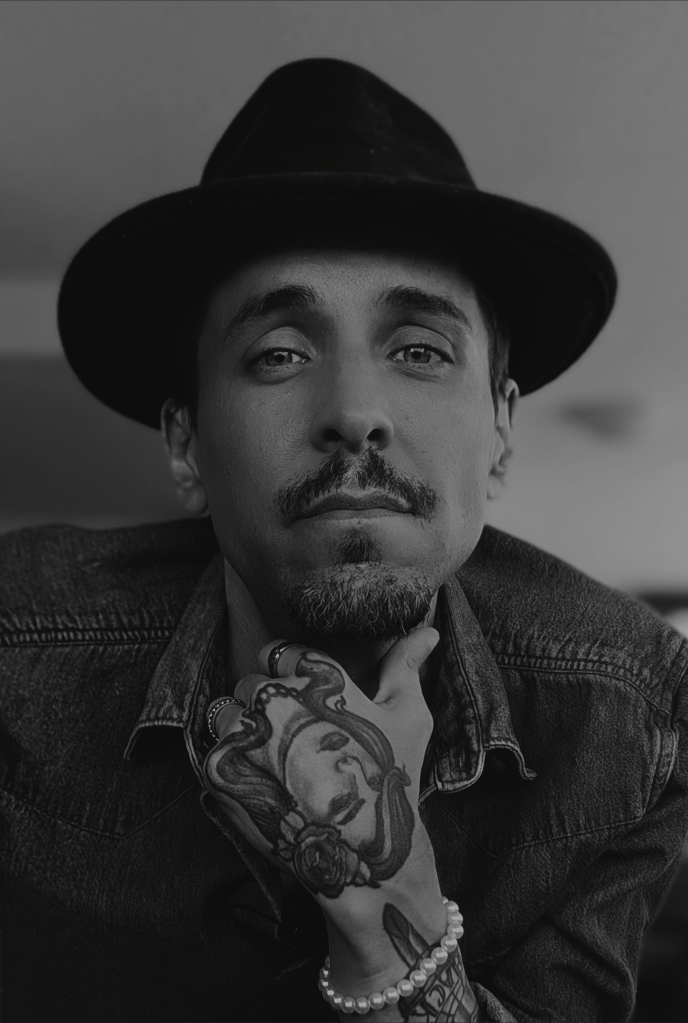
[Description of image below: close-up photo of Ray who has a mustache and goatee, is wearing a jean jacket and hat, and looking directly into the lens of the shot. Ray’s left hand, which is tattooed and on which there are two rings, is raised to his chin. A pearl bracelet adorns Ray’s left wrist.]
In May 2020, while trying to complete my doctoral thesis amid the COVID-19 pandemic, I experienced a severe ischemic stroke that added new layers of complexity to my already existing disability identity. By then, I had already come to adopt a disabled epistemology, that is, a deep, personal understanding of how ableist structures function. However, the stroke introduced a different dimension of disability experience that intersected with and complicated my established ways of navigating the world.
The stroke occurred suddenly during an ordinary domestic moment. I was sharing a meal with my partner when I found myself unable to articulate words despite maintaining a cognitive comprehension of the language. My right hand became immobile and my vision temporarily transformed into a kaleidoscopic distortion. Interestingly, my knowledge of my body in this instance was invaluable: I could immediately recognize something was profoundly wrong with my body and mind, and my partner’s familiarity with my responses enabled her to recognize the stroke symptoms rather swiftly.
The subsequent medical intervention was both intensive and lifesaving. Due to COVID-19 protocols, I was separated from my partner at the hospital. While framed as necessary health safety measures, this separation might demonstrate how medical institutions can control patients by removing their support networks, loving care, and advocates. As someone who uses a wheelchair and has experience navigating medical ableism, I know that it is crucial for me to have an advocate present who understands my body and its uniqueness to ensure appropriate care and accessibility. The COVID protocols effectively stripped away this essential support system at one of my most vulnerable moments, illustrating how institutional policies—even policies justified by legitimate concerns—can function as mechanisms of power that particularly disadvantage disabled people.
I remained unconscious for approximately five days while my partner navigated complex decisions about my care over the phone. Our prior conversations about medical preferences were extensive, given my existing disability and my engagement with bioethics and neuroethics. As a disabled rebel in bioethics and neuroethics who often resists certain bioethical principles, I had explicitly chosen maximal intervention and purposefully embraced the possibility of acquiring additional disabilities. This decision emulates a multiply disabled politics and a rejection of the presumption that increased complexity of disability alone necessarily or sufficiently diminishes life’s value. My disabled life is far more complex and contextual than what standard bioethicists want to contain in their neat, tidy, and pretty little boxes, as my moral pluralism or my moral particularist side might say.
Upon regaining consciousness, I confronted the reality of Broca’s aphasia, a language processing condition resulting from a change to my left frontal lobe regions responsible for expressive speech coordination. While my linguistic comprehension remained intact, my ability to transform thoughts into articulate language was, in a way, disconnected. The words were lost whenever I wanted to speak or write, as if I were trying to find a lost little animal in a dark or dim forest. This situation created a poignant new intersection: as someone already experienced in advocating for accessibility and challenging ableist assumptions, I now faced a new form of communicative ableism that intersected unpredictably with my previously existing disability identity.
Though my speech has improved tremendously over the past almost five years, the experience of temporary but severe communication barriers provided insights into linguistic ableism and the hierarchy of communication forms within disability communities. The subsequent rehabilitation process involved neuroplasticity-driven relearning while I adapted to my new, transformed physical body. My expressive language gradually improved through intensive speech therapy, reading, and practice, though I still experience some ongoing effects when I am tired. This experience expanded my perspective on what complex embodiment entails, recognizing that disabled bodies exist simultaneously in multiple, sometimes ambiguous or puzzling states, and that recovery trajectories can be partial but still meaningful.
The transformation that this experience entailed led to a fundamental reconfiguration of care relationships. I now require professional caregiving support twice daily, supplemented by my partner’s assistance. The nature of my care needs has shifted dramatically. Previously, my care primarily addressed physical assistance with mobility and environmental navigation. Post-stroke, my personal care increased, and communication support became pivotal, creating new vulnerabilities and power dynamics.
This shift illuminated important distinctions in care provision that I believe disability studies has inadequately theorized. While I had extensive experience with respect to advocating for my needs and training caregivers, the acute phase of aphasia temporarily disrupted these established patterns. I discovered that effective care relationships often require communicative flexibility and adapting interaction styles, while also maintaining the care recipient’s autonomy and decision-making authority. This dynamic can be very challenging, although not impossible to do.
During the early months when my speech was most severely affected, I noticed that some care providers, faced with my communication differences, often resorted to loving yet paternalistic approaches. They sometimes assumed that I had almost cognitive incapacity, despite my unchanged intellectual abilities to make decisions; or they believed that they understood what I wanted, when they didn’t; or they thought that they knew what was best for me, when they clearly didn’t; or they would prioritize their own needs or wants over mine.
The intersection of my acute aphasia with my existing disability created particularly complex dynamics during those early months. My speech seemed to trigger assumptions about cognitive capacity or autonomy in ways that my physical disability alone had not, demonstrating the hierarchy of privileging of certain forms of communication within care relationships. As my speech improved over time, I witnessed how these dynamics shifted, providing insight into the contingent nature of these ableist assumptions. While loving and caring relationships play a central role in supporting disabled people, truly respecting our freedom requires more than care alone.
Professionally, the changes resulting from my stroke necessitated a temporary departure from academic philosophy, leading me to work remotely as a senior data analyst in the financial sector. This position accommodates my disability, allowing the remote work while my partner completes her sexology degree and I finish my thesis. The good insurance that my employer provides doesn’t hurt either!
I’m weighing what I might do with my newer body and mind after I complete the dissertation. If the finances work out, I would love to pursue a postdoctoral project related to disability or Indigenous philosophy. If the opportunity arises and someone wants me, I might also consider teaching. Or, I might continue as a data analyst and data scientist, which has proven surprisingly engaging, especially with the rise of AI. My future is shaped by both possibility and practical considerations, much like my disability experiences.
You are a member of the Métis Nation and a descendant of the Historic Red River Métis Nation. You also have Cree kinship ties through your father, who is a member of the Swan River Band in Treaty 8 Territory. How has this social position conditioned your understanding of disability?
In Black Skin, White Masks, Frantz Fanon explored the psychological effects of racism and colonialism on Black people, including how colonization operated through and on the mind by establishing societal perceptions of blackness as inferior, particularly around rationality. Building on Fanon’s framework, Glen Coulthard, in Red Skin, White Masks, demonstrates how the portrayal of Indigenous peoples as “uncivilized” or “savage” was strategically used to argue that we weren’t making “proper” use of the land, thereby justifying settler appropriation under the doctrine of terra nullius and similar legal fictions.
Carmen Robertson and Mark Cronlund Anderson’s book, Seeing Red: A History of Natives in Canadian Newspapers, reveals how news coverage from the late 19th century through much of the 20th century consistently emphasized problems, dysfunction, and dependency rather than Indigenous agency and resilience. I would argue that Indigenous peoples were systematically and falsely pathologized by being labelled as “savages,” “brutes,” “feeble-minded,” and other epithets that positioned us as inherently deficient, and often falsely characterized people as disabled. This mischaracterization was not merely racist rhetoric; it was instead an institutional strategy to strip away our agency and autonomy across multiple domains: our relationship to land, our parental rights, our cultural identities, our language, our bodies, and even our healthcare decisions.
The above colonial history of pathologization of Indigenous peoples has shaped my understanding of disability in a few ways. First, it reveals how disability categories have been weaponized to justify oppression and dispossession. Second, it highlights the importance of questioning whose voices are centred in defining normalcy, capacity, and agency. I also bring a fundamentally different understanding of agency—one that does not align with Western individualistic models, which are usually tied intimately to rationality–an understanding that recognizes agency as inherently relational and interconnected. We understand that we rely on others to achieve our goals and that our autonomy is exercised within networks of kinship and community.
Ray, how does your recent and current experience of disability inform your academic and other philosophical writing?
One significant way my recent experience of disability informs my academic writing is through my current use of AI as an assistive technology. I now rely on AI tools to help me write due to my communication condition. This experience has given me a deeper appreciation for something that many people do not realize: disabled people were early adopters and regular users of AI technologies long before the emergence of popular generative models like ChatGPT, Claude, or Llama.
Consider the assistive technologies that many people with disabilities have utilized for years, including speech-to-text software, auto-completion tools, auto-correction tools, systems like Grammarly, and text-to-speech systems. All these technologies rely on sophisticated AI architectures, including neural networks, transformer models with attention mechanisms, and language models that predict contextually appropriate word sequences. I personally use several of these tools, and I have been experimenting with Claude for editing assistance and to find new, interesting, and unusual words. Additionally, I have been using Claude to compile literature reviews for new studies and books as the starting points for my personal research.
My lived experience has shaped my philosophical stance on AI in academia. I find myself opposed to scholars who categorically condemn AI and advocate for blanket bans in educational settings, as such policies may disproportionately harm disabled students and scholars who depend on these tools for access by putting them behind a stringent and, quite frankly, awkward bureaucracy. Rather than restricting AI use, I believe that teachers should focus on teaching responsible implementation and practical prompt engineering. AI, like any tool, can be used either constructively or destructively, but the genie is out of the bottle, and Pandora’s box is already open. This new technology knowledge is not going away, and you cannot revert things back to their original state. The role of educators should be to guide students toward ethical and practical usage, rather than limit their access and freedom to technologies that may be essential for some people’s participation in academic life and beyond.
Please tell us more about your work on disability and agency.
My work on disability revolves around developing a relational conception of agency that challenges traditional individualistic models. Rather than view agency as the capacity of isolated actors, I argue for an understanding of agency as fundamentally interconnected—one that recognizes how we rely on others to achieve our goals, desires, and autonomy, and conversely, how others can hinder them.
This approach draws heavily on feminist scholarship, particularly the work of Anita Silvers, Jennifer Nedelsky, and Marilyn Friedman, who have explored similar relational frameworks. For example, in her work, Friedman argues that personal relationships and the partiality that they entail should be viewed as morally valuable rather than as impediments to ethical thinking. This perspective also resonates with values prominent in many Indigenous communities, where interconnectedness and community are rudiments in our notions of agency.
Like Anita Silvers, I apply this relational framework specifically to examine how people with cognitive disabilities navigate autonomous decision-making within care relationships. However, my conception of relational agency requires more careful ethical consideration than does her conception. I argue that it becomes problematic when we treat caregivers as mere extensions of disabled people, because this conflation can lead us to mistake the caregiver’s preferences for the preferences of the disabled person, or vice versa. When this sort of mistake happens, we risk overlooking instances where we have overridden the disabled person’s autonomy. Therefore, while caregivers may support and facilitate agency for people with disabilities, it’s important to recognize that each person—both the individual with disabilities and their caregivers—maintains their distinct perspectives, desires, and sense of agency. The challenge lies in fostering genuine relational support while preserving the distinct autonomy and voice of the individual with a disability.
This emphasis on voice reflects the warrior poet Audre Lorde’s insights in “The Transformation of Silence into Language and Action,” where she argues that silence in the face of oppression is not safe and does not protect you—it may be a form of complicity in one’s marginalization. Lorde advocated for the act of speaking truth—even when it brings discomfort or danger—and viewed agency as tied to the use of one’s voice to effect change. Applying this structure to relational agency suggests that we may need to work to amplify the voices of those who are oppressed and create genuine opportunities in which those who are silenced can speak. Without this attention to marginalized voices, we risk perpetuating the very marginalization that we seek to address.
Ray, you have written a chapter entitled, “A Sacred Bond: Indigenous Reflections on Disability, Love, and the Church,” which is forthcoming in a theology book. Please explain the argument of the chapter and your motivation to write it.
While I have a deep familiarity with theological thought through my father’s work as a theologian and my own personal engagement with figures such as Kierkegaard, Augustine, Aquinas, Ockham, Barth, Bonhoeffer, and others early in my philosophical journey, I would not describe myself as a good Christian in any sense. I embrace some aspects of human experience—particularly sexuality—that Augustine would find troubling; I am deeply skeptical of intelligent design; and I hold significant reservations about many Christian doctrines and contemporary Christian attitudes toward LGBTQIA+ people (being pansexual myself) and sex workers (many of which are great comrades and friends of mine).
Perhaps most interesting philosophically is that my epistemological stance toward religion is fluid and unstable—it can shift dramatically within hours or days, often in response to my embodied experience as someone with a disabled body and neurodivergent mind. My body often becomes a kind of battleground and a garden, where questions of faith, doubt, and meaning play out in real time. When a colleague of my father’s invited me to contribute to a theology textbook for pastoral care students, I decided to write the chapter precisely from this position of epistemic uncertainty and skepticism about God. This approach allowed me to offer an Indigenous philosophical perspective on disability and ecclesial community that could inform Christian praxis regardless of one’s specific doctrinal commitments or degree of belief. The chapter’s central argument unfolds through three interconnected claims:
First, I establish that, for many Indigenous people, “church” cannot be confined to institutional buildings due to the historical trauma of residential schools, where churches were complicit in cultural genocide. This colonial history reconceptualized the church as existing within broader communities and in relationship to land itself.
Second, I argue that disabled people often require communities of caregivers to support their autonomy, but this support must avoid paternalistic approaches that assume that caregivers possess superior knowledge about what constitutes a given disabled person’s good. Instead, I propose that authentic care resembles friendship, involving active collaboration and the formation of shared intentions between disabled people and their supporters.
Finally, drawing on Aquinas’s understanding that charity and friendship are inextricably linked and that love of God encompasses love of neighbour, I argue that churches should embrace disabled individuals through genuine friendships that encompass the full spectrum of human experience—shared meals, joy, grief, and collaborative engagement. This approach reflects the ministerial example of Jesus, who purposefully reached out to those positioned on society’s margins.
In sum, the chapter offers both a critique of exclusionary ecclesial practices and a constructive theological framework for genuine inclusion of disabled people grounded in Indigenous relational ontologies and Thomistic understandings of caritas. I argue, from an Indigenous perspective, that caregivers can either support or hinder the social agency of people with disabilities. Historically, colonial institutions have impeded, interfered, hindered, or obstructed Indigenous people under the guise of offering help. To assist disabled individuals, I argue, one must approach them with friendship and love, reflecting a very loosely Aquinas-inspired understanding of these concepts.
Raymond, how would you like to end this interview? Are there topics or concerns that we have not discussed that you would like to address? Would you like to recommend some books, articles, blogs, or videos that readers and listeners should explore for more information about the issues that you have addressed?
Before offering literature recommendations, I wish to address a persistent critique of diversity, equity, and inclusion (DEI) initiatives within educational institutions. DEI frameworks try to incorporate considerations of students from socially or historically marginalized populations into admissions and employment evaluation processes. Critics frequently contend that such approaches compromise merit-based selection protocols. However, this critique rests on a reductive and narrow conceptualization of educational objectives, one that positions merit as the sole criterion for institutional access. While academic merit remains a crucial evaluative component, it constitutes merely one element within a comprehensive assessment framework. Even within DEI, one must simultaneously consider factors such as the likelihood of degree completion and the cultivation of diverse learning environments that can accommodate multiple qualified candidates from underrepresented populations. Merit-based evaluation can remain integral to DEI processes, yet does not need to function as the exclusive determinant of educational access.
Educational attainment yields substantial economic dividends and provides significant social protection across multiple dimensions of human welfare. Empirical research indicates that university degree holders earn 53% more per hour than individuals without higher education credentials, while maintaining substantially higher employment rates, with 83.2% for university graduates compared to 75.5% for secondary school graduates. Labour market analyses further indicate that university degree holders experience markedly reduced unemployment rates (3.5%) compared to individuals without secondary education completion (9.5%). Educational attainment additionally confers robust protection against housing instability, with only 1% of university degree holders experiencing unsheltered homelessness compared to 5% of those who did not complete secondary education. Protective mechanisms of education extend to health outcomes, substance-abuse prevention, and suicide-risk mitigation, usually across demographic populations.
Educational disparities among Indigenous populations in Canada are especially urgent, with every measure above revealing significant gaps compared to non-Indigenous populations. In particular, Indigenous suicide rates represent one of the most acute public health crises in contemporary Canada, with First Nations populations experiencing mortality rates three times higher than non-Indigenous populations (24.3 versus 8.0 deaths per 100,000), Métis populations experiencing rates twice as elevated (14.7 per 100,000), and Inuit populations experiencing rates nine times higher (72.3 per 100,000).
Critically, some empirical research demonstrates that postsecondary education functions as a protective intervention against suicidal ideation. The 2012 Aboriginal Peoples Survey established that off-reserve First Nations young adults enrolled in postsecondary education exhibited reduced rates of suicidal thoughts, with postsecondary attendance demonstrating an “inverse association with suicidal thoughts among off-reserve First Nations and Métis young adults.” This protective mechanism operates through “increased availability of mental health resources, peer networks and social supports” endemic to postsecondary institutional environments.
Educational participation data, unfortunately, reveal systematic institutional exclusion; Indigenous people are significantly underrepresented in education, with only 49.2% of Indigenous adults having completed postsecondary qualifications compared to 68.0% of non-Indigenous people, and merely 16% attaining university degrees compared to 36% of the general population. Things get even worse with graduate degrees, with a so-called “leaky pipeline” effect becoming more pronounced, with fewer Indigenous students progressing from bachelor’s to graduate degrees compared to the general population. Indigenous people are 3 times less likely (or more) to have graduate degrees compared to non-Indigenous Canadians. These disparities manifest early within the educational pipeline, where only 63% of First Nations youth complete secondary education compared to 91% of non-Indigenous youth.
DEI initiatives in education, therefore, challenge reductive and narrow merit-based paradigms. While maintaining a type of rigorous academic standards, these approaches recognize education as a critical structural intervention that provides marginalized populations—particularly Indigenous peoples—access to protective factors associated with higher educational attainment. Through dismantling systemic barriers that preclude equitable participation in academic institutions, DEI frameworks serve as a mechanism that ensures access to the economic opportunities, social capital, and health protections that educational attainment provides. In addition, these initiatives ultimately serve as a component of broader strategies aimed at alleviating disparities in life outcomes across Indigenous populations.
I believe that the incorporation–by my ancestors and elders–of education into treaty negotiations demonstrates a profound understanding of the transformative power of education. The right education can empower marginalized populations. As W.E.B. Du Bois stated, “For education among all kinds of men always has had, and always will have, an element of danger and revolution, of dissatisfaction and discontent.” When state apparatuses or other institutional bodies begin restricting or controlling educational access for marginalized populations, these constraints constitute a significant indicator of colonial and fascist mechanisms in operation. Consequently, any scholarly analysis of colonization or fascism that excludes or inadequately addresses educational exclusion and accessibility for marginalized groups remains woefully incomplete or inadequate.
The texts that I wish to recommend either rest in my summer reading collection this year, awaiting deeper conversation, or they are books that I have already encountered, leaving indelible impressions that continue to shape my thoughts. Among the latter is The Selected Works of Audre Lorde, edited by Roxane Gay, which I have recently begun reading. Even from the few essays that I have encountered so far, Lorde’s incisive prose and lyrical power are luminous, confirming why her voice remains so vital to contemporary discourse.
Emily Dall’ora Warfield’s zine called Blemishes & Abominations delivers an incisive intervention into disability and sex work literature. Warfield exposes a glaring oversight in existing research, which has fixated almost exclusively on disabled men as consumers of sexual services while rendering disabled sex workers themselves nearly invisible. Her work centers these marginalized voices, making a compelling case that feminist discourse has become mired in abstract debates over sex work’s legitimacy and has not confronted the material realities faced by disabled people who enter the industry. Warfield argues that when formal employment remains systematically inaccessible, sex work often becomes a necessity for economic survival rather than merely a choice. Her critique demands that scholars and activists alike pivot from theoretical positioning toward addressing the immediate safety concerns and economic vulnerabilities of this doubly marginalized population. Readers and listeners can discover more of Warfield’s zines and work at her website.
Two essential texts await at the top of my summer reading list: Michelle Good’s Truth Telling: Seven Conversations about Indigenous Life in Canada and Angela Sterritt’s Unbroken: My Fight for Survival, Hope, and Justice for Indigenous Women and Girls. Though I have yet to delve into either work, both promise vital perspectives on Indigenous experiences in Canada.
Finally, Saidiya Hartman’s Wayward Lives, Beautiful Experiments: Intimate Histories of Riotous Black Girls, Troublesome Women, and Queer Radicals captivates with its luminous prose and meticulous scholarship. Even midway through, I am struck by Hartman’s extraordinary ability to weave historical research into a deeply affecting narrative. Her writing possesses a remarkable quality in that she does not simply tell you about these women’s lives; rather, she creates an almost visceral connection that allows you to inhabit their experiences, to feel the weight of their struggles, and the power of their resistance. The depth of her research is evident, yet it never feels academic or distant. Instead, Hartman transforms archival materials into living and breathing stories.
Thank you for welcoming me back for another interview, Shelley. There’s something satisfying about returning to a conversation with you, wherein each exchange feels like an intellectual adventure, and your questions always lead me down paths that I had not expected to roll. I am grateful and honoured to have received the invitation.
Ray, thank you for your wonderful recommendations and your truly insightful, rebellious, and thought-provoking remarks throughout this interview. We are indebted to you for this additional contribution to the Dialogues on Disability series archive.
Readers/listeners are invited to use the Comments section below to respond to Raymond Aldred’s remarks, ask questions, and so on. Comments will be moderated. As always, although signed comments are preferred, anonymous comments may be permitted.
The entire Dialogues on Disability series is archived on BIOPOLITICAL PHILOSOPHY here.
From April 2015 to May 2021, I coordinated, edited, and produced the Dialogues on Disability series without any institutional or other financial support. A Patreon account now supports the series, enabling me to continue to create it. You can add your support for these vital interviews with disabled philosophers at the Dialogues on Disability Patreon account page here.
__________________________________
Please join me here again on Wednesday, August 20, 2025, for the next installment of the Dialogues on Disability series and, indeed, on every third Wednesday of the months ahead. I have a fabulous line-up of interviews planned. If you would like to nominate someone to be interviewed (self-nominations are welcomed), please feel free to write me at s.tremain@yahoo.ca. I prioritize diversity with respect to disability, class, race, gender, institutional status, nationality, culture, age, and sexuality in my selection of interviewees and my scheduling of interviews.
 BIOPOLITICAL PHILOSOPHY