Hello, I’m Shelley Tremain and I would like to welcome you to the one hundred and sixteenth installment of Dialogues on Disability, the series of interviews that I am conducting with disabled philosophers and post to BIOPOLITICAL PHILOSOPHY on the third Wednesday of each month. The series is designed to provide a public venue for discussion with disabled philosophers about a range of topics, including their philosophical work on disability; the place of philosophy of disability vis-à-vis the discipline and profession; their experiences of institutional discrimination and exclusion, as well as personal and structural gaslighting in philosophy in particular and in academia more generally; resistance to ableism, racism, sexism, and other apparatuses of power; accessibility; and anti-oppressive pedagogy.
The land on which on which I sit to conduct these interviews is the traditional ancestral territory of the Haudenosaunee and Anishinaabeg nations. The territory was the subject of the Dish with One Spoon Wampum Belt Covenant, an agreement between the Iroquois Confederacy and the Ojibwe and allied nations around the Great Lakes. As a settler, I offer these interviews with respect for and in solidarity with Indigenous peoples of so-called Canada and other settler states who, for thousands of years, have held sacred the land, water, air, and sky, as well as their inhabitants, and who, for centuries, have struggled to protect them from the ravages and degradation of colonization and expropriation.
My guest today is Dannish Kashmiri. Dannish is an unemployed philosopher whose research focuses on moral universality, that is, “moral values that all of us can share,” though he is interested in almost all areas of philosophy. Dannish tries to find a creative outlet in whatever he can, wherever, and whenever he can, including in painting, cooking, crafting, poetry, music, and especially martial arts. He also likes to get lost in fiction through various mediums, both as inspiration and as a distracting break from reality.
Welcome to Dialogues on Disability, Dannish! Please describe your background and how it led you to philosophy.
Hello everyone, and thank you, Shelley, for inviting me to be interviewed. I would like to apologise for the brevity of my answers on some matters, but there is a lot to cover. I have tried to strike a balance between what may potentially be helpful to others and what I feel that I need to get off my chest if I am to continue in academic philosophy.
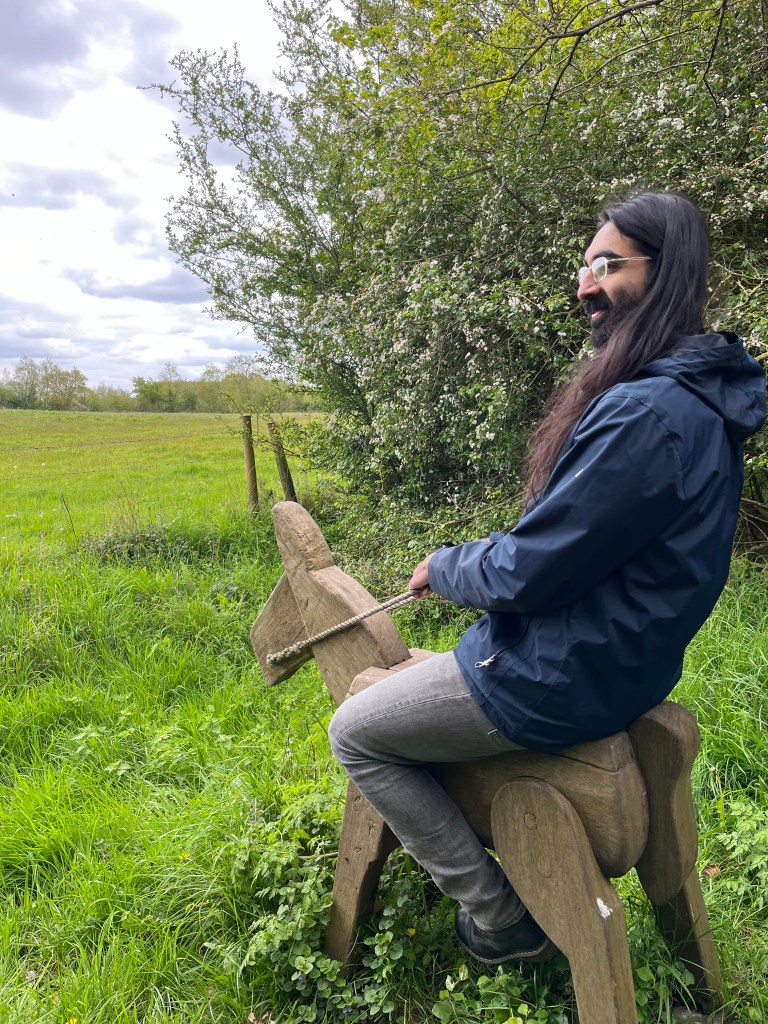
[Description of photo below: Dannish, who has long dark hair, a beard, and a moustache, and is wearing glasses and a rain-jacket, sits on a wooden horse in a field of tall grass, looking to his left. Trees can be seen in the background of the shot.]
My parents are first-generation immigrants from different parts of Asia who met in their late teens in the United Kingdom. I was born and raised in what would be considered a working-class area in Manchester. My father had a small business selling clothes from abroad, which meant that he was often away from home. My mother studied profusely and yet struggled to find suitable work due to both racism and ableism.
I never quite fit in at school; I was often perceived as “misbehaved” and often sent out of class. Towards the end of high school, a teacher who made fun of my stammer, nevertheless saw creativity in my chaos and, in essence, appreciated that there was more to me than just a misbehaved teenager. This teacher eventually introduced me to philosophy, which was rarely taught at state schools during the time. I discovered a genuine interest in studying and pursued the only thing in which I was genuinely interested. It is not an overstatement to say that philosophy has given me an identity and a purpose.
After much self-introspection, I was eventually diagnosed with several conditions, including dyslexia, autism, social anxiety, and delayed sleep phase syndrome. I am sure that other conditions are yet to be diagnosed. It became clear to me why I had always struggled both at school and in life in general, foreshadowing my experiences in academic philosophy and in life in general.
I began a B.A. in philosophy, which was a time of both great intellectual discovery and social isolation. I finished with a good honours degree but nevertheless felt dissatisfied with academia. I was depressed and had no idea what to do, so I did what any sensible person would do: I joined the army, even though I am a member of an ethnic minority with several disabilities.
After a short but nevertheless rewarding experience in the British Army, I used the money that I had earned to enrol in a M.A. programme in philosophy. Unfortunately, it was more of the same when it came to my experience in academia, conjoined with the struggle of living at home. I barely passed, which meant that for the next 4 years or so, I would be repeatedly rejected from Ph.D. programmes. Academia is, understandably, obsessed with superficial grades.
I returned to my alma mater for a second M.A. This second time, I achieved a distinction on my dissertation. Although I enjoyed my time in academia for this second degree, I nevertheless could not shake the frustrating feeling that I needed to jump through another hoop just so that I could enroll in a Ph.D. programme.
Finally, I was admitted to a recommended Ph.D. programme, which, unbeknown to me, would not involve the contribution to philosophy that I had hoped. It was yet another perilous and frustrating hoop through which I had to jump. As always, I struggled with academic writing. I failed my first confirmation of registration and had to fight to have another go at it. During this time, I was refused teaching because of a stammer. Then, COVID followed. Towards the end, my primary supervisor passed away, which was a major setback. I eventually got a new supervisory team and, with support from a study skills tutor and mentor supplied by disabled students’ allowance, I was able to complete my doctorate.
The moment of redemption for me came when my external examiner—a respected emeritus in the field of metaethics—said that he thought a particular chapter in my thesis was ingenious and that he had never seen anything quite like it. In all my time in academia, this is what I knew that I had to offer. Someone finally acknowledged it.
In the last year or so, I have attended and presented at international conferences. Having it lodged at the back of my mind that my stammer was a barrier, my first two presentations were pre-recorded. In my latest conference presentation, however, I decided to present in real time, stammering live and in person. Doing so made me realise that having stammer is not, and should not, be seen as a barrier to my recognition as an effective communicator or teacher.
At present, I aim to publish some of my work, which seems like yet another hoop towards what I have always wanted to do: further develop my ideas.
Dannish, you have indicated that philosophy has given you an identity and a purpose. How would you describe this identity and purpose and the process of attaining them?
My social identity was always fragmented. Ethnic minorities tend to find solace with members of their race and their shared identity. Because my parents come from different backgrounds, however, that was not the case for me. Unlike the majority population, who can seemingly blend in, ethnic minorities stick out like sore thumbs simply by virtue of their physical appearances, their names, and so on. For example, I once was fortunate to be involved in a school trip to the United States with other students of government and politics. At the U.S. airport, I was interrogated and even asked if I had a bomb in my bag. Unsurprisingly, none of my fellow students received such a reception.
It occurred to me early on in life that ethnic minorities, especially, are forced into a dichotomy between subservience to any relevant system in which they find themselves or hostility to it. Both sides of the dichotomy are tragic for the individual: the individual must choose between a loss of dignity and pride, on one side; or hostility and negativity, on the other. I think there is a golden mean of some sort along that dichotomy, one toward which I continuously strive, but it is difficult to find.
When I became aware of the disabilities that I have, this awareness contributed to my social identity. But here again, it was an identity that I shared with others, such as the neurodiverse, people who stammer, and so on. My stammer is a particularly interesting case in this regard because I only stammer when around others. I can talk and read aloud to myself without stammering. So, for me, stammering is a part of my social identity rather than a personal one.
Thinking about shared identities has made me realise what being a member of a shared identity means for the individual. I may share a given identity with someone else—say, as a person who stammers—but I do not own that identity because it is an identity that I have in common with someone else. What I can own is my particular stammer. So, although having a stammer is a part of my social identity, it cannot define my identity because my identity is something which is personal only to me.
And so, when I say that philosophy has given me an identity, I do not mean academic philosophy. Philosophy, in its purest sense, of simply thinking about how to live or, as I like to term it, how to survive, has allowed me to come to realise that my identity is something that I need to construct for myself. My identity is not fixed; nor is its constitution as simple as picking a religion or political ideology and hoping that it will give me a sense of purpose. If one’s personal identity is not fixed, then it is only through philosophy and thinking about how to survive in particular that one can sustain a potentially changing and unfixed personal identity through time.
Then there is the question of purpose. I think it is from constructing one’s identity that one finds purpose. I live in this world, and I see fragmentation. There are clearly things that individuals share, but I see it as my purpose to figure out what we can all collectively share despite any differences. And this is where I come to my work in philosophy: capturing moral universality.
Tell us about the ableism that you have experienced in philosophy and the university more widely, as well as how these experiences conditioned your identity and purpose with respect to philosophy.
I think the first kind of ableism that I have come across in academic philosophy is the emphasis on written clarity. Now, there is an extent to which—and I think that most philosophers would agree—that one must write clearly to be understood. However, I think that there is something more to it than just writing clearly. There is, I think, at the root of it, a cultural bias. The language employed in academic philosophy becomes a barrier for the neurodiverse, such as dyslexic people. This language cannot be learned in the same way that one can learn, say, a method to solve a mathematical equation–even then, mathematics allows one to solve an equation through alternative methods!
There is no blueprint of how to write clearly in philosophy. If someone has such a blueprint, they are doing a disservice to academic philosophy by keeping it hidden.
The tragedy is that people outside of the field view this language as impenetrable and quite boring. After many years of writing academic philosophy, I have been able to improve how I express myself in writing; but there are some things that seem as if they will not change, such as my odd sentence-structures.
Then there is the blatant ableism—which some people have regarded as simply discrimination—that I have experienced in academic philosophy. The rationale used to justify withholding teaching assignments from me was this: my stammer might result in student dissatisfaction. I struggle to understand this rationale and would like to dissect it here, playing devil’s advocate for the moment and putting to one side that it is simply a case of discrimination.
There are two things at play here which I think can be dissected and that are indeed related in some way: student satisfaction and being a good teacher.
Students can be satisfied in a myriad of ways, from feeling the passion a teacher brings to the classroom to the fact that a teacher is very lenient when it comes to marking. Likewise, students can be dissatisfied in a myriad of ways, from a lack of preparation on the teacher’s part to the fact that students simply find the material boring.
What, then, may potentially cause student dissatisfaction because the teacher stammers? It seems that any legitimate reason has nothing to do with having a stammer as such. Students might find a teacher difficult to understand, but that concerns how well a teacher can communicate, which is not necessarily ruled out by having a stammer. Students may find that a stammering teacher requires too much attention because they speak too slowly. Yet, one would think that having a sufficient attention span and not being distracted is required at the university level.
But what if students just find a teacher who stammers annoying? That is a distinct possibility, but students can find a teacher annoying for a myriad of reasons, such as the teacher’s voice, accent, physical appearance, gender, ethnicity and so on. I think it is reasonable to say that what students may or may not find annoying is one thing that should not be taken into consideration when determining who can teach. Of course, there are exceptions, say if a teacher has a habit of bursting into song during class. That, indeed, may be quite distracting.
Then there is a question of what makes a good teacher, and here are a few ideas:
Communicating complex ideas in interesting and engaging ways.
Empathy—being able to see how information is received and observing how students participate.
Listening—A good teacher spends an equal amount of effort in understanding their students because, ultimately, that is how they can aid their students’ learning.
Adaptability—Remaining flexible in a constant change regarding departments, student bodies and institutions.
Not forcing personal views or particular positions in philosophy on their students.
As we can see, it takes a lot to be a good teacher, but I do not see anything there which disqualifies someone simply because they have a stammer. In fact, people who stammer are more likely to be more empathetic, especially when it comes to teaching, compared to people who do not stammer. The person who stammers knows very well what it is like to remain quiet and be fearful of speaking out in the classroom. It is that understanding that can help foster inclusivity for students.
Bringing the two questions together, student satisfaction and what makes a good teacher, I would like to come to this verdict: having a stammer alone does not make anyone a bad teacher or necessarily result in student dissatisfaction. On the contrary, a person who stammers can indeed be a good teacher and their stammer is no barrier to teaching.
My experiences have shaped my identity as an outsider in academic philosophy, and in this regard, my purpose is to point out everything that I perceive to be wrong with academic philosophy and promote positive change.
Like many disabled philosophers, your research has generally been undervalued and underestimated. Nevertheless, as you have indicated, your dissertation has received high praise from some experts in metaethics. Please describe the research and its reception, as well as the way in which you want to develop it.
My research is currently focused on moral values, broadly construed, that everyone can share. At first, it may seem like a very common and well-known topic which is of interest both inside and outside academic philosophy. The problem, however, is that I came into academic philosophy as someone who naturally thinks in layers. My mind unintentionally makes connections to, and within, what analytical philosophy would regard as separate areas in philosophy. Not surprisingly, the area that I was forced to settle with is metaethics as it is one area in philosophy which is allowed and, in fact, required to dip in and out of areas across philosophy.
Another problem is that I entered academic philosophy with very strong intuitions, and much of my time in academic philosophy has been spent trying to match those intuitions with contemporary literature. I remember liking Plato very much when I first came across philosophy, but over time, I found that there were fundamental disagreements. For example, Plato thought that moral excellence could be achieved through mathematics. My own thinking has led me to the view that the moral and the mathematical are completely distinct ontological categories. (Assuming each can be an ontological category).
I wrote my second M.A. dissertation on ethical intuitionism, which was a theory about innate ethical awareness. The idea of ethical intuitionism is like Chomsky’s theory of language-acquisition: we are born with an innate capacity to become aware of a moral reality, which takes the form of ethical intuitions. Our ethical awareness can either flourish or become stunted depending on the environment. Contrary to many ethical intuitionists, I think that ethical intuitions do not function like mathematical intuitions because they are not propositional in their base form. Instead, they are imaginative states which can only be rationalised and formed into propositions afterwards. Though much needed to be developed, I was very pleased with this work.
I clearly got too excited because I would find that my Ph.D. thesis, certainly not out of choice, would mostly involve arguing against other theories that attempt to capture moral universality. I argued that moral universality requires mind independence and the support of ontology. So, if there are any moral values that all agents share, that moral phenomena would need to be mind-independent in the sense that the truth of that phenomenon does not depend on the attitudes and desires of agents. It would also need to be a phenomenon that has an ontological status, which is to say that moral phenomena can be said to exist.
And so, trying to capture moral universality through rationality and/or desires alone will not work. Kantian and Humean approaches to capturing moral universality are prone to arguments from moral scepticism. As one of my examiners noted, my thesis reads like it could have been written by a moral nihilist, which is true, though I did offer some glimpses of hope here and there.
One elucidation that emerged from the thesis was a challenge for metaethical theories in general, a question of social deviancy: how are we morally justified in holding social deviants accountable for any transgression of moral norms? So, imagine someone who does not believe that there are any moral norms and so breaks any/all norms, believing that they are simply social norms. Now, consider that some social norms ought to be broken, i.e., shaking hands during the COVID pandemic. Sure, we might think that we can simply put that person in jail, but how is that ethical? Human history has a bad record of locking people up simply because society at large or the powers that be disagree with them. To answer the question of social deviancy is just one facet involved in capturing moral universality.
Thinking that moral universality requires mind independence and the support of ontology, whilst hoping that there are indeed moral values that we can all share, makes me a kind of realist. The problem is that there is no moral realist position in contemporary metaethics that I can say that I support.
The sociology of the moral realist position is quite interesting. On the one hand, it is supported by many: it is a staple position in analytical philosophy with a heritage going back to at least Plato, as far as Western philosophy is concerned. On the other hand, I think moral realism has a bad reputation; and at least one reason that it has a bad reputation is due to its reliance on moral norms, which themselves have a bad reputation in academia in general because they can symbolise, and historically have symbolised, something else: cultural imperialism, patriarchal codes of conduct, and so on. For example, a stammer was once considered a moral deviancy, that a person who stammers is tainted and under the devil’s influence. The irony here is that it is said that Moses, who prescribed the word of God, had anomalous speech.
Influenced by recent work of Sharon Street, I have written two inter-connected papers that were not included in my Ph.D. dissertation. In these papers, I develop my own constructivist strategy, which involves both establishing a universal problem that all agents have by virtue of being agents (no matter what they may value) and finding a solution to that problem.
My problem, which I call “The Problem of Not Being God,” focuses on beings in general rather than just agents who are capable of valuing. In short, it is the notion that all beings strive for something for which its consummation cannot be guaranteed because they are not God. The solution is simply acceptance that we are not God. I provide a universal solution through the notion of accepting reality, which I show can be found in various traditions, from Buddhism to existentialism. I argue that the solution of accepting reality can provide practical solutions by invoking contemporary research in clinical psychology and provide theoretical vindication for capturing moral universality.
Going forward, I would like to finally develop and establish my own metaethical theory which I provisionally call Constructive Realism. Constructive because, unlike many moral realist positions, it does not begin with moral norms but rather a constructivist strategy. And realism because it accepts that mind independence and the support of ontology are required in order to capture moral universality.
As you noted, Dannish, during the past year, you presented your work at international conferences. Please tell us about the research you presented and your rationale for presenting it in various formats.
I decided to pre-record my presentations “The Problem of Not Being God” and “Acceptance and the Status of Moral Reasons” because the allocated times were so stringent. Although, as I mentioned, I do not stammer when talking to myself or reading aloud, knowing that I am being recorded results in some stammering. In any case, given the stringent time-limit, I made a practical decision about how much information that I could express within an allocated time. The presentations went well. I think that being allowed to pre-record them was a more-than-reasonable adjustment. In fact, if everyone had hypothetically pre-recorded their presentations, then the conference programming would not have been as prone to running late.
Still, even though I did get a chance to speak during the Q&A after the presentations, I was left unfulfilled. Something inside of me wanted to have spoken live and in person. And so, in my next conference presentation “Constructive Realism,” I decided to do just that. Again, the presentation went well, even though it ran over into some of the time that was left for Q&A. I felt so much better after this presentation; I felt a sense of fulfilment and achievement that I had delivered my presentation in the way that I wanted and that it was well-received.
There are lessons about “reasonable adjustments” to take away from these events. First, what counts as a reasonable adjustment depends not on the condition but on the person. For example, if there was a systematic way of making adjustments that permitted the presenter to use AI software to read text, then I think it would fall foul of being a reasonable adjustment because it is not the case that someone who stammers, for example, cannot speak.
Consider someone who is indeed without speech. They may not like an AI software to present for them and would prefer alternative methods, say, having a friend or colleague speak for them. Furthermore, reasonable adjustments will differ from one person to another. Being able to pre-record their presentation may indeed be a reasonable adjustment for someone who stammers and their preference. It’s not for me; but that’s O.K. I would prefer more time, so that I can speak in person, allowing me the time to still express what can reasonably be expected in a given time slot.
I think that the crux of the matter regarding reasonable adjustments is that what counts as reasonable adjustments ought to very much depend on the individual. Organisers can only be said to be making reasonable adjustments if they can facilitate that. Otherwise, it’s simply a matter of organisers not taking the disability needs of their presenters seriously enough.
Dannish, how would you like to end this interview? Are there topics or concerns that we have not discussed that you would like to address? Would you like to recommend some books, articles, blogs, or videos that readers and listeners can seek out for more information about the issues that you have addressed?
I would like to end the interview with a couple of things. First, I would like to tell a story which I wrote a long time ago, that motivates my current work. I think that some of the people reading or listening to this interview may relate to the character of the story and their relationship to the world around them:
Imagine an Outsider, alien to almost every aspect of this world and our society, originating from far away, unknowing of our culture, customs, languages and of course our ethical values. Our Outsider is by our standards highly intelligent. In fact, the mental, physical, and emotional conditioning of this individual are beyond exemplary for human standards. Our intelligent Outsider is friendly but cautious, agreeable but not gullible. As a society, we may perceive that this individual is a threat but imagine that this is not wise nor is it ethically called for. It would be unwise to attempt to harm or imprison this individual because the Outsider carries a distress signal, which purportedly has the capability to destroy the entire planet. By ingenious methods of communication using musical sounds, the intelligent Outsider refuses to accept our customs, laws, and values unless it can understand them and an adequate explanation is given why it should follow them.
As it is slowly revealed that much of our customs, laws, and values are in fact relative and largely artificial, with no foundation or substance to support them, the intelligent Outsider grows weary of our society and decides to rebel. As a society, we are worried that the Outsider will soon begin to commit atrocious and immoral acts that lead to human suffering, ones which It perceives as perfectly normal and, in fact, common practice in our society.
The intelligent Outsider, however, happens to have an ethical disposition with which humans are also predisposed. We would hope that the Outsider can somehow access this ethical intuition and not commit such actions, that it will have mercy on our society and is able to grasp moral truths for itself and see that human ethical values, the most basic and primitive kind, are objective. Having grasped this ethical awareness for itself, the intelligent Outsider now acknowledges such ethical awareness as its greatest attribute: The only thing that makes it feel a part of our society, one which it hopes everyone else can see for themselves so that they may all live together with acceptance and in peace.
Finally, I would like to finish with a message of support for those reading this interview and who may have found my remarks helpful. Disclosing some of my experiences in academic philosophy has painted a rather negative picture; not saying anything about the positive ones does not do justice to the kind people with whom I have had the pleasure to talk and work. There are many very nice, friendly, and supportive people in academic philosophy. I have at least been lucky in the sense that I have come into contact with many in the field who have provided support and mentoring. And so, I would urge anyone who is struggling to reach out and make those connections. For every bad apple, I am sure that there is a good one. Understand that those bad apples are indeed harbouring some insecurity on their own part. It’s not you, it really is them.
I have found that searching and continuing to strive towards my authentic self is what has ultimately helped because when you find that, there is nothing in this world that can take it away from you. Everything around you can crumble and burn, but your authentic self will persist so long as you allow it to bloom inside of you. The only defeat is denial, whether that be letting the world get the better of you or hiding behind a fallacious façade. There are times when you will come across beautiful souls who will hold your hand and guide you through an open door. Then there are times when you may need to struggle and persevere on-route and find the courage to knock on that door to find that you are welcomed with open arms. Sometimes, that door does not open, and only after repeatedly knocking does it creep open as eyes of adversity remain fixed upon you. Finally, there are times when that door is laced with poison and oppression, and you find that it is locked shut. It is then that one must be willing to kick that door down.
That’s a great note on which to end this interview. Thank you so much for taking the time to join me, Dannish. Your interview is a valuable addition to the series archive.
Readers/listeners are invited to use the Comments section below to respond to Dannish Kashmiri’s remarks, ask questions, and so on. Comments will be moderated. As always, although signed comments are preferred, anonymous comments may be permitted.
The entire Dialogues on Disability series is archived on BIOPOLITICAL PHILOSOPHY here.
From April 2015 to May 2021, I coordinated, edited, and produced the Dialogues on Disability series without any institutional or other financial support. A Patreon account now supports the series, enabling me to continue to create it. You can add your support for these vital interviews with disabled philosophers at the Dialogues on Disability Patreon account page here.
__________________________________
Please join me here again on Wednesday, December 18, 2024, for the 117th installment of the Dialogues on Disability series and, indeed, on every third Wednesday of the months ahead. I have a fabulous line-up of interviews planned. If you would like to nominate someone to be interviewed (self-nominations are welcomed), please feel free to write me at s.tremain@yahoo.ca. I prioritize diversity with respect to disability, class, race, gender, institutional status, nationality, culture, age, and sexuality in my selection of interviewees and my scheduling of interviews.
 BIOPOLITICAL PHILOSOPHY