Hello, I’m Shelley Tremain and I would like to welcome you to the one hundred and twentieth installment of Dialogues on Disability, the series of interviews that I am conducting with disabled philosophers and post to BIOPOLITICAL PHILOSOPHY on the third Wednesday of each month. The series is designed to provide a public venue for discussion with disabled philosophers about a range of topics, including their philosophical work on disability; the place of philosophy of disability vis-à-vis the discipline and profession; their experiences of institutional discrimination and exclusion, as well as personal and structural gaslighting in philosophy in particular and in academia more generally; resistance to ableism, racism, sexism, and other apparatuses of power; accessibility; and anti-oppressive pedagogy.
The land on which I sit to conduct these interviews is the traditional ancestral territory of the Haudenosaunee and Anishinaabeg nations. The territory was the subject of the Dish with One Spoon Wampum Belt Covenant, an agreement between the Iroquois Confederacy and the Ojibwe and allied nations around the Great Lakes. As a settler, I offer these interviews with respect for and in solidarity with Indigenous peoples of so-called Canada and other settler states who, for thousands of years, have held sacred the land, water, air, and sky, as well as their inhabitants, and who, for centuries, have struggled to protect them from the ravages and degradation of colonization and expropriation.
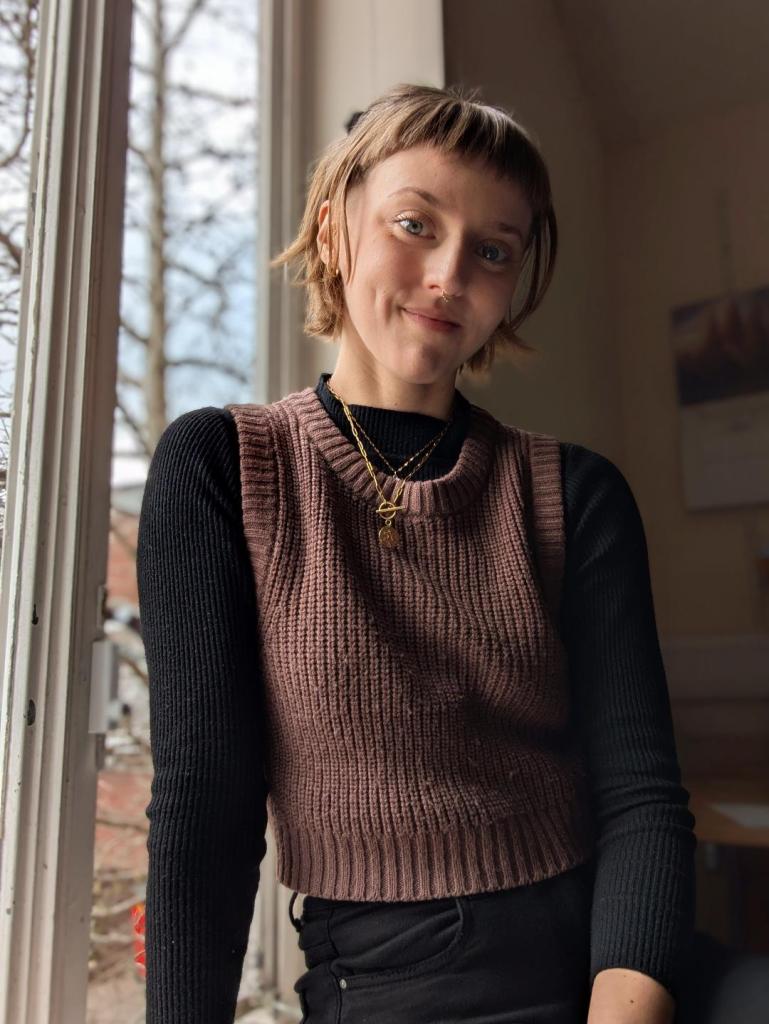
My guest today is Clarissa Müller-Kosmarov. Clarissa is an AuDHDer and Ph.D. candidate at the University of Warwick (UK). Their doctoral thesis, which presents a critical phenomenology of othering as both the exercising and effects of a particular kind of perceptual and interpretative practice, brings key aspects of Merleau-Ponty’s phenomenology of embodiment into conversation with first-person accounts of racialized, gendered, neurominoritized, and ableist otherness and othering. Clarissa is interested in the philosophy of disabilityꟷparticularly the philosophy of neurodivergenceꟷsocial epistemology, and the writings of Michel Foucault. In her free time, Clarissa can be found rock climbing, crocheting, or indulging in her latest hyper-fixation.
[Description of photo below: Clarissa stands by a window, looking slightly down into the lens. They are smiling widely and their right hand rests on the window sill. They have short brown hair and a nose-ring. Bare tree branches and a dull sky can be seen through the window.]
Welcome to Dialogues on Disability, Clarissa! Please tell us about your background and educational history, as well as how they led you to pursue a Ph.D. in philosophy.
Thank you for inviting me to contribute to this amazing interview series, Shelley! I have been a reader of BIOPOLITICAL PHILOSOPHY and the Dialogues on Disability interviews for a while now, so it’s exciting to be taking part in the series.
I will start with the basics about me. I was born and raised in the UK and have spent most of my adult life living in towns and cities around the southeast coast of Englandꟷthink white cliffs and pebble beachesꟷthough most of my childhood was spent a little further north in an area called Cambridgeshire. I am now based in the Midlands and undertaking my Ph.D. in Philosophy at the University of Warwick.
That snapshot makes my background appear quite neat, but if I had one word to describe my journey to Ph.D. candidacy, it would be tumultuous. In fact, I think if most people were to look at my academic history on paper, they would be quite surprised that I am in the position that I currently am!
Throughout my early education, I was largely able to get by without issue. I was a bright and curious child who loved to learn, and despite the recurrent refrain in my report cards of “Clarissa needs to talk more in class,” “Clarissa needs to make sure that she finishes her homework before she hands it in,” and “Clarissa excels in classes that she finds interesting, but needs to apply herself more in those that she doesn’t,” everything was relatively smooth sailing. I got good grades, did not get in trouble, and went into high school thinking “I’ve got this, easy”. Oh boy, was I wrong.
In my teenage years, I started experiencing difficulties with my mental health which wreaked havoc on virtually every aspect of my life. In hindsight, I think much of these difficulties stemmed from my unknown, and therefore unmanaged, ADHD and autism. I lost virtually all of my friends, started falling behind at school, and became more and more distant from my loved ones. In the final two years of school, though, I managed to claw my way back up. My grades improved, I made a couple of friends, and I even sat some exams early. By the end of school, I graduated with good grades, even getting a smattering of A’s in my favourite subjects, though it is not false modesty when I say that I genuinely do not know how I achieved them. I did not feel any better: I still hated school, and I never revised for any of my exams.
Whilst near-constant depression and anxiety had eroded most of my interests, I loved chemistry and physics and decided that I wanted to pursue them at university. So, when it came to choosing what to study to get there, I landed on maths, physics, chemistry and philosophy. When I signed up for the philosophy class, I thought it would be a fun bit of humanities on the side, but not something that I would pursue. It was STEM that I was looking to take seriously. If only past me could see me now!
At the end of my first year of A-Level study, though, I received failing grades for everything except philosophy! I remember feeling utterly shocked. I had done the exact same thing preparation-wise that I had done previously, but whereas in the past I had been able to achieve B’s and A’s, I was now getting F’s and U’s. A whole host of exam re-sits and a repeated year later, I had lost virtually all motivation for my studies and hope that I would qualify for university. I dropped out of school, moved out of my family home, and worked in local bars and restaurants whilst I set to figure out what I wanted to do with my life.
I was aware that my education and academic performance had gone into a tailspin; yet it never crossed my mind that what I was experiencing might be related to anything beyond personal flaws or deficiencies. In my mind, I had failed because I was bad at exams, never learned how to revise properly, was just incompetent and stupid. Even though I had many conversations with my teachers about my results, the narrative, both externally and internally, was that I simply needed to do better, with very little curiosity as to why I might be oscillating between A’s and U’s or what support I might need to stabilise my performance.
It was only in 2020, a semester into my M.A. degree at the University of Kent, that I came back to the question of why I seemed to be struggling disproportionately relative to my peers. After an initial chat with my doctor, I was referred for an ADHD assessment and received a diagnosis later that year. Four years later, after decades of questioning and denial (and countless online AQ50 questionnaires), I pursued and received an official autism diagnosis. At the time, though, I did not have those hermeneutic resources available to me, and so I simply understood myself to be a dropout and failure.
In my time away from school, I realised that I was still very much interested in academia and wanted to get an education. I knew that I would never be satisfied if I did not give it another concerted try. It was at this point that I returned to philosophy. Not only was it the sole subject that I had passed in my A-Level exams, but I enjoyed it. In fact, I enjoyed it significantly more than I enjoyed anything else I had studied to that point. So, my new goal and exclusive focus became to get a degree in philosophy.
In 2016, after returning to education and picking up enough credits to be able to apply to university, I joined the Philosophy Department at the University of Kent. Since I had a “mixed bag” in terms of my exam results, I did not meet the entry requirements for most of the undergraduate philosophy programmes in which I was interested. However, I was able to speak with a member of the Kent Philosophy faculty, Dr. Todd Mei, who asked what happened with my results and who, seeing that I excelled in my philosophy exams, took a chance on me and gave the green light for my admission.
Undergraduate study was a real turning point for me, both personally and academically, especially the courses on Existential Philosophy and Continental Philosophy that I took in my second year. I remember thinking “Finally, people are asking the important questions!” when I read scholars like Beauvoir and Camus for the first time. I felt seen by them, and the constellation of thinkers that I encountered in these coursesꟷBeauvoir, Camus, Foucault, Gadamer, Ricoeur, and Husserlꟷgave me permission to get philosophically curious about my experiences and the experiences of other marginalised people. It was here, in these courses, that I began to develop an interest in phenomenology and hermeneutics. The ideas and concepts to which I was introduced in these classes have, in many ways, informed the foundation of my academic career, influencing and appearing in my work to this day.
During this period, I had access to comprehensive disability support for the first time. I still had no idea that I was autistic or that I was dealing with unmanaged ADHD, but much of the support that I was offered due to my depression and anxiety helped to mitigate some of the difficultiesꟷe.g., submitting assignments on time, staying abreast of readings, maintaining a semblance of work-life balanceꟷwith which I had been grappling because of my neurodivergence. I can say without hesitation that my years in the Philosophy Department at the University of Kent not only informed my academic career but were something of a life raft for me. I feel truly grateful to have experienced the generosity and care of the people who made up that Department.
I graduated my B.A. degree with distinction and stayed at Kent for my M.A. degree, though I pivoted to a different department and undertook an LLM in International Law and International Human Rights Law. Nevertheless, I knew from the moment that I applied to law school that I would return to philosophy for my Ph.D. When, in 2021, I started my doctorate in the Philosophy Department at Warwick, it felt like a homecoming.
Tell us about the research and writing in which you have engaged for your Ph.D. dissertation.
Throughout my undergraduate and postgraduate studies, I developed an interest in recognition, identity politics, and otherness, which I was able to explore in my dissertation. By the time that I started the process of drafting my Ph.D. proposals, it had become clear to me that the question of belonging, or, more specifically, not belonging was the overarching theme around which my interests crystallised. So, in many ways, my Ph.D. dissertation, which focuses on the emergence and experience of othering, represents the next stage of this intellectual development and the refinement of a fascination with difference and social inclusion that has underpinned virtually all my work up until this point.
Initially, I took what Foucault would call a “top-down” perspective from the macro-level of institutions and structures to the micro, subjective level. Eventually, my methodology shifted from a structuralist approach toward a critical phenomenological analysis. The twin questions of “What is it like?” and “What does it do?” have become the driving force of the project and the dissertation is much richer for it. Whilst objectivist, or top-down, approaches undoubtedly supply an important part of the picture, they cannot supply a whole picture. When it comes to something like othering and existing as “the other,” subjectivist perspectives are indispensable for fully grasping the complexities and nuances of these experiences both at the abstract or conceptual level and of the everyday lives of othered people.
So, it is against this background that the dissertation orients itself toward the question of othering. The thesis sets out an account of othering as a particular kind of perceptual and interpretative practice, namely, one that transforms what otherwise would ostensibly be a descriptive difference into something normatively and existentially significant and the effects of that practice. As part of this approach, I present phenomenological analyses of first-person accounts of lived experiences of racialised, gendered, ableised, and neurominoritised otherness and othering to bring its spatio-material, affective, discursive, and visual dimensions into relief.
I then use aspects of Merleau-Ponty’s Phenomenology of Perceptionꟷparticularly his concept of habituation and theory of embodied intersubjectivityꟷto show how the array of normatively loaded beliefs about, attitudes toward, and responses to social others are not simple perceptions of the real but rather are expressions of certain ways of perceiving others, informed by sedimented matrices of meaning-making. In short, the thesis is concerned with how the ways that other people see us and the stories told about us inform who we are and how we are able to live.
The upshot is that certain perceptions produce very real material and social effects; for instance, insecurity in housing, unemployment, lack of healthcare, and unfulfilling interpersonal relationships. Othering, in other words, influences factors that inform the ways in which one can live one’s life, and, thereby, one’s subjectivity. The general idea is that othering produces a specific style of embodied subjectivity which is characterised by the assimilation of the body image into the body schema (to use Merleau-Ponty’s terminology). By this, I mean that the third-person view of the bodyꟷthe “body-as-object”ꟷbecomes constitutive of bodily experience and accordingly restructures the fundamental relationship between the body and the world.
Have your own experiences of ableism and disability conditioned your scholarship, research interests and approach to philosophy and academia more generally? If so, how and why have they done so?
Yes, though, not straightforwardly. My interest in disability and neurodivergence is deeply personal. My curiosity is not that of an unaffected third party, but rather comes from a desire to make sense of my own experiences and, hopefully, to help others to make sense of themselves. It is only very recently that I have come to understand myself as disabled. Whilst now I can see very clearly the impact that my experiences of disability have had on my work and my time in academia, I had not been cognizant of this impact because I had not believed that the term disabled applied to me.
My doctoral study has coincided with a personal journey of self-understanding and the two feed into, and bounce off, each other considerably. Although I was diagnosed with ADHD in 2020 and autism in 2024, I have experienced chronic migraine attacks since I was a child, have dealt with pain, hypermobility, and PoTS for as long as I can remember, and have wrestled with my mental health for most of my adult life, I never connected my experiences to disability or saw myself through that lens. It seems obvious now that the constellation of effects that these physical and neurocognitive conditions produce are, to varying degrees of frequency and intensity, disabling to me and constitutive of the label disability. Although, in the past, these characteristics had not seemed remarkable to me, I have experienced a major reorientation toward myself and I have been fortunate to explore, through my academic pursuits, the various revelations that I have had concerning my experiences of disability.
My dissertation is concerned with how we are perceived by other people and what that might mean for us in our daily lives. I have been preoccupied with these concerns for decades because, as an autistic person, they are everyday features of my existence. Although I have only recently recognized myself as autistic, I have always felt the effects of being autistic in a neuronormative world. Like many autistic people, I have spent most of my life trying to understand others and to be understood, trying to decipher the invisible rules that govern our social lives, rules that seemingly become visible only when breached, and trying to constantly moderate my surface in anticipation of these rules to avoid the harms of neuronormative perception. Although feeling the weight of other people’s perception and interpretation of oneself is by no means unique to autistic people, I have encountered this weight as part of my experience as autistic. Without the significant role that such perception has played in my everyday life as an autistic person, I doubt my research would otherwise have taken this shape.
My experiences of disability and ableism also colour my approach to academia more broadly. As many disabled disability advocates and scholars have said before me, academia was not intended for disabled bodyminds; our presence in it is a bug, not a feature. From its inception, academic spaces have emerged in expectation of a particular kind of person (white, male, cisgendered, nondisabled, neurocognitively convergent, and so on). Although academia has become more progressive and tolerant of “atypical” bodyminds, academia continues to be an environment that is not sustaining for people beyond the narrow confines of what it emerged in anticipation of. As the saying goes, however, I would not want to be part of any club that wanted me as a member.
Being a disabled academic is a double-edged sword. On the one hand, there is something profoundly rebellious and liberatory about occupying a space that is not “for you”; the active participation of disabled people in knowledge-productionꟷparticularly knowledge concerning disabilityꟷis an indispensable part of disability justice and academia is undeniably part of that picture. Yet, on the other hand, to be a disabled academic also means that one is complicit in a system that (re)produces disabled oppression and involves existing in an environment that is potentially harmful to us. It can be challenging to mete out these conflicting realities. But it is with them in mind that I approach my engagement in academiaꟷwhether that be in my research, teaching practice, or departmental engagementꟷand I endeavour to face them head on, to have difficult conversations, and to create spaces of refuge or solidarity for my disabled peers.
Clarissa, you are co-authoring (with Robert Chapman) an entry on neurodivergence and philosophy of disability for “Philosophy and Theory of Disability,” the area that I am curating for The Oxford Encyclopedia of Disability Studies, an online resource to be launched in January of 2026. Please tell us about the entry, the material it covers, and why you are writing it.
It has been such a pleasure to work with Robert on the entry and I am immensely grateful for the opportunity to contribute to what will be the first encyclopaedia-style entry on the philosophy of neurodiversity. So, huge thanks to them, and to you, Shelley, as well as to everyone else who has made this project possible.
From our first conversations about what we wanted to do with the entry, Robert and I were of the same mind insofar as we both believed that it presented us with an opportunity to achieve a couple of intersecting goals. We wanted to provide a holistic overview of the emergence of, and debates within, the philosophy of neurodivergence that could act as an accessible comprehensive resource for readers with varying degrees of familiarity with the neurodiversity movement and the philosophy of neurodivergence. Both of us recognised that the very existence of the entry is itself bound up with the values and goals of the neurodiversity movement and serves as a platform to advance disability justice for neurominoritised individuals.
Historically, neurodivergent people have neither authored nor been included in most of the academic literature about neurodivergence, which reflects the enduring belief that neurodivergent people are incapable, or otherwise unfit, epistemic and rhetorical agents. Robert and I follow the ethos of the disabled people’s movementꟷthat is, “nothing about us without us”ꟷand approached the entry as an opportunity to play a part in correcting this exclusion. The entry recognises and celebrates neurodivergent contributions to neurodiversity theory and the philosophy of neurodivergence.
It was important to us to afford representation to underrepresented forms of neurodivergence and point out that the term neurodivergent is not a synonym for autism, though in both educational and clinical settings, as well as in popular culture, the former term has been coopted and used interchangeably with the latter. Autismꟷparticularly white, male, heteronormative presentations of itꟷtends to get the lion’s share of attention in both scholarly and popular discussions or projects concerning neurodivergence. We wanted to be very clear that neurodivergent is a dynamic and expansive term that refers to any kind of mind that diverges from so-called normal functioning. Thus, we have sought to shine a light on forms of neurodivergence that are not commonly associated with the label, including dementia, schizophrenia, and borderline personality disorder (BPD; or emotionally unstable personality disorder, EUPD, as it is called in the UK).
We wanted the entry to be accessible to people unfamiliar with neurodiversity theory; therefore, it systematically covers the historical background and fundamental theory of the philosophy of neurodivergence before going on to show how it has important implications for a range of existing subdisciplines, debates, and concerns in philosophy. The entry also outlines key concepts like neuronormativity, the pathology (or normalcy) paradigm, and neurominoritisation, as well as surveys how the philosophy of neurodiversity has begun to be applied to other key subfields in philosophy.
For whilst the philosophy of neurodivergence developed in relation to the philosophy of disability and the philosophy of psychiatry, it also developed in relation to areas such as political philosophy and ethics, social epistemology, phenomenology, and neuroqueer theory. In the entry, we focus on the relation of the philosophy of neurodivergence to these other areas to help clarify the ways in which the philosophy of neurodivergence has emerged and impacts well-known, pre-existing disciplines and debates.
What sort of advice‒e.g., about coming out as disabled, internalized ableism, finding disabled mentors, researching disability‒would you offer to other disabled students, especially neurominoritized students?
Approach yourself with curiosity and not with harsh judgement. Many of us are primed early on in life to dismiss our experiences, differences, and needs; hence, we develop a strong internal critic and a low tolerance for our unique way of being. We internalise the judgements with which we are bombarded in our everyday lives, adopting the dominant narrative that we are inherently deficient or broken. But we are not broken, nor are we deficient; nor are we too sensitive, too demanding, or otherwise “too much.” The tension and criticism that many of us feel is not evidence of our own failure, but rather evidence of a failure within the broader cultural imaginary: it lacks the openness to, acceptance of, and accommodation for the fullest spectrum of human comportment and cognition.
My advice to my disabled and neurominoritised peers is this: be kind(er) to yourself. Try to tune into what it is that you need, or what you might find helpful, and try to think about whether there are ways that you can make life a little less difficult and a little less exhausting for yourself. Do you need to take more breaks? Do you find physical copies of texts easier to read than digital ones? Could it be helpful to integrate mobility aids, joint supports, or compression wear into your toolkit? Do you need visual schedules? Would seeking out things like support groups, therapy, or coaching be helpful? No matter how it takes shape, practicing self-regard is important and serves as a powerful antidote to the narrative that many of us default to, namely, that we should prioritise the comfort of others, or the status quo, over our own comfort or needs.
I, too, need to take this advice seriously. By no means do I want to project the idea that it is easy to practice self-acceptance and self-compassion or that I have everything figured out – it is not easy, and I do not have everything worked out. Going against what feels acceptable or appropriate is hard. Approaching yourself without judgement is hard. Reorienting your relationship to yourself is hard. Based on my own experiences of trying to embrace myself and my differences, what I can say is that whilst it may not be easy or straightforward, it is work worth doing.
Clarissa, how would you like to end this interview? Are there topics or concerns that we have not discussed that you would like to address? Would you like to recommend some books, articles, blogs, or videos that readers and listeners should explore for more information about the issues that you have addressed?
Shelley, I would like to close things off by providing readers and listeners with links and resources related to some of the topics that I have spoken about should they like to dive a bit deeper into them.
Here is a blog post of mine that discusses the experience of being an ADHD grad student: https://phdlife.warwick.ac.uk/2022/10/19/too-many-tabs-open-doing-a-phd-with-adhd/
Public philosophy blog-style pieces that I have written covering topics such as the politics of authenticity, emotional emptiness, and the indispensability of others to the constitution of the self: https://www.philosophy2u.com/post/politics-of-authenticity; https://www.philosophy2u.com/post/emptiness; https://www.philosophy2u.com/post/self-without-others
Another blog post (not mine) on practicing radical rest: https://www.disabledginger.com/p/its-time-to-throw-away-the-coulda
A lecture by Russell Barkley, clinical neuropsychologist and expert in ADHD, on adult ADHD: https://www.youtube.com/watch?v=nDgOmFd5SlE&t=1s. And a link to his website: https://www.russellbarkley.org/
“How to ADHD,” a website, YouTube channel, and book dedicated to advice and support concerning ADHD: https://howtoadhd.com/
National Autistic Society: https://www.autism.org.uk/. In particular, I would like to draw attention to their online community resource (https://www.autism.org.uk/what-we-do/community) and their page on masking (https://www.autism.org.uk/advice-and-guidance/topics/behaviour/masking).
The Ehlers-Danlos Society: https://www.ehlers-danlos.com/
PoTS UK: https://www.potsuk.org/
Hypermobility Syndromes Association: https://www.hypermobility.org/
Minorities and Philosophy: https://www.mapforthegap.com/
More information about me and my work can be found on my webpage (https://warwick.ac.uk/fac/soc/philosophy/people/muller/). I can also be found on most social media platforms (mainstream and academic) if anyone is interested in reaching out or learning a bit more about some of the projects with which I’ve been involved.
Lastly, I would like, again, to extend my thanks to you, Shelley, for inviting me to do this interview with you and for all the work that you do with and beyond BIOPOLITICAL PHILOSOPHY to create space for disabled voices and experiences.
Clarissa, thank you so much for these links and for your considered and candid remarks throughout this interview. I know that many philosophers will have taken lessons from them. I’m so delighted that your work will be included in the Philosophy and Theory of Disability area of The Oxford Encyclopaedia of Disability Studies.
Readers/listeners are invited to use the Comments section below to respond to Clarissa Müller-Kosmarov‘s remarks, ask questions, and so on. Comments will be moderated. As always, although signed comments are preferred, anonymous comments may be permitted.
The entire Dialogues on Disability series is archived on BIOPOLITICAL PHILOSOPHY here.
From April 2015 to May 2021, I coordinated, edited, and produced the Dialogues on Disability series without any institutional or other financial support. A Patreon account now supports the series, enabling me to continue to create it. You can add your support for these vital interviews with disabled philosophers at the Dialogues on Disability Patreon account page here.
__________________________________________________________________________________
Please join me here again on Wednesday, April 16, 2025, for the eleventh-anniversary instalment of the Dialogues on Disability series and, indeed, on every third Wednesday of the months ahead. I have a fabulous line-up of interviews planned. If you would like to nominate someone to be interviewed (self-nominations are welcomed), please feel free to write me at s.tremain@yahoo.ca. I prioritize diversity with respect to disability, class, race, gender, institutional status, nationality, culture, age, and sexuality in my selection of interviewees and my scheduling of interviews.
 BIOPOLITICAL PHILOSOPHY