Hello, I’m Shelley Tremain and I’d like to welcome you to the one hundred and fourth installment of Dialogues on Disability, the series of interviews that I’m conducting with disabled philosophers and post to BIOPOLITICAL PHILOSOPHY on the third Wednesday of each month. The series is designed to provide a public venue for discussion with disabled philosophers about a range of topics, including their philosophical work on disability; the place of philosophy of disability vis-à-vis the discipline and profession; their experiences of institutional discrimination and exclusion, as well as personal and structural gaslighting in philosophy in particular and in academia more generally; resistance to ableism, racism, sexism, and other apparatuses of power; accessibility; and anti-oppressive pedagogy.
The land on which on which I sit to conduct these interviews is the traditional ancestral territory of the Haudenosaunee and Anishinaabeg nations. The territory was the subject of the Dish with One Spoon Wampum Belt Covenant, an agreement between the Iroquois Confederacy and the Ojibwe and allied nations around the Great Lakes. As a settler, I offer these interviews with respect for and in solidarity with Indigenous peoples of so-called Canada and other settler states who, for thousands of years, have held sacred the land, water, air, and sky, as well as their inhabitants, and who, for centuries, have struggled to protect them from the ravages and degradation of colonization and expropriation.
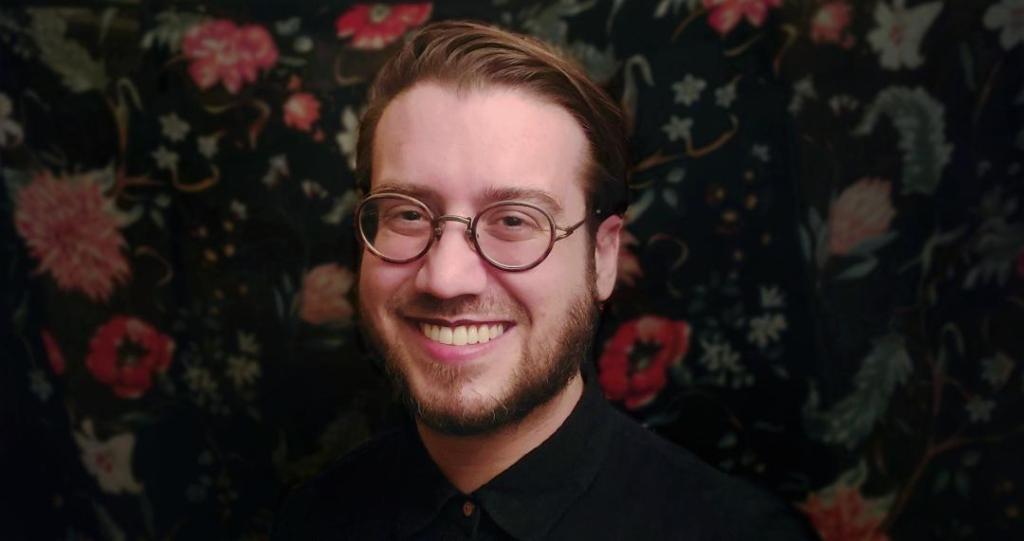
My guest today is C Dalrymple-Fraser. C is a Ph.D. candidate in philosophy at the University of Toronto, where they recently submitted a dissertation on silence and narrative approaches to healthcare. Their primary research interests include public health ethics, social epistemology, critical suicidology, and philosophy of disability, often in combination, and not always in that order. In their spare time, C can be found navigating a backlog of books, an accumulation of grief, old video games, and long winding ravines.
[Description of photo below: C, a white nonbinary person with facial hair, is directly facing the camera and smiling. They are wearing round glasses and a shirt with buttons down the front of it. A floral fabric screen fills the background of the shot.]
Welcome back to Dialogues on Disability, C! I conducted an interview with you in October 2018. Back then, you were just beginning to approach your dissertation. You recently submitted the dissertation and hope to defend it by the end of 2023. Some disabled students who read or listen to this interview might be immersed in, or about to embark on, their own dissertations or other large research projects. It might, therefore, be helpful to them if you were to share any strategies you found helpful for (say) developing your dissertation’s area of focus, how you organized and conducted your research, translated it to your own arguments, and fine-tuned and edited your writing. How would you summarize these strategies?
I’m glad to be back, Shelley! It’s certainly been a difficult journey to submission, especially (but not only) due to the COVID-19 pandemic. Reflecting back on it, much of my research process might be described as negotiation of my research habits and goals against emerging needs, contexts, and commitments. I will share a few anecdotes to this effect, and then explain one strategy that I found to be generally helpful.
First, I received very little guidance on citation during my undergraduate studies in philosophy, and only slightly more in psychology. For most undergraduate and graduate course papers, I managed just fine with manually creating, inserting, and managing citations. However, these citation strategies did not scale to the dissertation, where I was working with several hundred citations. Similarly, although I had developed some practices in reading, annotating, and marking up readings and sources, more complex searches across dozens or hundreds of sources required different strategies. What worked before was not manageable now.
Second, I was struggling with some moral methodological choices. Because I was trying to conduct research on silence and exclusion, I struggled with knowing that I was always missing something and likely reproducing existing silences. Norms of academic integrity encourage rigorous citation and documentation of evidence. In many cases, however, my evidence is generated from accumulated stories and experiences. Documenting these stories and experiences can pose material risks to those who shared them. I struggled with who and what to include, how to balance competing interests in disclosure and protection, and where to draw the line at having done due diligence.
Third, early into the COVID-19 pandemic, my neighbourhood fell under heavy construction. Rental corporations managed to skirt government construction-stoppage orders. In their process of building parking lots or renovating balconies, the companies were often drilling concrete, sawing metal, and making other miserable noises throughout the day. Sound pressure levels in my apartment often exceeded occupational safety standards, and there were scant other places to which I could retreat during lockdowns. Perhaps obviously, this impacted my health in many ways: I am still navigating some newly acquired disabilities with auditory processing.
Beyond impacting my general capacity to do work, these noise-levels affected my specific writing strategies. In our previous interview, I briefly mentioned that I often write with transcription software. During this construction, my best technology could not discern my voice against the din. I could shout or articulate all that I wanted; I would not be heard, and I could not write.
Finally, because I was reading and researching across so many disciplines, and because my writing was so often thwarted by noise, health, loss, and other disruptions, I struggled with measuring any sense of progress. In addition, I was advised (prudentially!) to leave aside some of the content that I was most happy to have generated. I found it difficult to measure myself against the goal of a completed dissertation.
I outline these tensions in case they feel relatable to readers and listeners. Common between these tensions was the realization that I needed to think more critically about my own relationships to research and research practices. I had not received explicit methodological training or support in most of my previous coursework. In turn, I had largely adopted research habits that seemed to work for me, without interrogating why or how they worked and what alternatives were available. As a result, I spent about a month reading and inquiring about different methods (whether for reading, researching, annotating, citing, writing, time management, data analysis), as well as excavating my own habits and commitments.
In the end, I started a research-reflection journal. Initially, I used it to log daily activities that would help me monitor progress. But my central goal was to reflect on my habits, goals, and methods in researching, rather than reflect on the content of that research.
Some of the more basic questions that I addressed in the journal included: (1) What are my goals in using this strategy? Do I really endorse those goals? Are they met by this strategy? How could I better meet these goals? (2) Which of these goals or strategies actually needs to be met in this dissertation as opposed to in other work or venues? Do any of these goals cause friction with my local goals of graduating? (3) Which goals or strategies am I willing or unwilling to let go of for now? Why? What alternatives exist that I have not yet tried? What resources or support would I need in trying them?
Ultimately, these questions are relatively abstract; but they were helpful points from which to engage in self-reflection. In the process of developing the journal, I found myself in a tentative but happier place. I now introduce similar assignments and resources into the courses that I teach.
For closure on my anecdotes: I started using citation-management software and qualitative-data analysis tools to manage my scaling problems. I developed criteria for when and how I would use different sources, writing these choices into the dissertation. I began to write in isolated parks and ravines or late at night to escape the noise. But I also accepted the times when I could not write at all. I started to collect excised content for future projects, while advocating for what I wanted to keep. And I ultimately divested from the need to measure progress in terms of output, though I am definitely still working on this last one!
C, you regard your work as interdisciplinary and are keen to explore employment possibilities in a variety of disciplines rather than in philosophy alone. Please talk about how you conceive the areas and scope of your research and teaching, as well as the institutional settings in which you envision them as potentially situated.
Several things ground my commitments to interdisciplinarity in research and in teaching. I will summarize a few of them and then talk about professional aspirations.
First, very few of the questions that I explore are the domain of philosophers or bioethicists alone. I am interested in issues concerning health, disability, knowledge, and ethics, all of which are discussed widely across different disciplines and in non-academic spaces. Some of the real “a-ha!” moments in my research on silence and health, for example, came while I was engaged with works classified as trans memoir, queer and disabled poetry, acoustic engineering, or Indigenous sound studies, as well as while I was engaged in conversations with friends, students, colleagues, and strangers. Although I think that it’s worthwhile to explore questions in specific disciplinary contexts, I am more inclined to explore fuller discussions and discourses that are available.
Even if I wished to focus on philosophy alone, a lot of very good philosophy is done outside the formal spaces of academic philosophy. Patricia Hill Collins’s work is no less philosophical for the fact that she is located in sociology. Meanwhile, as I have glossed elsewhere, my disabled and trans students often report feeling deterred from studying bioethics in philosophy departments because of their experiences with discrimination in their classrooms and in the academic literature. They turn instead to health studies, disability studies, or queer studies, among others, where they are still doing bioethical or philosophical work. Many others do not enter or continue through academia at all!
Beyond a rhetoric of displacement, I think that other disciplines or departments would often benefit from more critical philosophical engagement. Similar to your arguments, Shelley, that bioethicists often leave epistemological and ontological assumptions and methods around disability uninterrogated, I find the same true of neighbouring disciplines like public health, epidemiology, and health humanities.
Finally, I admit that I am not quite sure what philosophy is! At what point do theoretical physics or urban planning become (also) philosophy? What are the conditions under which a translation of archival texts or critical appraisal of quantitative data become (also) a philosophical inquiry? In part, my commitment to interdisciplinarity is an admission that institutional and disciplinary boundaries often seem porous, uncertain, or mutable. Where most of my work engages directly with disability, perhaps I could be considered doing disability studies as much as philosophy or bioethics. Sure, great! I would endorse it! But I admit that I am not presently concerned about drawing these distinctions too tidily.
Ultimately, I am interested in pursuing questions in whatever spaces enable these pursuits. While I have been fortunate to find spaces in philosophy to explore different approaches to the topics in which I’m interested and would be content to continue doing so, I am not convinced that academic philosophy departments are the only space for doing this work. Of course, there are other pragmatic reasons to widen the search: the discipline’s hostility to trans and disabled people, the politics of tenure for interdisciplinary work, the scarcity of employment opportunities, etc. But my grounds for exploring broader employment options often comes down to asking: what questions and methods can I explore, here?
Beyond research, I am deeply invested in teaching. My dream position would involve teaching and collaborating on curriculum development for programs in bioethics, or adjacent fields of health humanities, health studies, and public health. I’m particularly keen to explore ways of preparing students for more advanced study in bioethics as a practical and interdisciplinary area of study, and to address common pitfalls of a narrower disciplinary approach.
In my experience, for example, it is common for students of philosophical bioethics to take logic courses. However, they often cannot register in courses on biostatistics or health methodologies. As a result, students will often write well-structured analyses that rest on false assumptions or that commit fallacies of ecology, generalization, joint effect, etc.
Conversely, introductions to bioethics outside of philosophy departments can struggle to get students trained in epidemiology to engage with apparently abstract moral theories. Resultant papers and presentations can often fall into naturalistic fallacies and appeals to the authority of law or tradition. In extreme cases, bioethics taught in some professional programs may amount to little more than strategies to avoid litigation. I believe that engagement in interdisciplinarity can thrive in these places.
Overall, I would be excited to work in an environment that supports interdisciplinary approaches to issues in the ethics, epistemologies, and methodologies of health and healthcare. That is what I would like to explore, regardless of where I might end up doing so!
You mention some concerns about engaging with data and evidence. In our previous interview, C, you discussed laptop bans at length, specifically, how philosophers who oppose laptop use in classrooms settings often use data and research about their use in these settings improperly. Since the debate about the use of laptops in philosophy classrooms continues unabated, please review your arguments for us.
In our earlier interview, I discussed a slide-deck shared online by a philosophy professor. The slides aimed to summarize research on the “bad” effects of technology in classrooms. The professor who assembled the slides stated that they had shared the slides “not so much to make the argument for an outright ban, but rather to offer faculty who do want to ban […] resources to share with their students” and were “focusing on presenting the results of the research [and had not] paid attention to the design.” In short, this philosophy professor offered cherrypicked evidence for other philosophers and other academics who want to bolster their arguments for laptop bans, without having evaluated the substantive content and possible limitations of that evidence, nor considering and evaluating available counterevidence. I think that attitude to evidence alone should seem concerning.
But let’s assume that we did want to rely on those studies as possible support for an evidence-based policy on laptop bans (rather than, say, select policy-based evidence). Looking closer, I summarized that many of the studies included in the slides did not account for disabled students in their methods nor their data, were conducted in non-classroom settings or did not measure student attrition within classroom settings, and had other methodological limitations that I won’t enumerate in this context.
These issues do not necessarily mean that these studies were badly designed—though I think that several of them were—but rather that they require more critical engagement. I offered that many of the studies lack external validity for existing arguments concerning laptop bans, especially in debates concerning disability; that is, their findings do not necessarily support the development of laptop bans, but could also offer evidence of the need to provide more support in notetaking and further reflection on what coursework we assign. To engage these studies more properly, we need to more critically consider the limitations of their methods and applicability.
At a minimum, I argued, if we want to use data in a debate where disabled people are key stakeholders, a stronger data set should better account for disability and disabled students.
Ultimately, I believe that the upstream issue with this misuse of data for laptop bans is that professional philosophers are rarely trained in empirical methods. I don’t find it particularly surprising when philosophers rely on abstracts and conclusions alone when engaging empirical research: we’re rarely trained to do otherwise! This limitation is not unique to pedagogical research, of course, and applies to philosophical bioethics and other practical philosophies too.
As you have now indicated, you have similar concerns about the analogous misuse of evidence, data, and research in bioethical contexts. Please elaborate on how you perceive these misuses operating within bioethics and any recommendations for how they might be addressed.
An editor of a bioethics journal remarked last year that they often receive philosophical submissions that are “well argued, but misguided, because [they are] based upon false assumptions as a result of ignorance of the real world of medicine or science.” My experience often concurs. In more extreme cases, I have observed philosophers who were all but heckled by nurses at conferences due to misunderstanding the current sciences, having apparently entered the debates through decades-old literature and not evaluated whether their assumed premises might be out of date.
As suggested earlier, I see similar trends among student papers in philosophical bioethics. Many undergraduates report to me that they are relying on high-school sciences, which are often insufficiently nuanced or otherwise out of date. Meanwhile, many popular bioethics textbooks offer only limited further support.
For example, in 2020, I informally surveyed a textbook that was often assigned in introductory bioethics courses. (Now in its fifth edition, the following remarks are based on the fourth edition of the book). The chapters in that textbook included selected readings from the canon, which we were often the primary material assigned to students for coursework. Focusing only on those readings listed as published within the last fifty years (1970 onward, n=82)—excluding readings by Aristotle, Kant, etc.—I found that a mere 20 (<25%) of the selected readings were published in the past two decades, while only 4 (<5%) were from the past decade. The average and median “age” of the readings was about 28 years old (1992). In some chapters, this stretched back further: the readings on abortion averaged about 37 years old (1983), and medical assistance in dying averaged about 23 years old (1996).
It would be whiggish to assume that the age of a reading reliably indicates the accuracy of its arguments. Many older arguments still hold weight. Yet it would also be irresponsible to think that decades-old articles are necessarily applicable to current populations and medical sciences, or that we can judiciously appraise their arguments without also appraising the data and assumptions on which these arguments rely. Still, this corpus of readings is what budding philosopher-bioethicists are often trained on, with limited attention to examining where the readings may diverge from contemporary health and healthcare. Given that these students have limited additional training in finding and appraising updated information, they often produce inadequately informed research.
Many people do search for current data, but without interrogating their use of that data as evidence. Even if data is methodologically fit or apparently externally valid for our purposes, how we represent, interpret, and assess that data and select our purposes matter further. For example, Canada recently released its annual report on Medical Assistance in Dying (MAID). The report offers that:
“Of the MAID recipients who did not receive palliative care (19.6%), 87.5% were reported to have had access to these services. This result has been consistent from 2019 to 2022, suggesting that palliative care continues to remain both available and accessible to individuals who have received MAID.”
This data means that less than 2.5% of MAID recipients lacked potential access to palliative care, at least according to practitioner reports. Many scholars argue that MAID is “working” by appealing to these and other figures. Less than 2.5% feels small to many people, and possibly suggests acceptable outlier cases. Nevertheless, this “small” percentage also represents more than three hundred people. (Importantly, of all those who did access palliative care, we do not know the quality of that care!). The report further offers that MAID accounted for 4.1% of all deaths in Canada in 2022; 4.1% may also seem like a small number, but perhaps less so when expressed as nearly one out of twenty-four deaths.
Regardless of the conclusions that one might draw from these data—and I do not mean to suggest any from these observations alone—the point is that engaging with evidence warrants further philosophical engagement too. It is worth asking: how many people must 1% represent in order to feel significant? What other stories can we tell with or about data? I plan to say more about this matter in my presentation to the Philosophy, Disability, and Social Change 4 conference next month!
As a final illustration, we might consider a few issues with reliance on mortality data. One common measure of a nation’s health is the average life expectancy of the nation’s population. However, the collection and reporting of this averaged data on a national level risks obscuring local inequities.
A recent analysis from Statistics Canada estimated that Inuit peoples in 2011 had a life expectancy more than a decade shorter than non-Indigenous people in Canada, a discrepancy that is not easily identified in national aggregate data. Similar issues with aggregation impact monitoring and reporting on death inequities from COVID-19, suicide, and MAID. At the same time, an overreliance on mortality data can also obscure other important measurements. Gestures at low total death rates were used to argue that COVID-19 was not a “serious” threat, and eventual declines in COVID-19 death rates were treated as signs to reduce public-health mandates, even while infection rates, acquired chronic conditions, and hospitalization capacities remained high.
Now, I do not mean to suggest that all philosopher-bioethicists need to learn and adopt empirical methodologies. Certainly, not all inquiries lend to empirical evidence, and training across all methodologies would take an impossibly long time! Rather, my point is that inadequate training, resources, and curiosity can impede better inquiry.
Fortunately, other strategies exist. In healthcare and elsewhere, Critical Appraisal Tools (CATs) are used to guide closer critical readings of research scholarship. In a draft manuscript, I argue that CATs can be meaningfully integrated in philosophical bioethics coursework as a way of offsetting some of the above issues. Popular CATs that I offer my students include Trisha Greenhalgh’s series “How To Read a Paper,” the Critical Appraisal Skills Programme (CASP) Checklists, and the Centre for Evidence-Based Medicine’s CATs.
You regularly teach courses in bioethics and consider it one of your several specializations, especially topics surrounding death and dying. Tell us about how you teach this course and your motivation for designing it in the ways that you do.
Since I love thinking about teaching and course design, it would be very easy for this answer to stretch on! So, I will focus primarily on matters that relate to my previous answers about research guidance, interdisciplinarity, and evidence. I have shared some previous remarks on this course elsewhere, and a sample course outline is currently available on my website.
For content, I design my courses in collaboration with students, using entry surveys and optional townhalls to narrow down possible topics and debates and negotiating these surveys and townhalls against core learning outcomes and contemporary issues in the field. For many sessions, students are given a choice between readings—primarily from the past five years—and are sometimes asked to conduct their own research in lieu of assigned materials.
For example, in a session in which we discussed organ transplantation priority setting for end-stage liver disease, I did not assign any specific readings. Rather, students were asked to spend the equivalent preparation time researching whether transplant donors and recipients should be required to have current COVID-19 vaccinations and whether donors and recipients who are vaccinated for COVID-19 should be prioritized over others who are unvaccinated for it.
In class, we discussed what students had found and read, as well as how they used their research to develop a tentative answer, in addition to discussing the problem itself. The exercise allowed us to address the process of conducting that research, of struggling through unfamiliar literature, and of selecting and engaging appropriate evidence. In course evaluations, students report that these types of preparation make them more invested in their learning, in addition to supporting their research skills through exposure and practice.
For assessments, students write an argumentative blog post, a longer research paper, and a final take-home exam. A sample exam is included on my website. A significant portion of the exam requires students to critically reflect and engage with their own learning outcomes and strategies. My goal is to foster metacognition; I communicate this expectation at the outset of a given course, and regularly encourage students to reflect on their learning throughout the course. In courses that are not accelerated, I assign this aspect of assessment as an ongoing journal. While students themselves report enjoying this exercise, it also offers me insight into what the students valued and how my own goals or commitments translated or aligned with student learning priorities.
Although the strategies that I have described can be adopted in most courses, I consider them particularly important for a course on the bioethics of death and dying conducted through a pandemic. Most students had previously discussed MAID or priority setting and were familiar with common appeals to slippery slopes or theories of justice, but they tended to be unfamiliar with the on-the-ground processes that are involved in either and how evidence for the practices is developed and assessed.
In one survey that I conducted in class, most students said they had learned about “permanent vegetative states” (post-coma unresponsiveness) in their other classes, though none of them was sure how that state differed from a coma, how it was determined, etc. Nevertheless, many had written papers arguing one way or another about when to discontinue support! I believe that these students benefit all the more from developing closer skills in reading and appraising evidence across the disciplines, especially when it comes to weighing in on who lives and who dies.
C, would you like to add anything to your previous remarks or address something that we haven’t discussed in this interview? Would you like to recommend some resources such as articles, books, or videos with respect to any of the topics that you have discussed throughout this interview?
On thinking about data creation, representation, and interpretation, I think Jacqueline Quinless’s short book Decolonizing Data: Unsettling Conversations about Social Research Methods and John Worrall’s blog post “Statins and CVD (Cardio-Vascular Disease): Now It’s Personal” offer accessible entry points. Several of my students found the latter helpful for navigating their own healthcare!
While I did not focus on suicide data in this interview, I recommend Roland Chrisjohn, Shaunessy McKay, and Andrea Smith’s book Dying to Please You: Indigenous Suicide in Contemporary Canada as an important and accessible read. The authors shared a version of the full book through Academia.edu. I also recommend Jack Douglas’s Social Meanings of Suicide for its criticisms of reliance on government data in the development of suicide research, including how that reliance forecloses alternative conceptualizations of suicide.
While I have pointed in the direction of more engagement with empirical research, Jijian Voronka’s chapter “Slow Death through Evidence-Based Research” in Madness, Violence, and Power does well to interrogate the harms of research, especially when human rights are rendered subject to evidence.
In a longer version of this interview, I would say more about teaching the medicalization of grief and trauma. On this topic, I think that the show Andor offers a great deal to think about with respect to representations of death and mourning in fiction (among other things). I gave a talk about Andor earlier this year, recordings of which should be posted online soon. For literary entry points on grief, I like Catherine Foote and Arthur Frank’s “Foucault and Therapy: The Disciplining of Grief” in Reading Foucault for Social Work, Jennifer Poole and Jennifer Ward’s “’Breaking Open the Bone’: Storying, Sanism, and Mad Grief” in Mad Matters, and Leah Lakshmi Piepzna-Samarasinha’s The Future is Disabled: Prophecies, Love Notes and Mourning Songs.
Finally, a scene from Boots Riley’s show I’m a Virgo, which is related to some themes in this interview, has been sticking with me for the past few months. Spoilers ahead! Elijah Wood cameos as a character who finds the death penalty abhorrent. They decide–based on their belief that it will take along time to bring about the abolishment of the death penalty–to become an executioner and reduce the suffering of the people executed. The scene is currently available on YouTube and I’m sure to be using it in teaching for a while!
C, thank you very much for sharing your tools for the development of critical pedagogy and your strategies for dissertation research and writing. I am certain that many readers and listeners of this interview have benefitted tremendously from your advice.
Readers/listeners are invited to use the Comments section below to respond to C Dalrymple-Fraser’s remarks, ask questions, and so on. Comments will be moderated. As always, although signed comments are preferred, anonymous comments may be permitted.
The entire Dialogues on Disability series is archived on BIOPOLITICAL PHILOSOPHY here.
From April 2015 to May 2021, I coordinated, edited, and produced the Dialogues on Disability series without any institutional or other financial support. A Patreon account now supports the series, enabling me to continue to create it. You can add your support for these vital interviews with disabled philosophers at the Dialogues on Disability Patreon account page here.
____________________________________
Please join me here again on Wednesday, December 20th, 2023, for the 105th installment of the Dialogues on Disability series and, indeed, on every third Wednesday of the months ahead. I have a fabulous line-up of interviews planned. If you would like to nominate someone to be interviewed (self-nominations are welcomed), please feel free to write me at s.tremain@yahoo.ca. I prioritize diversity with respect to disability, class, race, gender, institutional status, nationality, culture, age, and sexuality in my selection of interviewees and my scheduling of interviews.
 BIOPOLITICAL PHILOSOPHY