Hello, I’m Shelley Tremain and I would like to welcome you to the one hundred and thirtieth installment of Dialogues on Disability, the series of interviews that I am conducting with disabled philosophers and post to BIOPOLITICAL PHILOSOPHY on the third Wednesday of each month. The series is designed to provide a public venue for discussion with disabled philosophers about a range of topics, including their philosophical work on disability; the place of philosophy of disability vis-à-vis the discipline and profession; their experiences of institutional discrimination and exclusion, as well as personal and structural gaslighting in philosophy in particular and in academia more generally; resistance to ableism, racism, sexism, and other apparatuses of power; accessibility; and anti-oppressive pedagogy.
The land on which I sit to conduct these interviews is the traditional ancestral territory of the Haudenosaunee and Anishinaabeg nations. The territory was the subject of the Dish with One Spoon Wampum Belt Covenant, an agreement between the Iroquois Confederacy and the Ojibwe and allied nations around the Great Lakes. As a settler, I offer these interviews with respect for and in solidarity with Indigenous peoples of so-called Canada and other settler states who, for thousands of years, have held sacred the land, water, air, and sky, as well as their inhabitants, and who, for centuries, have struggled to protect them from the ravages and degradation of colonization and expropriation.
My guest today is Élaina Gauthier-Mamaril. Élaina (she/her/elle), who holds a Ph.D. from the University of Aberdeen, is a philosopher of disability and research associate on the Wellcome Anti-ableist Research Culture (WAARC) project at the University of Sheffield. Her work focuses on disability cultural knowledges of care and chronic illness, specifically long COVID. You can find her traditional philosophy publications in Hypatia, Feminist Philosophy Quarterly, International Journal of Feminist Approaches to Bioethics, Journal of Global Ethics, and The Bloomsbury Guide to Philosophy of Disability. In addition, Élaina has written for Durham University’s online medical humanities magazine The Polyphony and the forthcoming Oxford Research Encyclopedia in Disability Studies. She is a freelance research-dissemination consultant and podcast producer. She lives with her tabby cat, Daisy, and a mountain of knitwear and yarn.
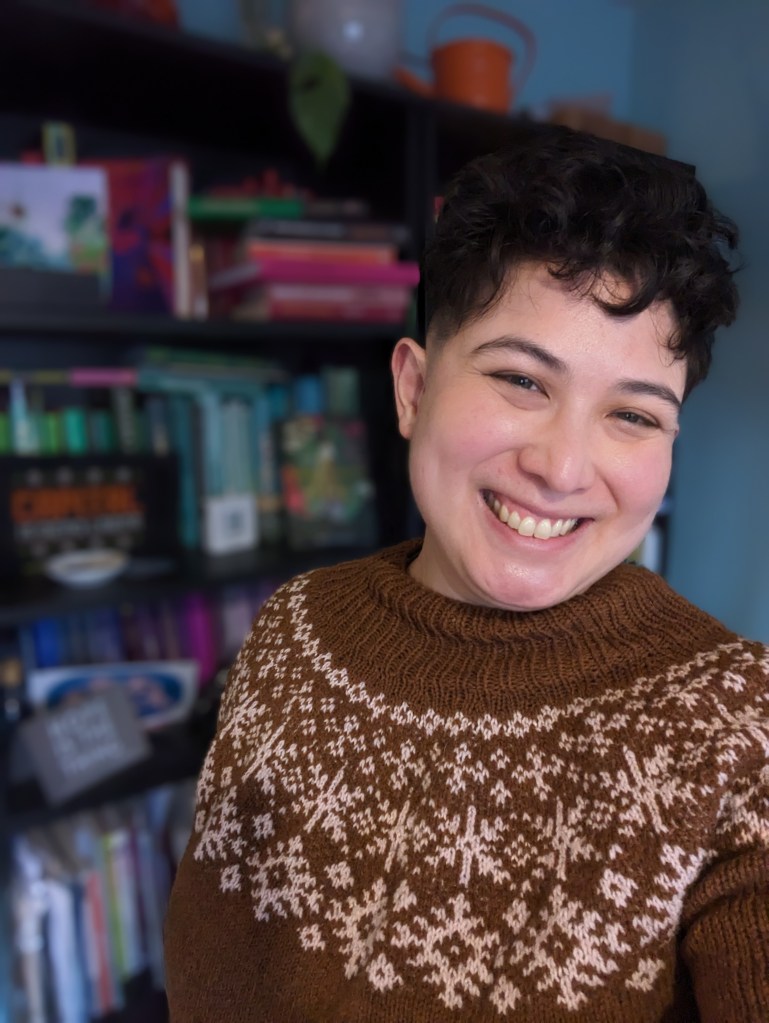
[Description of photo below: With tousled dark hair, Élaina wears a brimming smile and one of her knitted creations embellished with an intricate design of her making. In the faded background of the shot, a bookcase can be seen. On the top shelf of the bookcase, sits a watering can. Piles of books and decorative greeting cards can be seen scattered on the shelves below.]
Welcome back to Dialogues on Disability, Élaina! When I interviewed you in 2021, you had recently submitted your Ph.D. dissertation. I know that a great deal has happened in your life since that momentous event and our previous interview. Please bring us up to date on the broad outlines of your career trajectory and, if you wish to do so, on life in general since our last conversation.
Hi Shelley, thank you for having me back again! Currently, I am finishing my second postdoctoral research contract. From 2022 to 2024, I was an Interdisciplinary Research Fellow at the University of Edinburgh in Scotland. Then, I moved to Sheffield, England, where I am currently a Research Associate on the Wellcome Anti-ableist Research Culture (WAARC) project. On the WAARC project, I get to both develop my own research goals and work as part of a large team on an externally funded initiative.
Over the course of these postdocs, I have learned so much about who I want to be as a scholar and how I think that I can best contribute to knowledge ecosystems. Specifically, I am playing in the realm of an “epistemic broker,” which is a designation that I learned from sociologist Peter Keogh. I have long felt that my perspective and interests existed in liminal spaces—in between disciplines, blurring the lines between disabled community member and disabled scholar, and between philosophy of disability and medical humanities spaces. I have discovered an appetite to embrace this positionality in order to act as a broker or liaison between different knowledge cultures, that is, as someone who can help others navigate the power relations involved in collaboration.
Élaina, you describe yourself as a “scholarly podcaster [who] uses the medium of podcasting to push the boundaries of participatory research and her role as a knowledge broker between academic and non-academic cultures.” Please tell us about your current and past podcast projects, how you perceive them to push the boundaries of participatory research, and how you became interested in podcasting about disability.
As someone trained in philosophy, I was not schooled in the methods of the social sciences. As an undergraduate student, and even during my M.A., I did not think my work in philosophy would involve human participants, especially not work such as traditional qualitative interviews with human participants that need to be coded. However, my Ph.D. project veered towards applied ethics; with that project, I became increasingly interested in an interdisciplinary approach to philosophy. My first postdoctoral research fellowship pushed me into the realm of medical humanities. Midway through my Ph.D. studies, I began to identify as disabled, actively seeking out disabled community. So, when I arrived at the University of Edinburgh and was surrounded by sociologists, historians, anthropologists, and legal and science and technology scholars, I contributed my interest in critical disability studies, crip theory, and disability justice. It was in this explicitly interdisciplinary environment that I decided to explore the use of podcasting as a philosophical research method.
As readers and listeners of this interview may know, I launched my first podcast, Philosophy Casting Call, in 2021, after having conducted interviews with marginalised and underrepresented philosophers in 2020 during COVID lockdowns. At the time, I felt burnt out and isolated at the end of my Ph.D. journey. Podcasting gave me a structure and a reason to reach out to interesting scholars for semi-formal conversations. I think that it is important to note here that I was then, and am now, an avid podcast listener. So, I had an idea of the kind of content that I wanted to make.
Nevertheless, I told myself that the most important aspect of the process of making podcasts was to enjoy doing it, much like how other people made bread or painted during that time in the pandemic. I needed a creative outlet. Indeed, my production of podcasts was only accidentally scholarly because I used it to survive my scholarship. The most important revelation was how invigorating it felt, how full of possibility for community-building and joyous knowledge-sharing that it was. I had created a space for wonder and intellectual generosity in what felt like an otherwise bleak time in my life. It struck me that podcasting, as a process, could do more for scholarship than disseminate research results: it could also be a transformative way to produce new knowledge.
Since Philosophy Casting Call, I have, simply for the sake of pleasure, started multiple podcasts with friends. These podcasts have allowed me to refine my technical audio-editing skills and play with different formats. Playfulness has been an important part of my podcasting journey. I have tried not to make podcasting part of my job too quickly, which, I think, has benefitted me. By the time that I produced Massively Disabled: A Long COVID Research Podcast in 2023, I understood that I wanted to use podcasting as a creative medium to cripply elevate the “in-process” aspect of research. I wanted to subvert the idea that a podcast could only (legitimately) showcase a polished, finished product; a fully-fledged argument; or a definite result. That was not representative of my work.
Today, in 2026, long-COVID studies, all disciplines confounded, are still quite new. In 2022-2023, we had more questions than answers. I felt a keen need to respond in a timely manner to the mass disabling event that I was witnessing. I used my research budget to hire a composer and upgrade my microphone and started the process of creating what I call a “creative non-fiction podcast.”
Massively Disabled was motivated by my drive to grapple philosophically with how the narrative(s) about long COVID were either enshrined or erased, in addition to my desire to share with newly disabled people something that I wish that I, myself, had discovered sooner: namely, disabled community and culture. I consciously refused to sideline either of these two motivations and instead forged ahead, often breaking the Fourth Wall by inserting something personal about my emotional or physical reaction to the labour of editing and producing the podcast. I regarded it as important for me to push the definition of who holds epistemic authority both with respect to my choice of guests—whether they be academic, non-academic, disabled, non-disabled, living with and/or studying long COVID—and with respect to my own performance of a version of my whole self as a disabled scholar.
This kind of blurring of the roles is generally frowned upon in traditional participatory methods. I want to be clear that I do not wish to claim to have levelled all power relations between interviewer and interviewee, or between researcher and participant. The mere fact that I hold the creative, editing, and production rights of the podcasts means that I hold more power over the narrative of the podcasts than my guests do. However, I did approach this process with ethical questions at the forefront of my mind— including questions about podcasting and the ethics of consent, of triggering content, and of risk management—in terms of personal disclosure, digital data, the possible spreading of misinformation, etc.
After speaking about these issues with my colleagues who use ethnographic methods, it became clear to me that I operated with a slightly different set of ethical parameters than they did; but I do not think that this disparity is a bad thing. A key difference between a podcast guest and an interviewed participant is anonymity. While it is possible to anonymise oneself on a podcast with pseudonyms, voice modulators, or by having one’s written words read out by someone else, the default is that contributors use their own names and other identifying characteristics, such as gender, race, and a physical description. By contrast, an interviewed participant expects these details to be stripped from the data of the interview so that it may be aggregated and coded by the researcher in a way that cannot be traced back to an individual participant.
There are many good reasons to conserve participant anonymity in interviews; however, podcasting offers a place to experiment with de-anonymised research. My podcast guests have not only consented to give their names, but more so have given enthusiastic consent. I have mostly worked with marginalised people, all of whom have been excited to publicly share their knowledge. As participatory research continues to grow, I think that it is important to honour disabled people as knowers because they can contribute to reshaping research methods rather than simply rehearse palatable existing research methods. In short, I believe that podcasting offers a format and a playing ground for researchers and participants alike to develop new skills and reconnect with our ethical principles.
What is the Wellcome Anti-ableist Research Culture (WAARC) project and what are your roles on it? How does your philosophical training complement the project?
The Wellcome Anti-ableist Research Culture (WAARC) project is one the highest funded disability-related projects in the UK to date. It is one of several 2-year long projects on research culture currently funded by the Wellcome Trust. WAARC aims to evaluate the University of Sheffield on three areas regarding its disabled researchers—environment, inclusive methods and events, and research collaboration—and provide recommendations to the university’s executive board to improve research culture. I was hired to manage the cross-cutting themes of engaging institutions with the project and delivering recommendations based on an analysis of my colleagues’ data.
What I bring most to the role is my humanist training as a philosopher; that is, because I am an interloper in a sociology and education space, I bring my critical-analytical skills to question the processes and systems that impact disabled employees. I am not familiar with the status quo in these domains and therefore am more prone to question it. I would say that 80% of my job involves advocating for “crip practicalities,” or grappling with the bureaucracy of support (or lack thereof) offered to disabled researchers by their employer.
I am reminded of Jennifer Nedelsky’s “philosophy of administration” and Joan Tronto’s political ethics of care, except that I am on the ground floor while I reflect on the meta-system. My position may have been intended to be more focused on theory, but in effect it has become a praxis because I am faced with existing disabled colleagues who deserve support and respect now. A former professor had a saying that I love about “being elbow deep in metaphysics”. He would ask students to get “elbow deep” when we engaged with a text; in other words, he would ask us to not shy away from digging into concepts even if we felt overwhelmed or did not exactly understand what was going on. Akin to fixing a car engine, sometimes you must dig around to figure out how the machine works. I would describe myself as elbow deep in crip research culture, continuing to disentangle the pieces. Hopefully, something will work when I am done.
Some of my proudest accomplishments include the two polemic pieces that I co-wrote with my friend and colleague Daniel P. Jones on disability accommodations and access friction. I have also organised local, national, and international events that brought together academics, disabled people’s organisations, and queer disabled artists to both discuss the meaning of access and to perform it. My own flavour of philosophising involves identifying and creating relations; and my own background meant that it was important for me to remind the academic establishment that disabled people have been fighting for and figuring out inclusive cultures outside of the university or even corporate EDI projects.
By partnering with disabled-led community-interest companies such as Quiplash, I was able to tap into a vast network of disabled artists and activists that I could hire to host events and webinars based on the needs of disabled staff members. Participants have told me that they really enjoy having a virtual space to connect with each other in a creative and relaxed way. I am very aware that I am working on a time-limited EDI project in a world that is becoming more and more precarious for disabled workers; so I believe it is my responsibility, in the spirit of ethics of care, to provide spaces for community-building.
“A Crip Reading of Filipino Philosophy,” your contribution to The Bloomsbury Guide to Philosophy of Disability, drew upon philosophy of disability, feminist philosophy, and Filipino philosophy to produce a landmark Filipina feminist philosophy of disability text. Indeed, you have been at the forefront of efforts that aim to bring Philippine philosophy into feminist philosophy/theory and to bring philosophy and theory of disability into Philippine philosophy. Please describe the work that you have produced in these areas since the publication of the Bloomsbury volume.
Since the publication of “A Crip Reading of Filipino Philosophy,” I have served as a co-editor for an upcoming anthology of Philippine philosophy with other Filipina philosophers, led by Kelly Louise Rexzy P. Agra. The editorial process generated interesting conversations about the complexities of choosing a publisher and a language of publication when the project is explicitly feminist and decolonial. On one hand, everyone involved would love for mainstream (read: English-speaking in the USA, Canada, and Europe) philosophy to engage with Philippine texts. Publishing with an academic press outside of the Philippines would make it much easier for more universities to purchase the book and for faculty to assign it to students. However, this accessibility to the anthology for mainstream North Americans and Europeans would make it prohibitively expensive for residents of the Philippines to access.
We must also grapple with the fact that English is only one of the hundreds of languages currently used in the Philippines. Publishing a monolingual reference book is, in itself, a political act. However, the inclusion of side-by-side translations is also costly. At this point, we have mostly assembled the existing texts that we want to include, thanks to the efforts of my colleagues in the Philippines who have dug through archives and our collective networking to ask friends of friends to send us PDFs of desired texts. Through a survey shared with the Women Doing Philosophy group, we have identified scholars willing to author contemporary responses to the historical materials in an effort to present the anthology as a dynamic offering.
In the past few years, I have developed an interest in counter-archival projects; so, this editorial process has been extremely enriching for me. Everyone involved in the book is doing it in their spare time, on the fringes of our teaching and research contracts. Our limited time and energy must be poured into something that we believe in, a monumental offering—in the sense that we are building a monument, a rallying point—that needs to be somewhat legible to oppressive colonial systems, yet, ultimately, be accountable to the communities from which this knowledge comes, namely, to Filipino communities.
In my own research, I have slowly become acquainted with the scholarship on Nakem philosophy. In my chapter in the Bloomsbury volume, I analysed Tagalog terms and concepts. Nakem is from the Ilokano language, which is spoken by the third-largest ethno-linguistic group in the Philippines. Nakem is analogous to loób, the Tagalog term for interiority or the self. However, one of the arguments of philosophers of Nakem is that the very understanding of Ilokano selfhood is mediated by language.
Danilo S. Alterado, the philosopher that I am currently studying, raises questions of belonging, self-understanding, and political responsibility that resonate with my own intellectual concerns. In a world where the rise of ethno-nationalism, fascism, and xenophobia touches all aspects of my life, I am extremely interested in indigenous knowledge systems that grapple with honouring cultural difference, resisting hegemony, and committing to common political projects. As a mestiza Filipina born and raised in the diaspora, I choose to consciously engage with indigenous philosophies from a point of open dialogue, doing my best to avoid mystification of what I learn in order to extract it for a Western audience, even if that audience is my own mind. This process is slow and ongoing, but it is very exciting.
In your previous interview with me for Dialogues on Disability, Élaina, you said: “As my identity as a philosopher has matured, I have found that I want to invest in contributing to what Kristie Dotson calls a ‘culture of praxis’.” Please remind us, your readers and listeners, what you meant by this self-description. Do you still hold this view? If so, how does it manifest?
Kristie Dotson’s “How Is This Paper Philosophy?” and, specifically, her concept of a “culture of praxis” changed my life, forever altering the trajectory of my scholarship. In brief, Dotson argues that the academic discipline of philosophy as it exists in the 21st century has prioritised one approach to philosophising over all others. Dotson names this a “culture of justification,” where argumentative and zero-sum debate-style of intellectual engagement is seen as the only valid way to “do philosophy.” As a result, many other philosophical cultures that centre around, for example, discursivity and collaborative knowledge have become de-legitimised and their practitioners have been marginalised.
The way that I understand it, a “culture of praxis” invites philosophers to acknowledge a diversity of approaches to philosophising within the discipline. More than that, however, the existence of a culture of praxis would mean that the discipline embraces those of us who want to explore the messiness of engaged philosophy that blurs theory and practice. In my work, this blurring manifests as my exploration of epistemic authority in the very practical process of podcast production and in the way that I organise academic events to centre the care of disabled people.
Like many other early career and disabled researchers, I have no employment stability. One of the ways that I cope with this precarity psychologically is to filter my activities and commitments through the question: How is this activity or project contributing to a life-giving research culture? Ultimately, if tomorrow, I am no longer able to contribute to academia, I want to know that I have done my best to make the experience better for the next disabled woman of colour.
Since our last interview, I have leaned harder into being a crip killjoy in the tradition of Sara Ahmed’s feminist killjoy. It can be exhausting and tense to always be the one to publicly critique the ableism of my industry, but I know no change comes without resistance. Being a crip killjoy has brought me closer to people with whom I want to be in community and to whom I want to be accountable. Sometimes, crip refusal is the shape that my philosophical praxis takes, but this crip praxis of refusal has not been a lonely experience for me. What we often forget is that refusing to engage in certain cultures, be they at work or in social settings, frees you up to connect with the world in a different way.
In the last five years, I have invested more explicitly in being in community with my disabled kin in and outside of scholarly circles rather than trying to prove my worth to the higher-education system. I cannot vouch for this approach as a career move, but, looking around me, my peers who have played the system’s game to the best of their ability are not necessarily in a more secure position than I am. All I can do is invest every day in a philosophical practice of which I can be proud and that can be a part of me wherever I end up.
Élaina, how would you like to end this interview? Are there topics or concerns that we have not discussed that you would like to address? Would you like to recommend some books, articles, blogs, or videos that readers and listeners should explore for more information about the issues that you have addressed?
I do want to mention some of the exciting projects that I am mulling over, because otherwise it is easy to only dwell on how dire the job market is at present. Over the past few months, I have connected online with Emily R. Douglas, who you interviewed in December, about our shared ongoing COVID-conscious practices. This liaison led to a collective writing group that comprises me, Emily, and other scholars living with energy-limiting conditions.
I am currently working on a piece in conversation with Patricia Lockwood’s “long-COVID novel,” Will There Ever Be Another You, about my experience of post-exertional malaise (PEM).
In addition, I was approached to review Indonesian disabled author and artist Khairani Barokka’s genre-breaking book Annah, Infinite. Okka came to me specifically because of my podcasting practice. I am playing around with the idea of producing a creative podcast as a companion to the book. These projects are the kinds of endeavours with fellow crips that give me life, making it worthwhile for me to choose curiosity and wonder as an act of resistance in a world determined to crush the human spirit.
Élaina, thank you so much for your wonderful responses in this interview. Your remarks throughout the interview will be a source of reassurance and inspiration to many disabled philosophers and disabled academics in general. I look forward to enjoying your future projects and publications.
Readers/listeners are invited to use the Comments section below to respond to Élaina Gauthier-Mamaril’s remarks, ask questions, and so on. Comments will be moderated. As always, although signed comments are preferred, anonymous comments may be permitted.
The entire Dialogues on Disability series is archived on BIOPOLITICAL PHILOSOPHY here.
From April 2015 to May 2021, I coordinated, edited, and produced the Dialogues on Disability series without any institutional or other financial support. A Patreon account now supports the series, enabling me to continue to create it. You can add your support for these vital interviews with disabled philosophers at the Dialogues on Disability Patreon account page here.
__________________________________
Please join me here again on Wednesday, February 18, 2026, for the next installment of the Dialogues on Disability series and, indeed, on every third Wednesday of the months ahead. I have a fabulous line-up of interviews planned. If you would like to nominate someone to be interviewed (self-nominations are welcomed), please feel free to write me at s.tremain@yahoo.ca. I prioritize diversity with respect to disability, class, race, gender, institutional status, nationality, culture, age, and sexuality in my selection of interviewees and my scheduling of interviews.
 BIOPOLITICAL PHILOSOPHY