Hello, I’m Shelley Tremain and I would like to welcome you to the one hundred and twenty-seventh installment of Dialogues on Disability, the series of interviews that I am conducting with disabled philosophers and post to BIOPOLITICAL PHILOSOPHY on the third Wednesday of each month. The series is designed to provide a public venue for discussion with disabled philosophers about a range of topics, including their philosophical work on disability; the place of philosophy of disability vis-à-vis the discipline and profession; their experiences of institutional discrimination and exclusion, as well as personal and structural gaslighting in philosophy in particular and in academia more generally; resistance to ableism, racism, sexism, and other apparatuses of power; accessibility; and anti-oppressive pedagogy.
The land on which I sit to conduct these interviews is the traditional ancestral territory of the Haudenosaunee and Anishinaabeg nations. The territory was the subject of the Dish with One Spoon Wampum Belt Covenant, an agreement between the Iroquois Confederacy and the Ojibwe and allied nations around the Great Lakes. As a settler, I offer these interviews with respect for and in solidarity with Indigenous peoples of so-called Canada and other settler states who, for thousands of years, have held sacred the land, water, air, and sky, as well as their inhabitants, and who, for centuries, have struggled to protect them from the ravages and degradation of colonization and expropriation.
My guest today is Karin Boxer. Karin is a moral philosopher and disability advocate who left higher education after twenty-four years due to ableism and inaccessibility. She held tenure-track appointments at the University of Pittsburgh and the University of Richmond, where she served on the Disabilities Advocacy Committee. She is the author of Rethinking Responsibility (Oxford University Press, 2013) and writes articles on disability, ableism, and social justice for the general public. In her free time, Karin can usually be found puttering in her garden or trying to keep her new kitten out of mischief.
[Description of photo below: Karin, who has long dark hair and is wearing a red patterned garment, is in a garden with lush bushes, vines, and red flowers under an overhang.]

Welcome to Dialogues on Disability, Karin! Please describe your background and what led you to do graduate work in philosophy and become a professional philosopher.
I grew up on Long Island, New York. After my parents divorced when I was ten years old, I was raised by my mother, who experienced major depression, and by my grandmother, who had fled Germany after Kristallnacht. My grandmother was the strongest person that I have ever met. From the time that I was six, my mother was in and out of the hospital. During those times, my grandmother stayed with my brother and me, or we lived with friends.
My mother’s illness and debates about physician-assisted suicide in the news got me interested in medical ethics. I applied to Princeton with the intention to become a philosophy major, go on to get a law degree and Master’s in public health, and do applied work in medical ethics. The thought of becoming a professional philosopher was not on my radar at that point, though, apparently, as a six-year-old, I had told my mother that when I grew up, I wanted to be Socrates and sit on a rock and think.
My first philosophy class was with Frances Kamm, who was visiting Princeton. I was immediately in love with philosophy. At the time, however, there was not a lot of focus on ethics within Princeton’s philosophy department itself. Two exceptions were Sarah Buss and Dick Moran, from both of whom I took amazing classes and who later became mentors and friends. I decided to major in the School of Public and International Affairs, with a concentration in health policy and medical ethics. The interdisciplinary nature of the major gave me the ability to take all the moral and political philosophy courses on offer but skip the rest. When I was awarded a Marshall Scholarship, I decided to apply for the B.Phil. at Oxford, requesting to study medical ethics with Jonathan Glover. By some miracle, I was accepted, despite lacking the broad-based philosophical knowledge that would have come if I had been an undergraduate philosophy major.
The B.Phil. was notoriously difficult and rather cut-throat. Of the approximately 15 people with whom I began the program, only half of them completed the degree with me. Particularly in the early days, there was a lot of one-upmanship. My lack of a stronger undergraduate philosophy background made me feel like an impostor, especially among my peers. However, I was incredibly fortunate to be assigned these supervisors: Jonathan Glover for ethics, Quassim Cassam for Kant, Jerry Cohen for political philosophy, and later Joseph Raz for my B.Phil. thesis and Derek Parfit and Martha Klein for the D.Phil. While other students in my B.Phil. class struggled to get their supervisors to see them twice a semester, mine were more than happy to see me once a week and speak by phone in between.
When I met Jonathan for our initial tutorial, the first thing that he said to me was this: “Medical ethics is so boring. Let’s try some other stuff.” First up was the problem of the amoralist; second was Bernard Williams’s “One Thought Too Many”; third was moral responsibility. Immediately, I was hooked. Still, my intention was to return to the United States after the B.Phil. to attend Yale Law to which I had deferred acceptance. I stayed at Oxford for a D.Phil., in part because Jonathan had successfully enlisted many of its senior philosophers to convince me that I would make a horrible lawyer, but a wonderful philosopher. In addition, I had fallen completely in love with philosophy in general and with problems regarding freedom and responsibility in particular. I could not stop talking about it, to the point that David Wiggins, whom I was often seated next to at college dinners, imposed a 50% rule, that is, no more than half of our conversation could be focused on philosophy.
One year into the doctorate, I was awarded a Junior Research Fellowship (typically, a post-doc position) at New College. While I was honored, I also began to feel overpromoted, which sent my anxiety and impostor syndrome soaring. Three years later, with my dissertation still not complete, I landed a tenure-track position at the University of Pittsburgh. I was not ready, but the offer was too good to turn down. That was the beginning of my career as a professional philosopher. I stayed at Pittsburgh for the next twelve years.
Karin, you are not currently employed in academia. As you have indicated, however, you held numerous positions in the profession as a moral philosopher, including tenure-track positions. You also published a book in 2013 entitled, Rethinking Responsibility. An increasing number of disabled philosophers of disability have begun to write about disability and moral responsibility. Please describe the work that you have accomplished on responsibility and how you would approach the topic today in light of this more recent work by disabled philosophers.
The book grew out of my dissatisfaction with the incompatibilist argument that I had defended in my dissertation. There, I had defended a version of Galen Strawson’s “Basic Argument for the Impossibility of Moral Responsibility,” according to which being morally responsible for an action required one to be ultimately responsible for that action. I came to realize that rather than arguing for an ultimate responsibility requirement, I had been writing an ultimate responsibility requirement into my very definition of moral responsibility, thereby begging the question against my compatibilist opponents. The book was my search for a more adequate defense: Could I show that moral responsibility required ultimate responsibility without smuggling it in definitionally?
I concluded that I could not. Each chapter of the book examined a different understanding of the nature of moral responsibility and asked whether so understood moral responsibility would require ultimate responsibility. Chapter 2 considered accounts in terms of moral appraisal. Chapter 3 considered accounts in terms of the reactive attitudes. Chapters 4 and 5 considered accounts in terms of potential moral desert of punishment.
When I re-read the book to prepare for this interview, I was somewhat horrified at the ableist language and arguments to which I had appealed in it. In particular, I was alarmed by my uncritical appeal in Chapter 2 to Barbara Herman’s discussion of “normal” or “normal enough” adult human beings whose character is built atop a base of moral literacy and by my reconstruction and defense in Chapter 3 of Peter Strawson’s argument from “Freedom and Resentment.” I had been so concerned to defend his argument against various incompatibilist objections that I did not question various details of the argument that I should have questioned. Nor did I bat an eyelid at his talk of “normal” agents or his assumption that the people whom he described as “abnormal” were incapable of ordinary adult interpersonal relationships. Like Sofia Jeppsson, it did not occur to me that I was one of the people who would fall into that category.
I continue to think there is something correct about Peter Strawson’s and Barbara Herman’s claims. I continue to believe that Strawson was fundamentally correct that holding someone responsible is something that we do from the participant stance in relating to other human beings. Moral responsibility is relational, emerging from our actual interpersonal relationships rather than from abstract metaphysical facts. I think that he is correct that when we exempt people, it is because we see them as incapable of ordinary adult interpersonal relationships as we normally envision them. Moreover, I think that he is correct that because the capacity for participation is the relevant capacity, we can be confident that no metaphysical thesis of determinism compatible with “the facts as we know them” could show the reactive attitudes universally inappropriate by their own internal standards. Among the facts as we know them is that we do participate in such relationships. I continue to struggle with how the sort of relationship at issue should be described. The best that I can do now is describe it as a relationship organized around the basic demand and in which we assume that the other person can meet that demand. I still think the capacity to meet the demand is one and the same capacity as Herman’s moral literacy.
In addition to Strawson’s and Herman’s talk of “normal” versus abnormal agents, I should have challenged this picture of who can participate in the relevant interpersonal relationships and Herman’s characterization of who possesses moral literacy. This is what I got wrong, and what philosophers of disability—such as you, Shelley, Mich Ciurria, and August Gorman—rightly critique. To my mind, the problem is not the criterion–i.e., the capacity to participate in everyday adult interpersonal relationships– but rather who we wrongly assume does not meet it. In this regard, I break with Mich and Stephanie Jenkins in thinking that there is a capacity criterion for moral responsibility, though, importantly, I distinguish between who counts as morally responsible and who counts as an object of moral concern for their own sake. Those whom Strawson characterizes as psychologically abnormal CAN participate. Where obstacles exist, they are often ableist norms rather than agential incapacities.
If I were approaching these topics today, I would ask fundamentally different questions. The core insights about the relational nature of moral responsibility and the importance of moral literacy remain sound. But they should lead us to expand our understanding of who can meaningfully participate rather than restrict them. Instead of asking “Who lacks the capacity for interpersonal relationships or moral literacy as we normally picture them?,” I would ask “How can we develop broader, more inclusive understandings of what everyday interpersonal relationships and moral literacy can look like?”
In your July 2025 article “Ableism Nearly Killed Me. Recognizing It Saved My Life”, you describe the ableism and inaccessibility that ultimately led you to leave higher education. Will you describe those experiences in more detail?
I live with a subtype of Obsessive-Compulsive Disorder (OCD) called “Just Right” OCD. Unlike the more widely-recognized subtypes of OCD, Just Right OCD is fueled by a visceral sense that something is off—not quite right and a compulsion to fiddle with it until it is right—rather than by a fear of some consequence. OCD frequently targets what a person cares about most. For me, it targets my writing, and particularly my academic writing, although, when triggered, it can extend to pretty much anything, from writing a shopping list to picking a raincoat. I can talk spontaneously about my philosophical ideas; if you ask me to give a talk and I do not need to send in the full paper in advance, I can do that. That is how I got the position at Pitt. But getting the full text of a talk or paper finalized or sometimes merely drafted when my OCD is triggered is impossible. I will either repeatedly rewrite the same sentence until it feels “just right;” or I will include five different versions of the same sentence between which I am unable to choose. I am like Buridan’s Ass who starves on account of being unable to choose between two equally good bales of hay or like Frankfurt’s person whose obsessiveness prevents them from decisively identifying with any of their first-order desires, leading to inaction and a destruction of agency.
In the period between leaving Pitt and starting at Richmond, during which I held visiting teaching positions at Amherst and UBC, I got a brief respite. OCD symptoms are often exacerbated by stress. Without the pressure to publish, I was able to finalize the book, publish two articles, and draft two more. As soon as I accepted the tenure-track position at Richmond, the symptoms came roaring back. In November of 2020, the symptoms got so bad that I crushed my ulnar nerve by leaning on my elbow for 14 hours straight while trying to complete a single paragraph. By the following summer, trying to convert into consecutive prose the hundreds of pages of new ideas that I had written was making me suicidal.
At the end of my rope, I approached the Dean. I explained that I needed intensive inpatient OCD treatment, but due to the pandemic, it would take 18 months to get a spot. I asked to be taken off the tenure track and put into a teaching and service position either temporarily (while I waited for inpatient treatment) or permanently (which seemed the course that was both best for my mental health and most likely to get me publishing again). I was told that although there was precedent for getting off the tenure track, it would be a shame for someone with my talent and publications not to get tenure. I was advised to apply for formal accommodation under the Americans with Disabilities Act (ADA). That is when things fell apart.
The university responded that, at the time, a teaching and service position in philosophy did not exist and that the ADA did not obligate them to create one. There was no mechanism for moving out of the tenure-track temporarily; moreover, scholarship could not be waived. I asked whether I could go up for tenure without promotion based on my previous publications and was told that such a policy was reserved for exceptional circumstances. I asked whether the university could provide me with an editor to help me remove multiple versions of the same sentence and was told such a request was not a reasonable accommodation. Instead, I was given dictation software, which did not resolve the issue, since my problem was not typing but rather the knowledge that I was composing. I was invited to submit a second stop-the-clock request on grounds of extraordinary hardship. When I did, the request was denied. I was told that there was a hard limit of two extensions. Because I had previously stopped the clock after a medical leave and had accepted the one-year COVID-related extension that the university had offered everyone, I had exhausted my two extensions, they said, and the circumstances did not warrant a third.
Immediately after the initial accommodation denial, the Dean advised me to give up all my service projects and concentrate solely on writing, saying that unless I published again, there was no place for me at the university. That sent me into a total tailspin. My department chair, who was concerned about my mental health, suggested that I needed to accept that people with serious mental illnesses could not hold serious jobs.
Not going in with a lawyer was my first big mistake. I had believed the university’s rhetoric concerning diversity, equity, inclusion, and mental well-being; I believed that they would do the right thing. My second mistake was that I did not hire a lawyer immediately after the denial. My advice to anyone denied accommodation is to get a lawyer, if there is any way that they can afford to do so. In the United States, there is a 300-day window for filing an Equal Employment Opportunity Commission complaint. If it can save your career, it’s money well spent.
For all the ableism in what occurred, there was just as much in what did not. Like August, I have been heavily influenced by Anita Silvers’s counterfactual test for discrimination. What if people like me were the majority? How would things be set up? I also like to think about how things would be set up if we truly valued accessibility and saw accommodations as keys to unlocking talent rather than charity or a burden.
What if, instead of viewing my OCD as a defect that I should fix somehow, we recognized it as a historically marginalized functional difference, one that entitles me to accommodations so that I can exercise my philosophical talents? What if, instead of my chair telling me that I needed to accept that people with serious mental illnesses could not hold serious jobs, they had instead said, “Let me help you get accommodations”? What if, when I did apply for accommodations, rather than look for reasons to say “no,” the university had looked for ways to say “yes”?
What if, instead of saying, “We are not legally required to create a teaching and service position,” they had said, “We do not want to lose your talent. As things are, we cannot offer enough sections of your courses to satisfy demand. Furthermore, you are doing disability inclusion work that someone needs to do, so it will be a win-win for everyone”?
Or, what if they had said: “We know you have philosophical ideas that you are dying to get out into the world, so let’s figure out a way we can help you get them out.” The career coach that I hired after I was told not to apply for tenure needed only one hour to figure out a way to help me write, to help me get out my ideas.
Or, they could have said: “Let’s figure out another way for you to fulfill your scholarship obligations. You say that you can speak and not write? Go give talks and we will count them in lieu of publications.” Indeed, the university’s faculty handbook allows for alternative forms of scholarship. Yet the university, the department, and I were so caught up with ableist norms of production and product that none of us thought to question the notion of “publish or perish.” We all focused on what I could not do. We should have been focused on what I could. When I finally did, it was too late.
The lack of departmental support was the most hurtful aspect of the experience. The department could have requested that my position be turned into a teaching and service position. Even though the ADA expressly allows such requests, there was a perception that it would be unfair to do so. Besides, they did not want to give up a tenure-track position. When, thanks to my career coach, I finally managed to find a workaround, they could have backed me in appealing the denial of my request to extend my tenure clock. Instead, they told me that doing so was not part of their job. Yet it is everyone’s job to challenge ableist norms, just as it is everyone’s job to challenge racism, sexism, xenophobia, and transphobia. That did not happen in my case. I am sharing my story to prevent other disabled philosophers from having the same experience that I did.
How have these experiences fueled your advocacy since leaving higher education?
My current disability advocacy largely takes the form of public-facing writing, though I am also in a cohort designed to get disabled speakers high-paying speaking engagements. In terms of content, my advocacy falls into three main buckets:
The first is transformation of workplace-accommodation processes both to prevent accommodation failures of the sort that I experienced and to promote disabled thriving. I am currently partnering with an employment lawyer on a law review article that proposes regulatory reforms to strengthen the ADA interactive process. The most important of these proposals is the clear delineation of each party’s responsibilities, with ultimate responsibility for the identification of an effective accommodation (or for showing that no reasonable accommodation exists) placed on employers rather than disabled workers. One way to do so is to mandate consultation with third-party professionals who have the relevant expertise when solutions are not readily apparent. The sort of third-party professionals that I have in mind are occupational therapists, workplace ergonomists, or people with expertise in assistive technology. If the goal is to change the workplace rather than the worker, these specialists, and not medical doctors, will be the right people to consult.
In addition to the law review article, I’m working on several op-eds that advocate the business case for voluntary adoption of these procedures as best practices. Research shows that companies with strong disability-inclusion practices generate 1.6 times more revenue and see 90% better retention rates than their competitors. I have also started a LinkedIn hashtag campaign, #MyNDEAMDream, for National Disability Employment Awareness Month, which happens to be October. Incidentally, LinkedIn has been a great place for me to connect with other advocates.
The second advocacy bucket consists of reforms related to tenure. I use my story to advocate for three changes, in particular. First, other than at R1 universities (and perhaps even there), there should be more than one path to secure tenure, including a pure teaching and service track. It is odd that a job function that is now considered essential to the profession—conducting research—was not even expected 50 years ago, except at R1 universities.
Second, even on the research track and in fields like philosophy, we need to acknowledge that there is more than one way to share knowledge and, therefore, more than one tenure-worthy form of scholarship. It is somewhat ironic that a field such as philosophy, one of whose founding fathers never wrote anything, should privilege writing over speaking, particularly at a time when talks can be presented and circulated online just as easily (or more easily) than they can be written. Speaking allows one to reach audiences who learn better from hearing than from reading. And for those who learn better through reading, transcripts can be provided.
Finally, we need flexible tenure timelines that recognize individual circumstances. It is not as if speed correlates with quality. It is also not as if one person taking longer or producing less places a burden on someone else to produce more to keep philosophy afloat. If anything, the discipline could do with fewer publications rather than more. More generally, we need to recognize that rigid academic practices exclude equally talented faculty. If we want academia to be fully accessible to talent, we need to build in more flexibility.
The third bucket is cultural change, both in academia and society more broadly, which is a large part of what I worked on at Disability Belongs. I am advocating for the recognition of disability as an axis of diversity and identity and for a shift from a “bare compliance” model of disability inclusion to one grounded in belonging. More specifically, I have been advocating for the need to explicitly name and talk about ableism—something Disability Belongs historically avoided—and for infrastructure parity. Whatever programs and policies that an institution has in place for members of other historically marginalized identities, it should have in place for disabled people too.
Sticking with higher ed, infrastructure parity might, for example, entail the establishment of affinity groups for disabled students, faculty, and staff; the celebration of Disability Pride months; or arrangement of other programming that highlights disability history and culture. At another school, it might entail the creation of a Disability Studies department or certificate. At other schools, it might entail the establishment of a disability cultural center or designated meeting spaces for disabled students, faculty, and staff. At present, there are only 18 campus disability cultural centers in the United States, compared to more than 250 LGBTQ+ campus cultural centers and more than 175 Black campus cultural centers nationwide. This inequity needs to change. Disabled students deserve the same infrastructure as students of other identities.
What other philosophical projects are you working on at present?
I am currently working on two philosophical papers. The first paper concerns the work of the concept “disability”—both the work that it has historically done and the work that we need it to do now. I want to argue that, in fact, we need three concepts. For better or worse, I think that we need to acknowledge that, thanks in part to the influence of the ADA, the referent of the term disability in ordinary usage has changed. The term disability, rather than referring to inabilities to engage in particular activities—which is what both the original WHO model and the social model variously refer to as disability—has come to refer to what both models referred to as impairment. Bearing in mind this conceptual and linguistic change and the sort of social change that we would like to see, I want to propose that we define disability as a historically marginalized functional difference that affects the way that a person accomplishes tasks of daily living.
This definition was inspired, in part, by the work of Katherine Jenkins and Aness Webster and, in part, by the work of Anita Silvers and of Susan Wendell. I think that we still need a term to refer to particular activity limitations, as well as a separate term to refer to the specific activity limitations that are the products of society—that is, to what the social model referred to as disability. To mark this distinction, I refer to the former as “disablement” and the latter as “disenablement”. One nice thing about this terminology is that it allows us to say that one can have a disability without being disabled by it (because it is fully accommodated or society has been made accessible) and that all forms of oppression can be disenabling.
The second paper concerns how best to distinguish between weakness of will and psychological compulsion. Here, too, I think we need a tripartite distinction. Like Gary Watson (and, I believe, August and Sofia), I think many of the cases classically labeled as cases of psychological compulsion are better understood to involve coercion or choice under duress, including much of my OCD experience. In these cases, the agent could resist the supposedly compulsive desire; however, unlike in cases of weakness of will, this resistance would involve significant distress or effort, which would provide grounds for compassionate excuse or mitigation. That said, there are parts of my OCD experience that do not fit this model. These parts of my experience seem more like Frankfurt’s Jones 1, who is so overcome by terror at Black’s threat that he does not even remember his previous decision. Though there is action, there seems to be no choice in Aristotle’s sense because, unlike in coercion, it is impossible to step back from the desire and ask if this is something you have reason to do. Or at least it is impossible without some type of external disruptor.
Finally, I have a longer-term book project, a collection of essays on disability, equity, and thriving that combines personal narrative about my experiences of navigating academia with “Just Right” OCD, philosophical analysis, and advocacy for change.
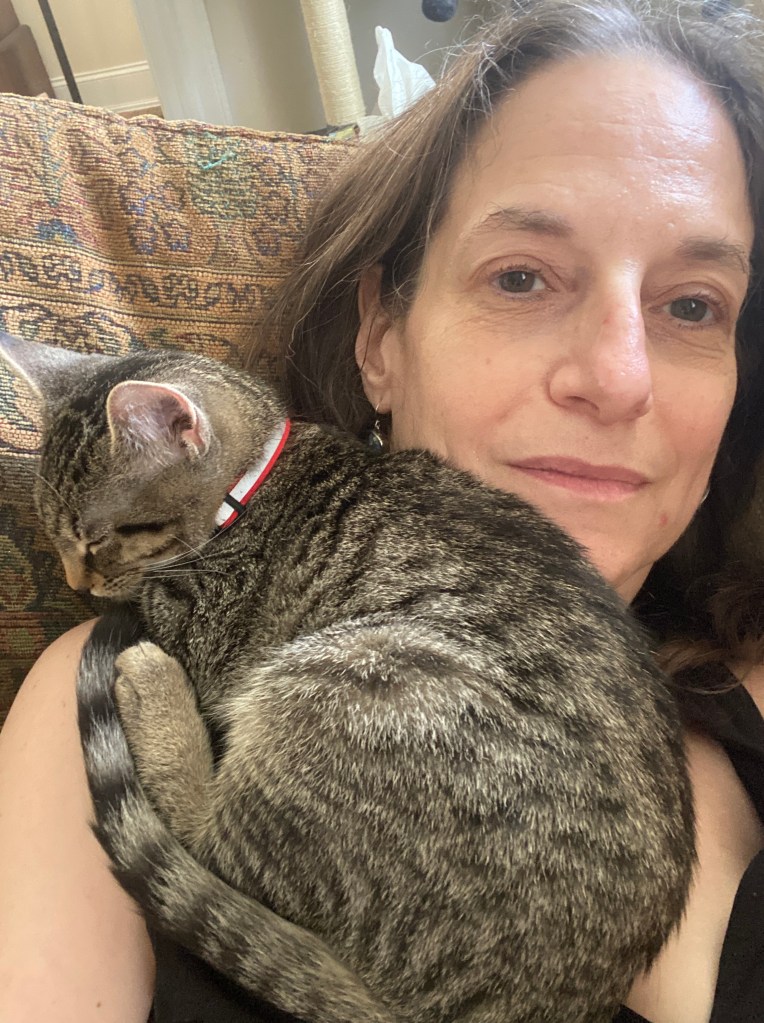
[Description of photo below: Karin, who is looking directly into the shot, is seated on a comfortable chair with pillows. Light from her left shines on her forehead. Her new kitten, whose eyes are closed, is nestled close to her.]
Karin, how would you like to end this interview? Are there topics or concerns that we have not discussed that you would like to address? Would you like to recommend some books, articles, blogs, or videos that readers and listeners should explore for more information about the issues that you have addressed?
Mainly, I want to thank you for the opportunity to be interviewed and for all your work to combat ableism and other forms of oppression. I am thinking of the Philosophy, Disability, and Social Change conferences that you organize, in addition to this interview series and the many books, articles, and edited collections that you have published. My attendance at last year’s edition of the Philosophy, Disability, and Social Change conference was pivotal for me. Being around other disabled philosophers helped me recognize that I was not misunderstanding my experiences and situation. The other participants of the conference and the conversations that took place amongst us reminded me that I do indeed have useful contributions to make to philosophy. Thanks to that, I am again applying for philosophy jobs.
I also want to give a shout-out to my students at Richmond. They were my joy-givers, what kept me going. Let me direct readers and listeners of this interview to some of the incredible interviews that they conducted as part of the More About Us campus disability visibility oral history campaign that I organized. If you sign up for a StoryCorps account, more interviews are available. Finally, let me direct you to the disability visibility campaign by Grosse Pointe Public Library that partly inspired ours.
Karin, thank you so much for this rich and important interview. You have provided readers and listeners of Dialogues on Disability with a great deal to think about, especially with respect to expanding ideas about accessibility and inclusion.
Readers/listeners are invited to use the Comments section below to respond to Karin Boxer’s remarks, ask questions, and so on. Comments will be moderated. As always, although signed comments are preferred, anonymous comments may be permitted.
The entire Dialogues on Disability series is archived on BIOPOLITICAL PHILOSOPHY here.
From April 2015 to May 2021, I coordinated, edited, and produced the Dialogues on Disability series without any institutional or other financial support. A Patreon account now supports the series, enabling me to continue to create it. You can add your support for these vital interviews with disabled philosophers at the Dialogues on Disability Patreon account page here.
__________________________________
Please join me here again on Wednesday, November 19, 2025, for the next installment of the Dialogues on Disability series and, indeed, on every third Wednesday of the months ahead. I have a fabulous line-up of interviews planned. If you would like to nominate someone to be interviewed (self-nominations are welcomed), please feel free to write me at s.tremain@yahoo.ca. I prioritize diversity with respect to disability, class, race, gender, institutional status, nationality, culture, age, and sexuality in my selection of interviewees and my scheduling of interviews.
 BIOPOLITICAL PHILOSOPHY