Hello, I’m Shelley Tremain and I would like to welcome you to the one hundred and thirty-eighth installment of Dialogues on Disability, the series of interviews that I am conducting with disabled philosophers and post to BIOPOLITICAL PHILOSOPHY on the third Wednesday of each month. The series is designed to provide a public venue for discussion with disabled philosophers about a range of topics, including their philosophical work on disability; the place of philosophy of disability vis-à-vis the discipline and profession; their experiences of institutional discrimination and exclusion, as well as personal and structural gaslighting in philosophy in particular and in academia more generally; resistance to ableism, racism, sexism, and other apparatuses of power; accessibility; and anti-oppressive pedagogy.
The land on which I sit to conduct these interviews is the traditional ancestral territory of the Haudenosaunee and Anishinaabeg nations. The territory was the subject of the Dish with One Spoon Wampum Belt Covenant, an agreement between the Iroquois Confederacy and the Ojibwe and allied nations around the Great Lakes. As a settler, I offer these interviews with respect for and in solidarity with Indigenous peoples of so-called Canada and other settler states who, for thousands of years, have held sacred the land, water, air, and sky, as well as their inhabitants, and who, for centuries, have struggled to protect them from the ravages and degradation of colonization and expropriation.
My guest today is Stephanie Jenkins. Stephanie is an associate professor in the School of History, Philosophy, and Religion at Oregon State University (OSU), where she founded the field of Phish Studies. A feminist philosopher specializing in ethics, disability studies, and critical animal studies, Stephanie co-edited Disability and Animality: Crip Perspectives in Critical Animal Studies; Concepts We’ll Ponder: Identity, Improvisation, and Community in the Phish Experience; and a special issue of the Public Philosophy Journal (Phish and Philosophy). Her most recent publication “On Becoming Incorrigible,” appears in a 2026 special issue of Feminist Philosophy Quarterly that commemorates the centennial of Foucault’s birth in 1926. She is currently writing a monograph entitled A Philosopher Goes to the Clinic and co-editing Phish Studies: New Perspectives in Music, Meaning, and Community. For fun, Stephanie enjoys vegan baking, experiencing live music, and playing with her dog, Hank.
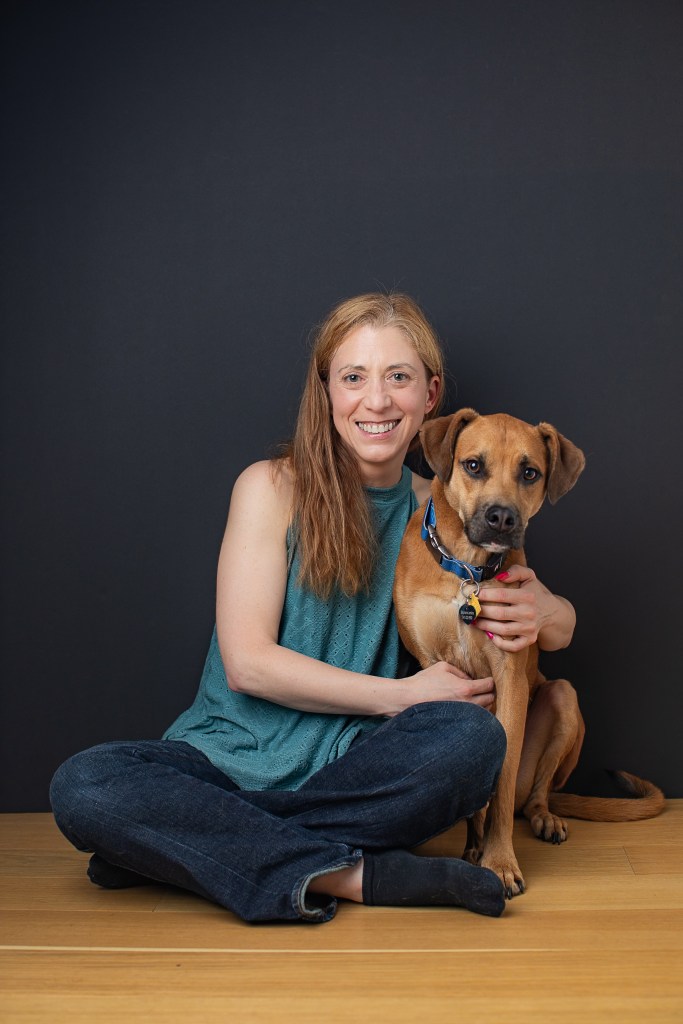
[Description of photo below: Stephanie, who is smiling for the camera, sits cross-legged on the floor. She is hugging her beloved Hank close on her left, her long hair hangs over her right shoulder, and she is wearing blue jeans and a flowing tunic top. Hank is gazing attentively into the camera and is wearing a blue collar.]
Welcome back to Dialogues on Disability, Stephanie! I previously interviewed you for the Dialogues on Disability series in June 2022. Friends and followers of the series love to be kept abreast of the lives and lessons learned of their favourite disabled philosophers, especially disabled philosophers of disability such as you. So, please fill us in on some of the salient changes in your professional life—and otherwise since your previous interview that took place more than four years ago.
Since our 2022 interview, there have been some significant professional developments. I organized the second Phish Studies conference at Oregon State University (OSU). Concepts We’ll Ponder, a volume that I co-edited featuring extended essays from the 2019 Phish Studies Conference, was published at the beginning of this year. The Public Philosophy Journal special issue on Phish and philosophy, the first peer-reviewed collection about the band, was published. As my bio for this interview mentions, “On Becoming Incorrigible” appears in the forthcoming commemorative issue of Feminist Philosophy Quarterly.
These activities reflect my experimentation with disciplinary methods. I have expanded my understanding of philosophical research to include event design, interviews, the anti-essay setlist, and forms that I have yet to imagine. For me, now, philosophical thinking is intimately entwined with play. I am increasingly open about what many would consider private experiences. Finally, I am working on philosophy beyond the medical model of it; that is, rather than diagnosing, categorizing, and treating ideas, I am interested in philosophy as the experience of wonder and contingency. This philosophy embraces ambiguity, explores confusion, and refuses answers.
Rereading our 2022 interview and analyzing the trajectory of my work, I was surprised by how much of it was characterized by a fear of getting in trouble. The 2019 Phish Studies Conference, the Gorge and Las Vegas field trips, the anti-essay all came with an overwhelming amount of anxiety. Before tenure, I was terrified to lose my job. After tenure, I worried that I would be discredited or be labeled as “crazy.” My fear is interesting to me, not only as a personal experience, but as a case study in the embodied enforcement of disciplinary norms. By contrast, one of my students read my FPQ anti-essay and said “What’s the big deal? I’m down with the anti-essay.” That’s the difference that over two decades of disciplinary training produces!
What struck me as remarkable about my 2022 interview responses is what they do not say. My responses are strategically open about my physical disability. I intentionally excluded discussion of my mental disability. I am less armored now and happily discuss my struggles with my bodymind and ableism. I spent a lot of time terrified that discovery of my diagnoses would disqualify me as a philosopher, especially discovery of any symptoms that affected my cognition. If it is my job to think, and I am struggling to decide, choose words, recall facts and ideas, or understand a paragraph due to fatigue, depression, or other mental impairments, am I still a philosopher? Am I bad at philosophy, or do I just do it differently?
What I did not say in my 2022 interview is this: I was recovering from severe manic episodes. I was working very hard to conceal my bipolar diagnosis. Describing mania as a “heart attack for the brain,” one of my providers told me it would take five years to recover. My medication was making it difficult for me to read. I was in survival mode and terrified someone would find out. For example, when I was working on Disability and Animality, it sometimes took me a day to write a paragraph. I had to search through the cognitive sand for every word, as if I was philosophically gold panning. There were a couple of times when I decided that I simply could not complete a project.
Since then, I have had time to recover, reflect on my experiences, and update my identity. My FPQ anti-essay and this interview are the first places where I have named bipolarity as part of my life. This turn to transparency came about because I decided I would no longer treat myself as if I should be ashamed of myself. And now that my FPQ anti-essay is soon to be published, I am relieved! It turns out that it took a lot of energy to maintain a secret; now, no one can “find out.” This fear of being “found out” that transformed into relief when I stopped performing the norm applies to both the bipolar diagnosis and experiments with new methods, for they both risk attacks on one’s rationality.
I am currently not living in survival mode, and I am at a different place in my healing journey. Although I am still disabled, I am better mentally and physically than I have been in a long time because I have the necessary treatment plan, support team, and life skills to maintain balance and my new normal. I am not, by any means, cured and my fluctuating bodymind disrupts the overcoming narrative. I am starting to discover what it is like to be less encumbered, at this moment, by my bodymind, without the promise of stability.
My focus on play is another aspect of my work that has become more explicit. In the introduction to Concepts We’ll Ponder, I identify and develop the concept of “serious play.” Along this line, my recent publications were fun to write. This transition started in 2014 when I launched my “Philosophy School of Phish” course. At concerts, I talk about philosophy–for fun–with friends, both new and old. In these conversations, I have learned a lot about how to do philosophy, how to spark a philosophical conversation, how to do activist work in a leisure space, and so forth. Phish concerts are my “intellectual playground,” with methodological and conceptual spinoffs into my other areas of expertise.
An increasing number of philosophers (and indeed theorists and writers in general) have turned their attention to philosophical, political, ontological, and social issues and concerns with respect to human and non-human/more-than-human animals. You have been at the forefront of the efforts and movement to do so, having written and edited numerous publications on these matters. How would you trace the genealogy of these efforts, this movement, and what directions do you want them/it to take?
Foucault taught me the distinction between the human and its others is historically contingent. It’s also the division that determines what counts as a harm. Critical Animal Studies is organized around expanding the moral community to include non-human animals. What I found meaningful about this literature is that it is paired with the practice of veganism: animal products—e.g., “meat,” leather shoes, fur, certain brands of makeup—are recognized as being someone rather than something. That is the difference between a hamburger and a corpse. It is a distinction that I am deeply committed to, but my personal practice has wavered in response to my own disabilities.
To enact a moral transformation, animal activists attempted to demonstrate that non-human animals should be included in the moral community because they exhibit similar capacities to normate humans. Rejecting species membership as a prerequisite for moral consideration, nonhuman animals with capacities leveled up while humans without those capacities were demoted through ableist arguments, such as marginal cases. Disabled people and non-human animals, in this framework, are in competition in the zero-sum game of consideration.
I would like to take a moment to focus on how deceptively appealing this line of argumentation can be, as it appeals both to empathy for animals and logical consistency. It is so persuasive that, as a high school student, I championed it. One of the topics that I researched and debated competitively asked participants to compare the sanctity of life to the quality of life. I distinctly remember reading Peter Singer and identifying with his position; it made sense that some nonhuman animals were valued over disabled humans. At that point in my life, I evaluated my life according to performance criteria and believed that I would be better off dead than disabled. It turned out that I do not actually think that I would be better off dead, but it took years of a misdiagnosed chronic illness for me to imagine otherwise. My work generally has been a search for moral worth independent of performance for myself and marginalized others, although I have pursued the task mostly in the third person.
More recently, some scholars—such as Sunaura Taylor, the contributors to Disability and Animality, and others—explore the ableist and speciesist network that produces the idea of species-typical capacities. I believe that the species-membership boundary inherits ableist performance criteria through its understanding of the human. Expanding the moral community is not just an object of scholarship; gatekeeping philosophy is itself a way of drawing boundaries around who matters. I would like the field to cultivate practices beyond a morality that is based on citizenship, purity, and performance.
I considered asking you to replace this question of the interview with a different question, as my publishing in Critical Animal Studies is on pause. I am responding to the question, however, because I think that doing so allows me to highlight the limitations of the philosophical essay: an essay requires a position that must be defended. Ambiguity, uncertainty, and inconsistency—the intersection where I find myself—cannot be captured by the essay format; these circumstances do not lend themselves to “positions.” My pause is not a lack of philosophical work, but the absence of a form for my thoughts and experiences.
Stephanie, you are a founding member of the Oregon State University Disability Network (OSUDN) and currently serve as one of its co-directors. Since many friends and followers/readers and listeners of this interview likely organize around disability and ableism at institutions where they work, please describe how the OSUDN came into being, what role it serves in your university, what the student and faculty reception to it and perception of it have been, as well anything else you want us to know about it.
In 2012, through a professional mentoring group for first year OSU faculty, I met other scholars interested in disability studies. Together, with other faculty, staff, and students, we created OSUDN as a collective interested in researching and teaching about disability, promoting accessibility on campus, and creating disability studies academic programming. Through 2020, we had regular research presentations or workshops. The group fell apart during the COVID shutdown. For my part, I was in the middle of a medical emergency. We reconvened during the last academic year to build disability community and work on our application for President’s Commission status. We are in the final stages of the application process. For the group to mature institutionally, we must stop depending on two disabled faculty who are willing to do a disproportional amount of service work.
Commission status is important for the stability of our group, because “networks” do not have their own budgets and resources. As a result, OSUDN has held our meetings in the same building as the philosophy program. That space is free to us but is not fully accessible. As a President’s Commission, we will be able to have funds, reserve more accessible spaces, host community building events, and create a website so that others can find us. Let’s pause for a minute and acknowledge that access is something that must be purchased, as many readers and listeners of this blog know too well.
OSUDN has been well-received by a small core of faculty and staff. We usually have 1-3 student participants. It has been difficult to grow our group. We need to identify more faculty who are willing to take on leadership positions. All of us have multiple diversity roles on campus. One of the problems that OSUDN seeks to ameliorate is the lack of a thriving disability community on campus, which is also our core recruitment obstacle. How do we recruit people who experience impairments but not a disability identity?
The OSUDN is what catalyzed my philosophical experimentation. It motivated me to begin to think about what an accessible philosophy would be. In discussing the importance of philosophical essays, I was asked—for the first time—”What is an essay for?” As you might predict, my initial response was that an essay evaluates clarity of thought, ability to follow an argument, effective use of evidence, etc. It was the follow-up question that threw me: “Is there another way that a student could demonstrate those skills?” This invaluable question compelled me to start thinking more deeply about the relationship between form and content.
One of the things that I love about philosophy is that everything is debatable, even the rules of the game as defined by a syllabus. I launched a new assignment structure: I give students an alternative-formats option that can be used to replace other assignments in the course.
So, for example, instead of a final essay, I have received a graphic novel, a painting, multiple drawings, a music album, a fully developed online undergraduate course, memes, stories, and more. In addition to the submitted piece, alternative-format submissions require an artist statement, in which the student justifies the format and explains how their submission uses course conceptual tools. For accessibility, the artist’s statement may be written or may take place orally during office hours. This practice has evolved into a course-wide flexibility policy. If a student does not like an assignment as currently formulated and thinks that they have a better idea, they can pitch an alternative. The alternative-format submissions often start as a response to access requests which, by the end of the term, evolve into one-of-a-kind reflections on our readings.
The pedagogical detour that I have taken is another way of saying that OSUDN has been a source of creativity, innovation, and collaboration for me at OSU. The inclusion of staff from Disability Access Services and the Office of Equity and Inclusion has been particularly helpful.
For example, with OSU’s then-Disability Access Services Director Martha Smith, I applied for grants, coordinated accessible pedagogy workshops, and co-authored an article on universal design for instruction (UDI). In the UDI essay, I outline some of the flexibility interventions that I have made in my courses. A subset of our members founded the OSU Chronic Pain and Neurodivergence Lab, which consists of me, psychology faculty, and students from a variety of disciplines. OSUDN is also where I workshopped PHL 275, my “Introduction to Disability Studies” class, before submitting my proposal for it. PHL 275, housed in the philosophy program, is the bedrock for current and future disability studies programs. Currently, it is a requirement for a micro-credential in psychology and will be a core requirement for a future disability studies certificate or minor. What’s exciting about the course is that it has grown beyond me; other colleagues are now teaching it.
In a recent conversation on email, you wrote that the Dialogues on Disability series is one of the most important developments in philosophy of disability. The comment filled me with pride and hope. On behalf of past interviewees (including yourself), I want to thank you and ask you this: Why do you value the series and what do you think it has achieved? What impact do you perceive the series to have had on the discipline and profession, as well as the lives of disabled philosophers, individually or as a group?
In short, this interview contains ideas that could not be published elsewhere and ideas that I discovered in the process of writing it. To explain why and how, I am going to address this question indirectly through some background that shaped my understanding of philosophy.
In the past, I have told the story of my introduction to philosophy through competitive debate. Debate was how, so the story goes, I found myself in philosophy classes as an undergraduate. At Emory University, I learned that philosophy is the pursuit of wisdom rather than argumentation. And insofar as my early philosophical studies were intrinsically motivated, and I had incredible teachers, this is true. It is more accurate to say, however, that the first philosophical text that I ever read was a novel: Sophie’s World. When I was 15, this book impacted me so intensely that I had panic attacks. Thus, I stopped reading it partway through and did not finish it until almost 20 years later when I became a philosophy professor. The second time, I was able to read it through curiosity and play. I won’t spoil the book, but anyone who wants to experience philosophy with a plot twist should check it out.
My ideas have been shaped through experiences like joy, anxiety, pain, fury, doubt, confusion, love, curiosity, and so forth. What excites me about Foucault is his ability to design experiences of contingency rather than a particular argument. I love the existentialists for their literary works. In fact, most of the Great Minds that I study did not limit themselves to academic essays. How did I learn that I was not allowed to do that?
As an undergraduate, I wanted to write my honors thesis as an existential novel. I did not do so because I thought that I was not allowed to do so. In retrospect, I never asked my advisor whether I could do so and I am now confident that he would have supported this endeavor. Despite my flexible pedagogy, until very recently I denied myself the opportunities that I create for my students. I was practicing the medical model of philosophy, which values products over process. The essay is a clinical practice that evaluates, diagnoses, corrects, and cures bad ideas. There is philosophical work in the tension and uncertainty of conceptual gold panning. Because such work lacks defended positions, it is considered pathological, if it is recognized as philosophy at all.
Let us return to your question. I value the series because you have, for more than 10 years, persistently cultivated a community for disabled philosophers and philosophy of disability. You have done this, despite your vulnerable position in academia and without financial support for much of the series’ existence. Because of your work, disabled philosophers can find each other and our scholarship. The platform has destigmatized disability in the profession, or, at least, it helped me battle my shame because I could read about other disabled philosophers who were navigating overlapping but different struggles. Paul Lodge’s interview, for example, shows that it is possible to be a bipolar philosopher. To be clear: the venue and community that you have created for disabled philosophers and philosophy of disability, without the protection of a faculty position or tenure, made mine possible.
You built Dialogues on Disability with complete disregard for how the profession devalued this work as service rather than research. I genuinely believe, based on my public philosophy and teaching experience, that the interview is often a more fitting format for philosophy than the essay. My favorite works of Foucault are his interviews! With an interview, the reader can experience the development of ideas, take on new perspectives, and witness ideas-in-motion in ways that are more engaging and accessible. Asking an effective philosophical question is quite difficult and the work that it takes is erased through its success. You have become a skilled interviewer. In both of our interviews, I have learned about my own work because your questions are personalized and reflective; through the dialogical engagement and framing of my ideas for a specific interlocutor, I discovered new details about my own work, such as understanding the profession through the medical model.
I offered the history of how my understanding of what counts as philosophy has changed over time because it shows why I told you that Dialogues on Disability is such an important development in philosophy of disability, but also why it is important for philosophy more generally. Your work, one interview at a time, is building a new philosophy. (Or arguably returning it home to the dialogue?) The interview should count as research and be recorded as such on interviewer and interviewee CVs rather than be labeled as service; furthermore, such “beyond-the-essay” public-facing research should be a professional requirement. I hope that our conversation creates professional cover for others to experiment with form.
Because of our interview, I am going to craft my anti-CV that will highlight work like this interview as research. More importantly, I am currently working on proposed peer-review criteria and procedures that will make alternative-format philosophy legible as academic scholarship. The creation and publication of my anti-essay constitute the first time in which I have tried to publish work that is not a standard essay in a professional journal. I was thrilled to receive two “anti-reviews” that supported the project on its own terms. Since then, your editorial creativity and flexibility have made me dream of new review methods.
I strive to be, for others–especially for my students, many of whom experience health crises–the person that I needed when I was struggling. One way to perform this role is to stop hiding. In this respect, my newfound selective transparency differs from confession; strategic disclosure is my methodological decision, while confession is incited and judged by another. I can experiment because I have tenure. There will be no economic punishment if my experiments fail. As a scholar with significant privilege, I have a responsibility to publicly speak about my diagnosis and resist the normalizing, clinical technique of the essay. It is not that the essay format is bad, but that it is dangerous. Some projects call for an essay, but we should not presume that the essay format is suitable to every philosophical inquiry and, moreover, we should be aware of the effects of the essay format and its limitations.
Stephanie, since you have mentioned the fabulous anti-essay that you wrote for “Foucault and Feminist Philosophy: Other Perspectives and Approaches,” the issue of Feminist Philosophy Quarterly that I guest edited to commemorate the 100th anniversary of Michel Foucault’s birth on October 15, 1926, I would like it if you talked more about its content and dimensions. This contribution to the issue, as you have indicated, defies conventions of philosophy scholarship in so many ways and at so many levels. I don’t want to say too much about it but rather want you to describe the anti-essay in your own words.
The anti-essay in the special issue takes up Foucault’s notion of the incorrigible, or the individual who resists correction, from his Abnormal, and treats it as the centerpiece of an ethics, a technique of self. In addition, this anti-essay integrates my work on Foucault, Phish, and disability. In my teaching and research, I have been saying, for some time, that philosophy is not exhausted by the academy or the essay. I have critiqued the essay and said we need alternatives, but it was not until this contribution to the special FPQ issue that I tried something different. The anti-essay also provides evidence for a claim that I have been making: namely, my “public” philosophy work in the Phish community has transformed how I work as a professional philosopher. A lot of times when we think about public philosophy, it is uni-directional: we impart wisdom on people and in places where it previously did not exist; to do so, we import academic formats—such as the essay or the—other spaces.
By “we,” I mean me and observations that I have made about other projects. But I think the mistakes that I made were because of my professional training. I had to de-discipline myself to do philosophy at concerts. For example, I learned that even when I think that I am being brief and kind, I may sound as if I am lecturing. I learned to listen more than I talk. Also, to do public philosophy in a music community, I had to cultivate expertise on the community’s own terms. Fans don’t care if you’re a professor. They care about whether you ask interesting questions and can engage with their ideas in a way that enables them to experience something that they love in a new way. In other words, I had to be a part of the community as a fan for decades and love the band as much as everyone else does to play with the rules.
Through this work, I learned different ways of thinking and doing philosophy. I genuinely believe a rock band is doing public philosophy better than many (arguably most, including me) professional philosophers. So, when I was faced with the question of what my new format would be, my first idea was the setlist. I tried to convince myself otherwise; I considered many other formats.
Every show that Phish plays is different from every other because it is improvisational music; this spontaneity is why setlists are created and archived. A setlist tells the story of, and archives the concert through, a list of songs and notations. It has a structure and temporality. Two sets are divided by a set break. The first and second sets typically play different songs in different ways. It has rhythm. I wanted my anti-essay to build an arc, generate dissonance, and surprise like a good jam.
I originally started writing the anti-essay as a braided structure: three different themes that wove together. I liked the idea, but in practice, it felt forced and artificial. I wanted the reader to have an experience, like I found in Foucault’s work. I am not claiming to be as transformative for the reader as Foucault, but the practice must start somewhere. The setlist may not turn out to be as transformative as I hoped; but it is an interesting case study because the resistance came from me. I sincerely thought that I was not allowed to do this. How does that fear of getting in trouble continue even after tenure?
Writing the anti-essay was definitively transformative for me. It was fun, freeing, healing, and creative. With the setlist structure, the anti-essay wrote itself. It is by far the piece of writing of which I am the proudest, because it is the most “me.” I did not disguise my voice through a philosophical costume, dressing up the argument in jargon, or channeling recognized philosophers. I talked about experiences that I have never spoken about publicly before.
The FPQ anti-essay will probably be the only setlist work that I write. This project showed me that something else is possible, and that gives me hope. I’m still ruminating on what my next format experiment will be, but it will appear in A Philosopher Goes to the Clinic.
It truly is an honor to be included in this special issue, celebrating my favorite philosopher. I have not addressed the content of the anti-essay, because I do not want to give any spoilers to the reader. It seems a little hubristic to craft an experience for a reader in a philosophical work. I learned that only Great Minds have the freedom to change form. By doing something different, I uncovered a lot of my assumptions about what counts as philosophy and who can be a philosopher. Thank you for supporting this project. Honestly, I had expected you to desk-reject it, because I did not ask permission to write it in this way. I considered checking in with you first, but decided incorrigibility demands not asking for permission. It’s not just that I had to think myself out of a disciplinary box, but also that the way “out” unfolded with the very practice of writing the anti-essay.
Stephanie, how would you like to end this interview? Are there topics or concerns that we have not discussed that you would like to address? Would you like to recommend some books, articles, blogs, or videos that readers and listeners should explore for more information about the issues that you have addressed?
I think a lot about method. I wish that we talked about it more often and at greater depth. Philosophical methodology became explicit for me when my old tools stopped working. Currently, I mine my own history for philosophical analysis. I do so because I think that all philosophy is autobiographical. I am explicitly experimenting with strategic disclosure as method, without replicating confession or overcoming narratives. My anti-essay demonstrates this experimental method in more detail.
I recognize that some people are uncomfortable with my work and find it too personal. My anti-essay is, however, simultaneously more personal and more public than the reader may expect. Through strategic disclosure, I present seemingly private details after I have processed those events, find sharing them effective for a project’s aim, and feel safe doing so. It is also important to note that there are no private medical emergencies. My physical decline may have been observed and talked about. My manic episodes happened in public; anyone in the vicinity could have heard my rapid speech, recognized that I was working on too many projects, or known that I had departed from consensual reality. Others have talked about my health. Strategic disclosure—revealing what is necessary for my project but keeping to myself parts that I want to remain private—is my way of inserting myself in the narrative.
As I experiment with method, I recognize ways that I am distancing myself from Foucault. I think that this reflects the professional confidence and creativity that came with departing from the essay. I no longer have a Great Mind’s position to defend. I did not realize that I was doing defensive work until I stopped (or at least hit pause). Even if the anti-essay setlist and this interview are ignored, labeled “crazy,” or rejected by others, the process of writing them has motivated me to continue philosophical experimentation and create spaces for others to do so.
For alternatives to the essay to thrive in academic philosophy, we need different venues with different selection criteria, as well as traditional journals—such as Feminist Philosophy Quarterly—that are willing to experiment. We need to recognize that doing philosophy in communities outside universities requires different expertise, local formats, de-disciplined communication skills, and community-specific platforms. Design, events, conversations, and fan reading groups become research, not because academic knowledge is inserted into a non-philosophical space, but rather because the participants are themselves scholars with different credentials.
My Phish Studies scholarship is taking over my CV, but this work has never been about the band. Phish concerts are where I found a community willing to generously participate in philosophical dialogue. More accurately, they were willing to put my academic philosophy in conversation with a philosophical dialogue that was already happening. Being a fan is a philosophical practice that involves arguments about what counts as a song, evaluating performances, reflecting on identity, discussing the meaning of Phish, and more. I am grateful for the creativity, grace, lessons, and support that I have received from other fans, especially when my professor costume was an obstacle to doing philosophy.
I have another experiment in “public philosophy” on chronic pain. In future work, I plan to write about my pain experiment. In this interview, I will identify two takeaways from these two projects.
First, the methods and review criteria are not transferable; I cannot assume what worked for Phish will work with chronic pain. Second, I learned the importance of studying something about which you are passionate with other people who share that passion. This, then, is a way that academic philosophers can coordinate with philosophers outside the academy. I want to see philosophy classes on baseball, other bands, birding, raving, fishing, and beyond. I would like to see these classes engage with lovers of these activities, including planning public philosophy events, field trips, and conferences. I am excited for the new formats that would emerge from these philosophical collaborations. What would an anti-essay as a baseball game discover? What will phenomenology learn from the experience of birdwatching? What will your philosophical passion do, even if it is only making academia more livable for you?
I would like to return to the question that I asked in response to your first question, namely, “Am I bad at philosophy or do I just do it differently?” This question only works if you assume that philosophy is academic philosophy. So, I suspect that, in that sense, I am bad at philosophy, because I am refusing the hegemony of the essay. Someone might read this interview or my anti-essay and say, “She is a bad philosopher.” I am not concerned about this judgment, because I am aware that it is produced by the discipline and, even more so, because participating in alternative format philosophy has clarified my philosophical anti-positions. That’s why experience and process must count as research. As an essay, the product does not reflect how the position was developed, uncertainties that were experienced along the way, non-position ideas that emerged, and what finding the position felt like. It is also why outlets—such as Dialogues on Disability—that publish interviews are so important: it was only after responding to your questions, editing my provisional responses, and answering this question that I realized what I have been doing, at least provisionally, all along.
Accordingly, A Philosopher Goes to the Clinic analyzes my experience as a “complicated” chronically-ill patient over decades of seeing countless medical providers. It demonstrates that philosophy saved my life, but also nearly killed me. Philosophy was a survival tool with methods, results, and limitations. Reaching beyond the medical model of philosophy, I am attempting to write the book that I needed when I was a teenager and my body started failing me. This task will be difficult, because it is hard to explain an experience to someone who has not undergone it. That version of myself could not recognize worth beyond performance. A later, sicker version of me could not contemplate a “why” of my experience with disability. The project is taking shape as a series of letters, vignettes, and conceptual tools.
For resources, I genuinely hope readers will consider my anti-essay. It is an experiment; so, the only way that I can assess my hypothesis is if readers tell me what they think worked, what they think did not work, and what (if anything) it inspired them to do.
I also want to offer a list of the resources that I mentioned in this interview:
Foucault, Abnormal
Gaarder, Sophie’s World
Jenkins, Dollar, and Reason (eds.), Concepts We’ll Ponder
Jenkins and Dirksen (eds.), Public Philosophy Journal special issue on Phish
Jenkins and Smith, “Universal Design for Instruction and Institutional Change”
Jenkins, Struthers, and C. Taylor (eds.), Disability and Animality
S. Taylor, Beasts of Burden
Dialogues on Disability: Shelley Tremain Interviews Paul Lodge (2020, 2024)
Dialogues on Disability: Shelley Tremain Interviews Stephanie Jenkins (2022)
Finally, I would like to also offer my assistance: If you, dear reader or listener, are experimenting with philosophical formats and/or doing public philosophy and going up for promotion, consider listing me as an open-minded reviewer. If you are an editor and you need work peer-reviewed, please reach out if you have a submission that you think is appropriate for me. I can be contacted at stephanie.jenkins@oregonstate.edu.
Thank you, Shelley, for this opportunity to reflect on my work. Thank you to readers and listeners of this interview for honoring me with your time.
Stephanie, thank you very much for contributing another fascinating interview to the Dialogues on Disability series. Your remarks about method and methodology push the limits of what counts as philosophy, challenging philosophers to think outside of and beyond current habits and expectations. In short, this interview will make an important addition to the archive for the series.
Readers/listeners are invited to use the Comments section below to respond to Stephanie Jenkins’s remarks, ask questions, and so on. Comments will be moderated. As always, although signed comments are preferred, anonymous comments may be permitted.
The entire Dialogues on Disability series is archived on BIOPOLITICAL PHILOSOPHY here.
From April 2015 to May 2021, I coordinated, edited, and produced the Dialogues on Disability series without any institutional or other financial support. A Patreon account now supports the series, enabling me to continue to create it. You can add your support for these vital interviews with disabled philosophers at the Dialogues on Disability Patreon account page here.
__________________________________
Please join me on Wednesday, October 21, 2026, for the next installment of the Dialogues on Disability series and, indeed, on every third Wednesday of each month ahead. I have a fabulous line-up of interviews planned. If you would like to nominate someone to be interviewed (self-nominations are welcomed), please feel free to write me at s.tremain@yahoo.ca. I prioritize diversity with respect to disability, class, race, gender, institutional status, nationality, culture, age, and sexuality in my selection of interviewees and my scheduling of interviews.


[…] If you missed last month’s raucous installment of Dialogues on Disability in which I talked to the enchanting disabled philosopher Stephanie Jenkins, you can find it on BIOPOLITICAL PHILOSOPHY here. […]
LikeLike