Hello, I’m Shelley Tremain and I would like to welcome you to the one hundred and fortieth installment of Dialogues on Disability, the series of interviews that I am conducting with disabled philosophers and post to BIOPOLITICAL PHILOSOPHY on the third Wednesday of each month. The series is designed to provide a public venue for discussion with disabled philosophers about a range of topics, including their philosophical work on disability; the place of philosophy of disability vis-à-vis the discipline and profession; their experiences of institutional discrimination and exclusion, as well as personal and structural gaslighting in philosophy in particular and in academia more generally; resistance to ableism, racism, sexism, and other apparatuses of power; accessibility; and anti-oppressive pedagogy.
The land on which I sit to conduct these interviews is the traditional ancestral territory of the Haudenosaunee and Anishinaabeg nations. The territory was the subject of the Dish with One Spoon Wampum Belt Covenant, an agreement between the Iroquois Confederacy and the Ojibwe and allied nations around the Great Lakes. As a settler, I offer these interviews with respect for and in solidarity with Indigenous peoples of so-called Canada and other settler states who, for thousands of years, have held sacred the land, water, air, and sky, as well as their inhabitants, and who, for centuries, have struggled to protect them from the ravages and degradation of colonization and expropriation.
My guest today is Julie Maybee. Julie is the Interim Dean of Arts and Humanities and Professor of Philosophy at Lehman College, City University of New York (CUNY), as well as an affiliated member of the Philosophy Program at the CUNY Graduate Center. Her books include Making and Unmaking Disability: The Three-Body Approach and Picturing Hegel: An Illustrated Guide to Hegel’s Encyclopaedia Logic. Recently, she authored the entry on “Conceptions and Models of Disability” for the Oxford Research Encyclopedia of Disability Studies, a chapter on “Disability and African Philosophy” in The Bloomsbury Guide to Philosophy of Disability, and the entry on “Hegel’s Dialectics” for the Stanford Encyclopedia of Philosophy. When Julie is not doing administrative or scholarly work, she likes to watch movies or detective/investigative TV shows to unwind.
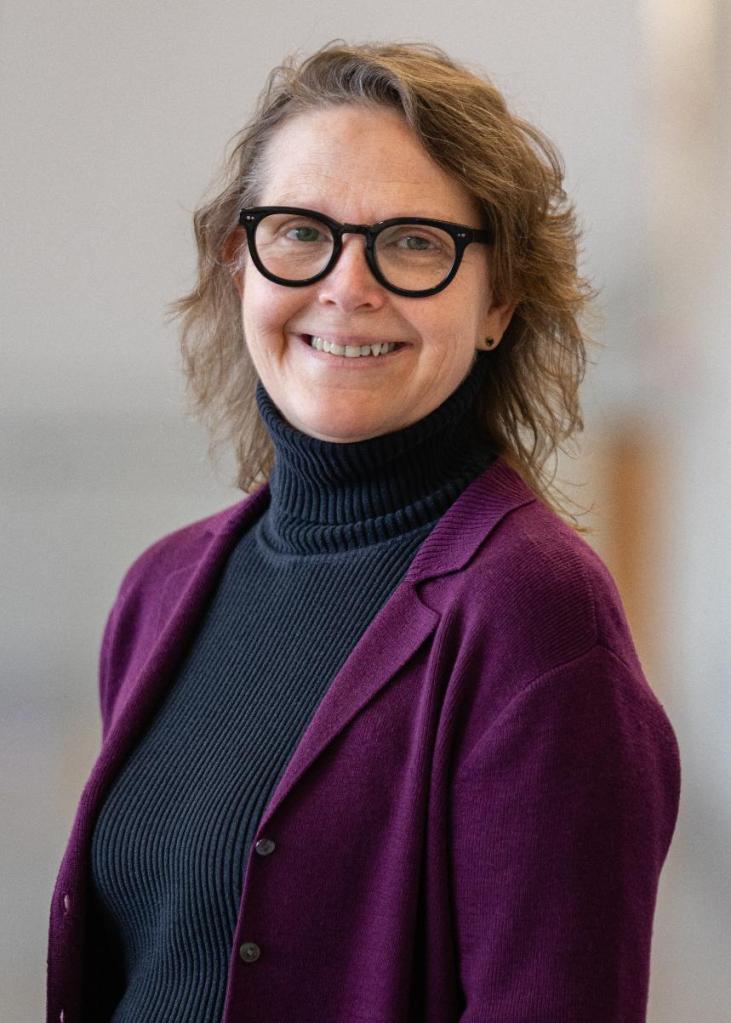
[Description of photo below: a smiling Julie looks directly into the shot. She has shortish brown hair and is wearing black-framed glasses, a black turtleneck sweater, and a purple sweater jacket. The background of the shot is blurred.]
Welcome back to Dialogues on Disability, Julie! I interviewed you back in July 2018 on the now-defunct Discrimination and Disadvantage blog. As I have said in the past, our faithful followers love to keep abreast of the lives of their favourite disabled philosophers through the interviews that the Dialogues on Disability series comprises. So, please tell us the significant (by your own standards) events that have occurred or unfolded in your life since your previous interview.
Professionally speaking, the three main events that have happened are (1) my appointment as an affiliated faculty member in the Philosophy program at the CUNY Graduate Center, (2) new administrative roles, and (3) exciting opportunities for scholarly and interdisciplinary work.
In 2019, I became a member of the graduate faculty at the CUNY Graduate Center, which is an honor that I never expected to happen. In spring of 2024, I was asked to serve as Interim Associate Dean of Arts and Humanities at Lehman. I returned to the Department of Philosophy in spring of 2026 as the Chair of the department and was subsequently asked to serve as Interim Dean of Arts and Humanities. The move into administrative roles has been a learning curve for me and has offered exciting opportunities to continue to serve Lehman and our students from a different point of view. I have been at Lehman since 1998; so, I suppose that I have dedicated my career to Lehman and its mission to serve students as well as the community in the Bronx more widely. It is a privilege to now be able to do that work in a role that can have significant influence on the institution as a whole.
I have also been privileged to work on some projects that allowed me to expand on work that I have previously done. The chapter “Disability and African Philosophy” in The Bloomsbury Guide to Philosophy of Disability (which you edited) allowed me to further develop some themes that I touched on in Making and Unmaking Disability. The chapter explores ways in which African philosophy and disability studies intersect, including by calling into question Western conceptions and definitions of disability, by exploring communalistic conceptions of personhood, and by emphasizing values that they share—values such as communalism and interdependence. The chapter also indicates some of the ways that African philosophy and activism defy values and assumptions of the Western disability movement, such as its emphasis on a dichotomy between disabled and nondisabled people.
Personally speaking, I have experienced some loss; both my parents passed away since we did the last interview. And I got older. But I have also had the privilege of continuing to see my children grow to be adults and flourish.
Julie, you founded the disability studies minor at Lehman College, CUNY, in 2012. What do you regard as the significant changes that have taken place within the field of disability studies since the establishment of your program?
These interests probably reflect my own biases, but I am excited by the work in disability studies that challenges traditional disciplines or fields. I have followed ongoing criticisms from a disability studies perspective by Jan Valle and David Connor, for instance, of special education and its dominant commitment to medical models of disability. I enjoyed Laura Mauldin and Robin Lewis Brown’s criticisms of sociology and medical sociology from a disability studies point of view.
I have been interested in new historical work—by, for example, Ninon Dubourg, Sara Scalenghe, and Pieter Verstraete—that defies assumptions about the histories of people in the West who, in today’s terminology, we would call “disabled.” I would put Coreen McGuire’s book, Measuring Difference, Numbering Normal: Setting the Standards for Disability in the Interwar Period, in this category of critical, historical work that has been influenced by disability studies. Your own work, Shelley, which continues to challenge and defy philosophy, the philosophical profession, and bioethics more particularly, I would put in that category too.
I have been excited by the increased attention to (what we in the West would call) disability in relation to specific cultural contexts, as well as to the Global South. This work challenges us to take seriously the ways in which cultural and social contexts define the experiences of people who we would regard as disabled and pay greater attention to problems that they may experience or changes that they would like to see in their own lives and societies. Since many estimates suggest that approximately 80% of disabled people live in the Global South, it is important to take seriously the local contexts in which people live and to mobilize local understandings of (what we would consider) disability, when appropriate, in any work that aims at improving the lives of disabled people.
Disability studies scholar Shaun Grech―who specializes in disability in the Global South―has pointed out that the experience of disability in the Global South is shaped by economic, social, and cultural factors that are not found in the Global North: complex livelihoods, particularly in rural areas, based on informal economic activity rather than paid employment; greater dependence on natural resources for livelihoods and a corresponding vulnerability to natural disasters; unequal land distribution as a result of colonial pasts; unreliable markets; little to no social safety nets and cultures and beliefs that emphasize social ties and close-knit communities rather than individual rights. In these contexts, the dominant strategies that have been used in the West to address problems associated with disability—medical or quasi-medical (e.g. rehabilitation) solutions, market-based solutions, civil rights strategies—seem to miss the mark.
I loved Diane Szántó’s book, Politicising Polio: Disability, Civil Society and Civic Agency in Sierra Leone, which describes the history and character of several collective dwellings or “polio homes” that were founded and run by polio-survivors in Freetown, Sierra Leone. Szántó argues that these “polio homes” defy some of the Western disability movement’s assumptions about which strategies disabled people should use in their struggles to flourish, including the assumption that collective living is disadvantageous and that integration is best achieved where disabled individuals live in a context dominated by nondisabled people. She suggests, to the contrary, that the polio homes are integrated by drawing in and supporting many nondisabled family members. Residents of the polio homes also employ members of their surrounding communities for a variety of goods and services. Collective living in the polio homes thus offers the residents of them the advantages of mutual support as well as integration.
Szántó says that the polio homes also challenge the emphasis on a distinction between disabled and nondisabled people. The needs of the residents of the polio homes are not much different from the needs of the poor, nondisabled people in the surrounding communities, she suggests, and the residents of the polio homes have a lot of interaction with nondisabled members of those communities. Hence, the Western emphasis on the dichotomy between nondisabled and disabled people may not be very useful for understanding the experiences of disabled people in Freetown’s polio homes.
The work of the philosopher Oche Onazi—whose book, An African Path to Disability Justice: Community, Relationships and Obligations draws on African philosophy to develop an account of disability justice—the work of the philosopher Elvis Imafidon, and the work of disability studies scholar Lieketseng Yvonne Ned have also both mobilized and contested African understandings of what the West would call disability. Ned is the Editor-in-chief of the open-access African Journal of Disability, and Grech is the Editor-in-chief of the open-access journal, Disability in the Global South.
As your bio in the preface to this interview indicates, you hold an affiliated professor position in the Philosophy Program at the CUNY Graduate Center, in addition to your positions at Lehman College, CUNY. Indeed, you are, essentially, the only disabled philosopher of disability in the large philosophy program at The Graduate Center. Thus, you seem ideally positioned to point out some of the ways that the relation between academic philosophy departments (and academic philosophy more generally) and disability studies as a discipline has changed in the last decade. What do you think?
Shelley, you do such a wonderful job of highlighting disabled philosophers of disability when you plan the Philosophy, Disability and Social Change conferences, the upcoming edition of which will take place online in January 2027. I have been very lucky to be at institutions that value the kind of interdisciplinary philosophical work that I do; but I am not sure that there is a lot of support for philosophy of disability or interdisciplinary work in philosophy and disability studies in most philosophy programs and departments in the United States.
I think that this neglect is such a shame. There are so many ways in which philosophy and disability studies enrich one another. To me, the field of disability studies is grounded in two main intellectual moves. The first is a shift in thinking that rejects a purely medical definition of disability in favor of thinking of disability as a social category and phenomenon. The second shift is a commitment to thinking about disability from the points of view and, in light of, the lives and experiences of disabled people. Given these shifts, philosophers are well placed to engage with disability studies, its practitioners and its texts.
A lot of work in disability studies has been concerned with how the concept of “disability” and the related concept of “impairment” have been and should be understood and defined. That is one of the things philosophers do too—think about how concepts should be defined. Disability studies examines disability as a social phenomenon, that is, how disability as a social category is practiced and enacted in various contexts and at various levels.
Philosophers should want to be part of any analysis of how social concepts or categories work and affect people’s lives at all kinds of levels—in personal lives, in interpersonal relationships, or in social roles, as well as institutional structures. As the African poet and philosopher Okot p’Bitek pointed out, culture and social institutions are philosophy that has been enacted and put into practice. To analyze culture and social institutions is therefore to tease out and illuminate a philosophy. Any philosopher who is concerned about ethics or justice should be troubled by the philosophy behind the ways in which disability has been enacted and is currently enacted and put into practice in the West.
What directions should collaborations between disability studies and philosophy take? What collaborations should be investigated and promoted?
I am often surprised by how little the core tenets of disability studies have influenced the philosophical world, which, as far as I can tell, continues to be dominated largely by a medical definition of disability. Disabled people and scholars of disability have been telling us for years to focus on the social aspects of the experience of disability, particularly social exclusion, discrimination, oppression. Philosophers are encouraged to think of concepts and categories from the point of view of eternity, rather than as historically changing results of human thought and intelligence; I worry that this bias often leads philosophers to embrace definitions of concepts that (they think) can avoid the pitfalls of the human world.
But looking at the history of the concept of disability in the West—the concept does not seem to have existed in the Middle Ages—and of how disability is understood around the world shows just how historical and culturally relative understandings of what we in the West call disability are. That should not be too surprising. Friedrich Nietzsche pointed out that concepts are like metaphors—they take different things to be the same and then forget the differences. G.W.F. Hegel suggested that the more abstract concepts become—the further away that they get from what’s “there”—the more that they come to be our own thoughts. Both “disability” and “impairment,” as concepts or categories, are highly abstract—they treat a bunch of things that are not alike at all as if they are the same and forget the differences. It should not surprise us, then, to discover that there is a lot of human fabrication and artistry, shall we say, behind these concepts. In many cultures and languages, these abstract concepts simply do not (or did not) exist.
For me, that raises a lot of interesting philosophical questions about how and why these concepts came to be and what very human social functions or purposes they have served and continue to serve. Philosophical work that touches on disability must get into the weeds and take seriously the social aspects of disability, the ways in which (what we call) disability has been and is enacted, experienced and understood, which means taking disability studies seriously. I would encourage any collaboration between philosophy and disability studies that take the latter seriously.
What projects are you working on at present?
Recently, I was privileged to be able to write the encyclopedia entry on “Conceptions and Models of Disability” for the Oxford Research Encyclopedia of Disability Studies. This piece allowed me to bring together research on rehabilitation medicine that I had started back in 2008 with years of teaching about philosophy of disability and disability studies at Lehman and CUNY’s School of Professional Studies. In teaching these classes, I introduced students to many of the conceptions and models of disability discussed in disability studies and began to develop a framework (and charts) to help students distinguish and evaluate these conceptions and models.
Because of the work that I have done on Hegel’s dialectics, I have had the opportunity to expand my interdisciplinary endeavors. Ecologist David G. Angler reached out to me to work on a paper entitled, “Dialectical Ecosystems: Theory and Applications,” that explores the advantages of applying a process ontology (as he called it) with roots in Hegelian dialectics to understand environmental systems and changes. David put together another team to produce a second article, “Embracing Process Ontology Towards a Dynamic Biogeochemistry,” that explores the use of process ontology to better manage biogeochemical processes and environmental change.
I was also invited by Sara Abdali at Microsoft to work with her and several co-authors on an article, “Self-reflecting Large Language Models: A Hegelian Dialectical Approach,” that explores using Hegelian dialectics together with a kind of social cooperation between large language models (LLMs) to improve the reasoning and self-correction abilities of LLMs. One of our co-authors, Michael Solodko, presented the paper at the MathNLP 2026: The 4th Workshop on Mathematical Natural Language Processing Conference in Budapest in October. It has been exciting to work with these teams to explore how the approach to Hegel’s dialectics that I outlined in the “Hegel’s Dialectics” entry of the Stanford Encyclopedia of Philosophy can be helpful in the work that they do.
Julie, how would you like to end this interview? Are there topics or concerns that we have not discussed that you would like to address? Would you like to recommend some books, articles, blogs, or videos that readers and listeners should explore for more information about the issues that you have addressed?
I really hope that anyone who reads this interview will be inspired to read more about philosophy of disability and disability studies. Some disability studies scholars like to say that disabled people are the largest minority group in the world; and I think we ignore the social experiences of disabled people at our own peril. Not only will most of us become disabled if we are lucky to live long enough, but disabled people are often the canaries in the coal mine, so to speak, of larger social forces: whatever is happening, happens to us first, but it is happening to everyone.
Any philosopher who wants to dive into philosophy of disability would be well advised to start with your anthology, Shelley, The Bloomsbury Guide to Philosophy of Disability. I would also recommend that people read your BIOPOLITICAL PHILOSOPHY blog on which this interview and the Dialogues on Disability series in which it is included are posted. I loved and would thus recommend philosopher Robert Chapman’s recent book, Empire of Normality: Neurodiversity and Capitalism.
In disability studies, in addition to the classic collections, someone might start with the more recent Routledge Handbook of Disability Studies or Handbook of Disability: Critical Thought and Social Change in a Globalizing World.
In general, I would encourage philosophers to get into the weeds more generally and engage in all kinds of interdisciplinary work.
Julie, thank you so much for your perceptive observations throughout this interview. Your long history of involvement with disability studies and philosophical work on disability makes you an elder and mentor in the area to whom students and faculty should reach out and should read.
Readers/listeners are invited to use the Comments section below to respond to Julie Maybee’s remarks, ask questions, and so on. Comments will be moderated. As always, although signed comments are preferred, anonymous comments may be permitted.
The entire Dialogues on Disability series is archived on BIOPOLITICAL PHILOSOPHY here.
From April 2015 to May 2021, I coordinated, edited, and produced the Dialogues on Disability series without any institutional or other financial support. A Patreon account now supports the series, enabling me to continue to create it. You can add your support for these vital interviews with disabled philosophers at the Dialogues on Disability Patreon account page here.
__________________________________
Please join me on Wednesday, December 16, 2026, for the next installment of the Dialogues on Disability series and, indeed, on every third Wednesday of each month ahead. I have a fabulous line-up of interviews planned. If you would like to nominate someone to be interviewed (self-nominations are welcomed), please feel free to write me at s.tremain@yahoo.ca. I prioritize diversity with respect to disability, class, race, gender, institutional status, nationality, culture, age, and sexuality in my selection of interviewees and my scheduling of interviews.

