Hello, I’m Shelley Tremain and I would like to welcome you to the one hundred and thirty-fourth installment of Dialogues on Disability, the series of interviews that I am conducting with disabled philosophers and post to BIOPOLITICAL PHILOSOPHY on the third Wednesday of each month. The series is designed to provide a public venue for discussion with disabled philosophers about a range of topics, including their philosophical work on disability; the place of philosophy of disability vis-à-vis the discipline and profession; their experiences of institutional discrimination and exclusion, as well as personal and structural gaslighting in philosophy in particular and in academia more generally; resistance to ableism, racism, sexism, and other apparatuses of power; accessibility; and anti-oppressive pedagogy.
The land on which I sit to conduct these interviews is the traditional ancestral territory of the Haudenosaunee and Anishinaabeg nations. The territory was the subject of the Dish with One Spoon Wampum Belt Covenant, an agreement between the Iroquois Confederacy and the Ojibwe and allied nations around the Great Lakes. As a settler, I offer these interviews with respect for and in solidarity with Indigenous peoples of so-called Canada and other settler states who, for thousands of years, have held sacred the land, water, air, and sky, as well as their inhabitants, and who, for centuries, have struggled to protect them from the ravages and degradation of colonization and expropriation.
My guest today is Kristin Rodier (she/her). Kristin is a white settler of French and German descent who lives and works on Treaty 7 territory. She specializes in interdisciplinary feminist philosophy and, increasingly, critical fat studies. Recently, she contributed an encyclopedia entry on “‘Fat’ in a philosophy/theory of disability context” to The Oxford Research Encyclopedia of Disability Studies and an encyclopedia entry on “Fat Studies” for the Encyclopedia of Phenomenology. When Kristin—the mother of a 10-year-old human and a 2-year-old dog—is not working or caregiving, she can be found swimming, cross-country skiing, hosting karaoke parties, or gardening.
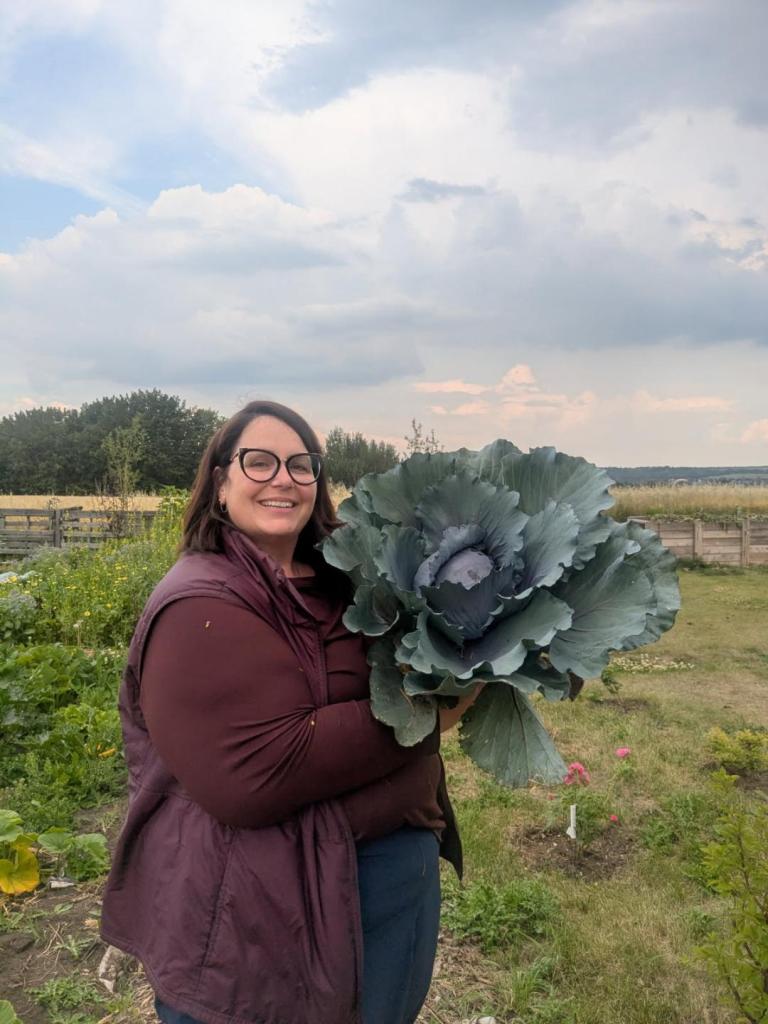
[Description of photo below: Kristin, who is a fat white woman with dark shoulder length hair and black rimmed glasses, smiles proudly as she holds a tremendous purple cabbage that she grew. She is under a moody prairie sky. A green field fills the background of the shot.]
Welcome back to Dialogues on Disability, Kristin! I interviewed you in March 2023. I know that important events have taken place for you since then. Please bring us up to date on what has happened in your professional life and otherwise.
Since my last interview, I was tenured and promoted to Associate Professor of Philosophy, started podcasting with Anna Mudde, and published a co-authored open access textbook on critical thinking with my late mentor, Eric Dayton. I also began to write more with my close friend, Cindy Baker, whose artistic practice inspires and informs a lot of my writing. We are part of a fat collective in what is colonially known as Edmonton, Alberta. In addition, I have become an active member of the editorial collective for Excessive Bodies: A Journal of Artistic and Critical Fat Praxis and Worldmaking. Baker and Fairytale II (the horse) are the cover models for our special issue on critical fat phenomenologies (2025).
In my previous interview, I explained that before I got the tenure-track job at Athabasca University, I had a part time union position there tutoring cultural studies and women’s and gender studies (WGS). This position came with excellent benefits including for tuition, which I used to take courses towards a Master’s of Distance Education. These courses, and working in writing and learning support, were crucial in securing my tenure-track philosophy position in the Department of Humanities at Athabasca.
Athabasca is an online university where we have a lot of access and flexibility that supports many of my accessibility needs without them having to be formalized. Because my work is only online, however, most of my ongoing communications with colleagues is done over email. So, I am beginning to understand how digital communication can facilitate negative affect in unproductive ways. I am more and more attuned to small slights, mischaracterizations, and weaponized business-speak that enact exclusions. If you know what an extrovert that I am, you will likely understand that it is a bit of a nightmare that email shapes my daily activities. I am more aware of how this particular form of communication carries with it specific formalities and codes that support individualistic and dehumanizing relationalities. Now that I am doing more work in publishing, small processes consume more and more of my time, corresponding with editors, and the dreaded Open Journal System (OJS) auto-generated emails a plenty.
Kristin, please tell us about your writing in feminist philosophy and critical fat studies and in particular why you understand it as interdisciplinary in character.
I am formally trained as a philosopher in the ways in which we recognize in the discipline: Course work, program, supervisor, comprehensive exams, and teacher training. Yet I have also taught widely in WGS for more than ten years.
Unfortunately, as a student, the only course that I took in WGS was Introduction to Gender Studies in my last year of undergrad. I avoided WGS in part because some of my philosophy mentors told me that “feelings talk” dominates WGS classes. Although I did not necessarily believe them, I wanted to avoid their ire. By my fourth year, I had been exposed to enough feminist philosophy that I hurried to take a course in WGS before I graduated. I think that I wrote an essay for the course on power-suits and “lipstick feminism,” whatever that is!
In my previous interview, I told the story about how feminist philosophizing about gender was not capturing my experience in a fat disabled body—sometimes I have used the term non-normative fat body, but I’m not just a body. My differences are bodymind. I think that the version of the story that I wrote in this interview tells the story of how training and mentorship in interdisciplinary WGS helped me navigate a way through that. It’s where I connected more with activism and creative resistance.
By the second year of my Ph.D., I started to work in WGS with Michelle Meagher at the University of Alberta, who generously mentored me into teaching WGS, especially representations of women and girls, including advertising, film, dolls, labour, food, history of feminist thought, and body politics. I feel as if I studied philosophy but did an apprenticeship with Michelle in WGS. She taught me to analyze material cultures, media, and artistic practices. If it was not for this fortunate happenstance, I would not be writing about fat in television, textbooks, and artistic practices, which has led me to my work with Cindy Baker.
Michelle’s article, “Jenny Saville and a Feminist Aesthetics of Disgust,” constitutes my first exposure to a philosophical exploration of a feminist artist’s practice and to a positive/neutral feminist philosophical discussion of fat. Rather than ask what disgust is, when it is good, bad or otherwise, the article picked apart the function of disgust and the experiential dimensions of engaging with the art that evokes it. This article continues to inspire how I critically approach material culture and representations.
I coauthored an article with Michelle, which is my second-most-cited work, my most cited article being a qualitative research paper that I cowrote on academic integrity. The article that I coauthored with Michelle analyzes the role of temporality in figurations of agential “self-care” that function to blame victims of sexual assault, examined through the media attention and reportage about the public abuse of Rihanna by Chris Brown.
Learning to write that genre with Michelle enabled me to develop my most recent peer-reviewed journal article, “See Jane Die: Postfeminist Lessons in Drop Dead Diva, which brings together many areas of my thinking. I talk about body switching and mind/body dualism, how stories teach moral lessons about what certain bodies “deserve,” and how normative femininity is preserved through the incorporation of more “normal” types of fat bodies. The first time that I saw the Drop Dead Diva episode in which a fat discrimination case is explored in terms of the Americans with Disabilities Act, I knew that I was going to write about it.
One of the topics that I discuss in this recent article is how I failed to be affected in the “right way” by a seemingly body-positive text. There’s a lot of mixed methodology in the paper. The political aspect of the argument is that the show beckons the figure of the plus-sized-fat-white-woman-power-lawyer only to collapse into notions that fat people are lazy, sloppy, and unhealthy; and it does so with a supernatural twist! One theme that conjoins fat and disability in my work is critical of forms of feminism that centre women’s “fitness” for powerful social positions, leaving extant structures such as ableism and racialized fatphobia intact.
What you do not see on my Google scholar or CV is the number of times that this most recent paper and many others bounced around before finding a home. I recently had a paper rejected; I am licking my wounds over the reviewer feedback that I received on it, especially given that disability was the theme of the special issue of the gender studies journal to which I had submitted it. Unfortunately, interdisciplinary is not a ticket to an easier publishing experience for me. I remain thrilled and a bit shocked when I am included in an edition of the Philosophy, Disability, and Social Change conference and other related projects. The support means a lot to me. Venues such as the conference series and this interview series make more work in the area possible.
So, in sum, I describe myself as an interdisciplinary feminist philosopher because I think that doing so most faithfully reflects how my training has been expressed in my work. My favourite Judith Butler quotation is that “moral critique has to become social critique if it is to know its object and act upon it” If that is good enough for Judith Butler, then it is good enough for me.
You have indicated to me that you are increasingly called upon to review articles on fat for philosophy journals and collections, although you continue to encounter difficulty getting your own work on fat published. To what do you attribute these difficulties? Are they related to the exclusion of critical philosophical work on disability and disabled philosophers more broadly?
I think so, especially when the work is meta-critical. My work is not well-bounded in philosophy, so I often must do extra work to explicate its value. I think there are several areas of difficulty, including publishing practices and normative forms of writing and expression. But I think that things are improving; there is enough published work now that the area has become established, making it harder to ignore. Important interdisciplinary work in Critical Disability Studies is resonating in philosophy thanks to volumes like The Bloomsbury Guide to the Philosophy of Disability. No such similar volume exists in relation to fat and philosophy.
My work tries to avoid separating fat and disability and then having to argue them back together—a kind of additive analysis. When theorizing from the direction I do—which is from the structures and practices that uphold and privilege a healthy normal body while disciplining, marginalizing and oppressing the “abnormal” body—fat and disability are inseparable. In practice, fat hatred is a form of regulation that is quite flexible, adaptable, and durable because of how we all have fat tissue in various forms and we all could be fatter, just as we all could become disabled.
In philosophy especially, fat calls up the body of a rational agent: How are they making decisions? What kind of self are they? And also, what kind of person gets to be a philosopher? Where the body is evidence of a less-than-ideal rationality, there’s a double reason to not include fat people in the professorial ranks. For these reasons, I am so fascinated by and cannot wait to read the new works by Talia Mae Bettcher and Ladelle McWhorter, both of which undermine and challenge historical and normative notions of personhood (they are next up in my reading list!). These philosophers inspire me because even very critical approaches to philosophy can use its tools to undermine problematic notions that are taken for granted, which I think speaks to the value of remaining in philosophy and changing it.
But, yes, as you say, I have been getting a lot of requests to review papers on fatness for philosophy journals. Going from maybe one request a year to one request a month. I was recently asked to speak at a circus arts festival about the fat body; so, the requests for my expertise aren’t all bad!! Fat is getting a lot of attention in philosophy because of hard work by fat studies scholars and activists. Yet it probably goes without saying that everyone is in a frenzy over GLP-1s. Much of my thinking about GLP-1s is captured in a Philosophy, Disability, and Social Change conference presentation that I published on BIOPOLITICAL PHILOSOPHY in December 2024.
More and more higher profile philosophers are wondering about and writing about fatness, drawing on, but not always citing, work done by scholars and activists in fat studies. For those of us who have been thinking and studying this topic for a while, it is like watching people with limited experiential and community basis get quite comfortable a little too quickly talking about fatness. I guess that is one thing: If philosophizing about fat is easy, then you might be doing it wrong! I’m half joking, but behind the scenes, the careful and painstaking progression on these topics has been up against massive pushback and personal and professional risk for decades.
Philosophers are just people in the world and people in the world are obsessing over GLP-1s. Ozempic is amplifying many of the problems that you have pointed out, Shelley, with respect to feminist bioethics. It is mostly women taking GLP-1s and mostly for weight loss; so you can see why they are drawing feminist attention. In this case, we need to start talking about how feminism deploys ableism, as well as nationalism, in calls for self-empowerment, self-care, and even loving our bodies—these calls are often about being better mothers, less of a “burden” on others, and other eugenic public health goals.
It is disheartening to see philosophers talk extremely openly about fatphobia without the liberatory critique that questions the foundations of what it means to have a “good” or “normal” body. A lot of the moral approach boils down to “fatphobia makes us unhealthy, so it’s bad.” For me, this approach misses the point of undermining eugenic bodily hierarchies. Even the openness to debate GLP-1s as if they are some kind of gamechanger is totally exhausting; for those of us with bodies that are highly surveilled by BMI/medicine apparatus, GLP-1s are merely one of many in a long line of technologies to eradicate fatness. Forms of medical management change, and in one respect—and I hope that readers and listeners can see where I’m coming from—GLP-1s are some of the least invasive techniques that someone my age and in my demographic would have had recommended to them (or forced upon them). And I think this explains their widespread interest and adoption.
There was a “first wave” of philosophical concern around Ozempic shortages, since the wider spread use of them primarily for weight loss caused shortages for people who use them primarily for diabetes management. GLP-1s are not without drawbacks, as with any pharmaceutical, but many who have diabetes—of different sizes—see important improvements in management. Thus, we have issues of distributive justice around availability for those who “really need” them within a bioethics framework of access. I am more interested in the lengths to which non-diabetes management users will go to access them (lots of unsafe practices and high costs). The message is that thinness for elites is an acceptable reason for creating shortages for people who use them for diabetes management.
Another “wave” of concern is that philosophers are now contemplating Ozempic’s morality. I recently saw this ethics bowl question (which is not the first and won’t be the last): “is it morally permissible for people to take Ozempic for purely aesthetic reasons?” Now we are back to fat hypotheticals, bracketing health and examining “reasons”. I am not surprised by this since my earlier writing with Samantha Brennan identifies an important part of philosophical fatphobia as about whether fat people are competent decision makers–not the least of which is because they cannot do math, i.e., calories in v. calories out. Now, more than ever, fat people are irrational because their “smart choice” is to take Ozempic: the cure is right in front of you! It is a nightmare thought, but imagine an ethics bowl question that fosters debate about the morality of coerced bariatric surgery. This practice directly exposes fat life to tremendous risk and is largely seen as a non-problem.
Kristin, you are, as you have said, an active member of the editorial board of Excessive Bodies (EB), an open access journal of critical fat praxis and worldmaking. What sorts of topics does the content of the journal address? What genres does the writing in the journal encompass? And why is it important to support the existence of the journal?
At the end of my previous interview, I talked a lot about fat resistance, joy, activism, and community care. At the time, I was not very connected with EB, mostly admiring it from afar. Since then, I have joined the editorial collective at EB and I am learning from especially Ramanpreet Bahra and Kelsey Ionnani. My research practices have shifted towards trying to produce sites where fat resistance work is made visible within caring conditions. We have so much power to shape the process of publishing for each other and to define scholarship of value for ourselves, especially in open-access venues like BIOPOLITICAL PHILOSOPHY, which I take to be an exemplar for justice-oriented public scholarship. I know the EB crew reads this blog!
Writing the introduction to the most recent edition of EB was challenging. Crafting the issue took place during the absolute proliferation of GLP-1 use for weight loss. We published the issue in what seemed like another world than the one in which we began it. Surviving and thriving amidst such ableism and racialized fatphobia in academia and in the world more generally requires that we at EB not only write about care, but also enact it, that is, that we enact care for our authors and each other as we go through the editorial practices that can often be sites of harm. We spent considerable time working with authors on multiple drafts and drawing out creative insights. The final product, I think, is an archive of resourcefulness, invention, and resistance.
This journal is a dream come true to me. That the editors have embraced me and my work and that I have a job that allows me to dedicate time to help authors and artists create work at this intersection blows my mind. Publishing is an important place for creating more just working conditions. Whether we get publications and where we get them affects much of our job prospects, career pathways, and the larger “reputational market” of academia. Academic publishing enacts structures that protect and promote ableism in terms of who receives and enacts feedback properly and who corresponds with a journal properly. Given that processes can rarely be anonymized, the reputational market tends to reiterate itself, giving more accomplished and well-known scholars more chances and more leeway. Many of the editors and authors at EB are early career and graduate students.
I care deeply about EB because writing is very difficult for me. I have struggled with actioning feedback and finding a place for my writing. When neurodifferences come into the picture, the kind of feedback, the actionability, and specificity are very important. I have now written two papers on how to give better feedback on writing in philosophy, not because I think that philosophers are mean—though they sure can be—but rather because supporting disabled philosophers and those with oppositional consciousnesses is very important to me. Living in oppressive conditions already affects who gets to thrive in academia; receiving a lot of negative and unhelpful feedback, especially about something you care deeply about, just compounds these difficulties.
A paper that I wrote with two writing centre colleagues in which we talk about how philosophers can improve their feedback techniques on student assignments was published last year. I failed to warn my coauthors that the reviewer comments could be next level compared to the harsh comments that they have seen on philosophy student papers. One reviewer condemned the writing-centre perspective, which specifically advocates on behalf of marginalized students. In the paper, we wrote, for instance, that, as people who have worked at writing centres, we have, between us, helped enough students—maybe thousands between us—to know that they find philosophy feedback especially challenging. The reviewers made it seem as if our experience was not real because it was not based on an empirical study. (No empirical study exists about how philosophy students experience feedback.) I think what triggered the gaslighting response is this: we argued that philosophers should listen to writing centre scholars especially because they disproportionately support marginalized students, including disabled students, and because these exclusions can be traced back in part to feedback styles.
Kristin, please tell our readers and listeners about your podcasting and efforts to expand the ways in which philosophy is done.
For me, one of the most difficult and sorest aspects of the profession has been getting published. My research requirements are more flexible than they would be at a more research-intensive institution; so, I am trying to push for more open and public scholarship. If not for yearly evaluation and job markets, who are we publishing for and why? Especially when that publishing is often behind paywalls, etc.
To try to lessen my work isolation, I have reached out to feminist philosophers with whom I wanted to work. I always loved Anna Mudde’s work and, over the years, we had met at several conferences. I asked her if we could read a book and talk about it over Zoom. We ended up co-writing a review on Talia Welsh’s book Feminist Existentialism, Biopolitics, and Critical Phenomenology in a Time of Bad Health (2021). Welsh’s book and our review are both open access. In 2024, I also received a call for an academic podcasting school at Simon Fraser University, hosted by the Amplify Podcast Network. Amplify has published an open access guide for academic podcast development and production if anyone wants to start a podcast! I jumped at this opportunity because I was very interested in alternative ways of doing philosophy that would create a collaborative venue for public feminist philosophy but also because I believed that doing so would help me with my isolation. While at podcasting school, I texted Anna continuously, realizing she was as interested in it as me. So, we co-developed a theme, structure, tagline, imagined audience, tone, etc. and launched a trailer. Our thinking bodies podcast was born.
It has been slow going, but we have seen tremendous growth in the last year. The scholars behind Amplify have continued to be so supportive of me personally and huge champions of thinking bodies. Hannah MacGregor and Stacey Copeland recently interviewed me about thinking bodies for their Amplify audio blog. They repeatedly remind me that there is an appetite for public feminist philosophy! Theory nerds abound!
During the design of the pod, we thought about how crafting a collaborative feminist philosophy podcast addresses problems of homogeneity in the discipline broadly and in philosophy podcasting in particular. A lot of what already exists is multi-episode, in-depth features on historical figures in the philosophy canon, dominated by white, able-bodied cishetmales who reflect the field. In tone and format, there are a lot of philosophy podcasts that read as if they are an academic paper, making them hard to follow, even for disciplinary insiders.
What I have learned is that podcasting is really hard! Picking a topic, scripting, bringing in collaborators, recording, editing, audio production, (listening to yourself over and over!) then all the distribution online is a lot of work. Recording is a new phenomenological experience too: minding a script, the audio and mic levels, pacing and anticipating, responding, and so on. Anna and I take turns editing the multi-track audio: moving between clips, our tracks, music, sound effects, and taking out weird noises and do-overs. We learned all of this from scratch! We also produce a descriptive transcript, trying to describe the audio and tone, not just the words.
One reason that I like podcasting so much is that it preserves what I like about doing philosophy, which is digging into ideas and concepts with generous others and following trains of thought to see what happens. But–this makes editing hard! If we scripted it tightly, editing would be a breeze. Philosophy podcasts released regularly are highly scripted and have teams of people working in the background.
Our podcast is more process oriented. We want to provide contributors with podcasting experience, involving them as much as they are comfortable. We are planning a second episode this summer with Corinne Lajoie as a guest producer on Rosemarie Garland Thomson’s “Misfits: A Feminist Materialist Disability Concept” (2011). As guest producer, Corinne is involved at every stage, gathering contributors, scripting, listening to audio drafts, transcription, etc. We want to provide a place for others to get scholarly podcasting experience without all the start up costs and the effort to learn audio production.
Kristin, how would you like to end this interview? Are there topics or concerns that we have not discussed that you would like to address? Would you like to recommend some books, articles, blogs, or videos that readers and listeners should explore for more information about the issues that you have addressed?
Recently, I have been reading Judith Butler’s Who’s Afraid of Gender? and Megan Burke’s Becoming a Woman: Simone de Beauvoir and the Politics of Transexistence. I am working through Sophie Lewis’ Enemy Feminisms, which is a radical rereading of western feminist activism. These readings are the result of conversations stemming from a conference that Anna and I attended last year, namely, the hybrid Thinking Trans/Trans Thinking conference in Easton Pennsylvania, hosted by Amy Marvin at Lafayette College. We released these conversations through the podcast, allowing for another mode of participation for people who could not attend. Academic conferences are so fraught and inaccessible–online/hybrid options for participation should be the norm. These conversations and the political turns of the last few years have underscored for me how important it is that feminism reckons with its tacit and explicit transexclusionary proponents. So many good reading recommendations come out of the podcast conversations; we capture them all in show notes.
A longstanding theme in my work has been how some tools and techniques of feminism shape and reinforce exclusions, including how we tell stories about feminist histories and public figures and thinkers. Clare Hemmings’s Why Stories Matter: The Political Grammar of Feminist Thinking is something that I come back to again and again. One huge takeaway from Hemmings, for me, is that to critique is not to overcome; that notion itself constitutes a progress narrative that enables and reinforces exclusions. Critical distance is not itself freeing from pernicious assumptions and practices. Burke’s book is a fascinating study of how feminist criticality in relation to a “star figure” in stories about feminism is not a mere intellectual exercise but takes place within a contemporary milieu and can be easily weaponized.
Some of my earlier work tried to explicate the mismatch between how we understand or know ourselves and how we are constituted through oppressions. I wanted to resist paradigms of self-transformation that centre transformational epiphanies or a reductive politics of refusal, so I centred on the ways that habits change over time and require structural and relational supports. In retrospect, I was unhappy with resistance stories that led to feelings of failure for those who hold a liberatory politics, but their habits still reflect oppressions. Oppression is designed for individualization and self-blaming, among other things.
The relation between blame and self-narration comes up in many venues, but recently I was struck by the controversy and backlash to the new book from writer and fat feminist activist Lindy West. I will admit that I did my own research into the controversy because I’m a nosy bitch who loves a deep dive. West—the title of whose latest book is sanist—is a big target in the feminist and fat activist space: she is loud, unapologetic, white, and from a privileged background in Seattle. Her previous works performed a very Fully Liberated Fatty, and she derived significant professional success from this.
Her new book reveals a lot of vulnerability and instability about the self-narrative that she previously wrote. Most of this revelation centered on bad behaviour from her partner; in the new book, she reveals that she had previously covered over a lot, including that she has a much more ambivalent relationship to her body than she indicated. The backlash has functioned on some perfectionistic standards, owing in part to this idea that West must always represent The Movement. Unfortunately, the backlash, even from fans and feminists, has the flavour of enjoyment because it is a public witnessing of a “fat downfall.” As Chris Farley famously said, “everybody loves to see fatty fall down.”
I think that feminism is especially implicated here by requiring fat people to be brazen about their fat pride so as to inspire women to feel good in their bodies. I have written about this phenomenon under the term “fatspiration.” These moves towards morally purging the bad fatties work well with the ways in which fatness is threatening to the social order of good bodies, which is always unstable. Not only do we need to broaden the scope of who is taken to be speaking for fat politics, I think that we all need to step back and let people be complex and flawed.
Devon Price recently published a phenomenal piece on West’s book. For Price, much of the backlash arises because writing is performative, aspirational, and geared into capitalist publication machines that churn out memoirs, demanding that writers perform triumphant refusals. West’s new book doesn’t do that. Price writes: “The real story, as fragmented and multivalent as it is, is far more interesting, and it makes me feel that, as a sometimes self-hating Autistic trans person, I haven’t been doing anything deceptive by being proudly defiant in my writing. Like West, I was playing a necessary role, and rounding up my desire to be courageous into a version of me that might help readers actually get there. But it is not a failure of fat liberatory politics or neurodiversity or queer rights to admit that it’s damn hard to be that person all the time.”
In my own work going forward, I am trying to strike this balance, that is, of holding a proudly defiant politics while carrying vulnerability and ambiguity. I am trying to move from critique of resistance practices to more messy work that enacts, experiments, and creates sites for liberatory ways of being; and perhaps of doing philosophy.
Kristin, thank you so much for your delightful and insightful remarks throughout this interview. I am so happy that you shared your important political thoughts with us again.
Readers/listeners are invited to use the Comments section below to respond to remarks, ask questions, and so on. Comments will be moderated. As always, although signed comments are preferred, anonymous comments may be permitted.
The entire Dialogues on Disability series is archived on BIOPOLITICAL PHILOSOPHY here.
From April 2015 to May 2021, I coordinated, edited, and produced the Dialogues on Disability series without any institutional or other financial support. A Patreon account now supports the series, enabling me to continue to create it. You can add your support for these vital interviews with disabled philosophers at the Dialogues on Disability Patreon account page here.
__________________________________
Please join me again on Wednesday, June 17, 2026, for the next installment of the Dialogues on Disability series and, indeed, on every third Wednesday of each month ahead. I have a fabulous line-up of interviews planned. If you would like to nominate someone to be interviewed (self-nominations are welcomed), please feel free to write me at s.tremain@yahoo.ca. I prioritize diversity with respect to disability, class, race, gender, institutional status, nationality, culture, age, and sexuality in my selection of interviewees and my scheduling of interviews.

