Hello, I’m Shelley Tremain and I would like to welcome you to the one hundred and thirty-fifth installment of Dialogues on Disability, the series of interviews that I am conducting with disabled philosophers and post to BIOPOLITICAL PHILOSOPHY on the third Wednesday of each month. The series is designed to provide a public venue for discussion with disabled philosophers about a range of topics, including their philosophical work on disability; the place of philosophy of disability vis-à-vis the discipline and profession; their experiences of institutional discrimination and exclusion, as well as personal and structural gaslighting in philosophy in particular and in academia more generally; resistance to ableism, racism, sexism, and other apparatuses of power; accessibility; and anti-oppressive pedagogy.
The land on which I sit to conduct these interviews is the traditional ancestral territory of the Haudenosaunee and Anishinaabeg nations. The territory was the subject of the Dish with One Spoon Wampum Belt Covenant, an agreement between the Iroquois Confederacy and the Ojibwe and allied nations around the Great Lakes. As a settler, I offer these interviews with respect for and in solidarity with Indigenous peoples of so-called Canada and other settler states who, for thousands of years, have held sacred the land, water, air, and sky, as well as their inhabitants, and who, for centuries, have struggled to protect them from the ravages and degradation of colonization and expropriation.
My guest today is Abigail Gosselin. Abigail is a professor in the Department of Philosophy, Politics, Economics, and Law at Regis University in Denver, USA. She has published five books and numerous papers, mostly on ethical and justice issues related to mental illness and mental health.
CAUTION: This Dialogues on Disability interview includes discussion of suicide and suicidality.
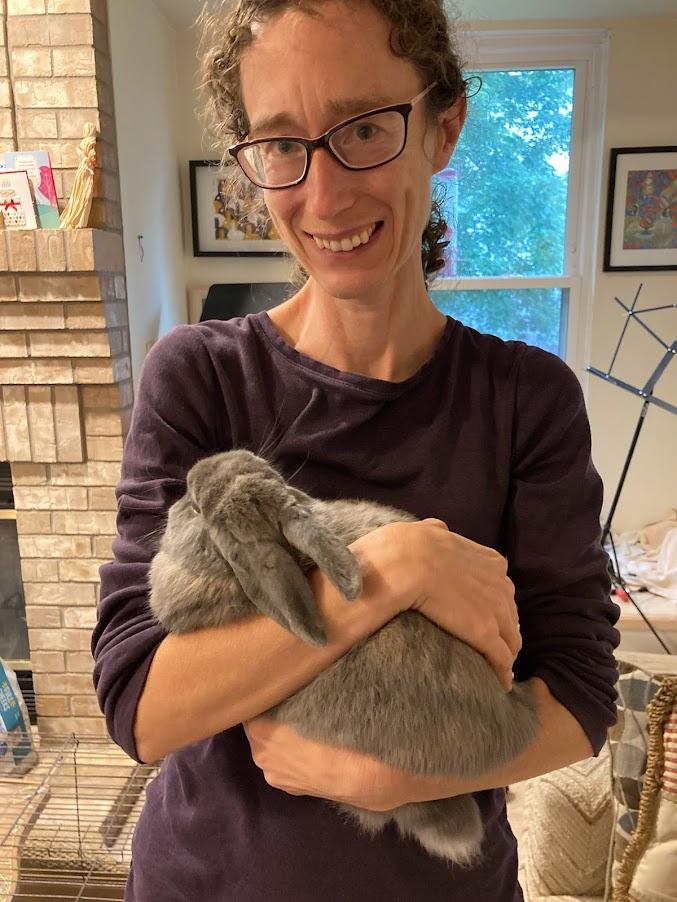
[Description of photo below: a smiling Abigail, who has glasses and curly hair, stands holding one of her furry grey rabbit friends in her arms. Leaves on a tree can be seen through a large window in the background of the shot, as well as a music stand, and framed art.]
Welcome back to Dialogues on Disability, Abigail! I interviewed you in September 2022. Our readers/listeners love to be given updates on the disabled philosophers that they come to know through the various interviews of the series. So, please bring us up to date on what has happened in your professional life and otherwise.
Since 2022, I have published three books: Mental Patient: Psychiatric Ethics from a Patient’s Perspective; Mental Health Resilience: The Social Context of Coping with Mental Illness; and most recently, Mental Illness Stigma and the Moral and Social Community. I have also written drafts of two additional manuscripts, Self-Care in the Face of Stigma and Well-Being in the Midst of Psychosis.
My job at Regis University, a Jesuit Catholic university in Denver, has been in turmoil the past few years. Last year, my philosophy department got merged with three other departments to become the Philosophy, Politics, Economics, and Law Department. Next year, we will merge with other departments to become a division. These structural changes are being made in order to provide more efficiency in our offerings to students as well as to give cover for faculty layoffs. Luckily, so far, I have not been one of the affected faculty members who were laid off. However, it has been a very stressful and anxious time at Regis for the past couple of years.
Although the university is in a state of upheaval, my department has been a zone of security and support for me. I am privileged to work with amazing and kind colleagues, all of whom are focused on the common good and student success. My department members are extremely supportive of my research and writing, as well as of my well-being, which is very helpful in sustaining my work as a professional philosopher.
In the 2022 interview, I talked about suffering from psychosis for a two-year period in my early 40s. That was, now, almost 10 years ago. Thanks to excellent medication and therapy, I have been mostly stable. There have been times when I was on the verge of psychosis, but I was able to move on from that state without completely decompensating. I have, however, suffered from anxiety and depression at times, especially in relation to job insecurity with the restructuring happening at Regis. I recognize that these are primarily situational occurrences, so I do my best to cope with them and go on with my life and my work despite living in so much uncertainty.
Abigail, as your previous remarks demonstrate, you are an incredibly prolific writer, having written six books on topics such as mental distress, stigma of psychiatrized people, and disabled people’s perspective on mental illness. Let’s talk about some of them. First, tell us about your most recently published book, Mental Illness Stigma and the Moral and Social Community, what motivated you to write it, what readers/listeners can expect to find in it, how they will be challenged by it, and so on.
Mental Illness Stigma and the Moral and Social Community analyzes the harms and injustices caused by mental-illness stigma, both public stigma that comes from other people and internalized stigma that persons project onto themselves. While there is more attention paid to mental health than in the past, and more resources directed toward addressing mental health issues, stigma remains a pervasive problem for individuals who have mental illness. I was motivated to write this book by an awareness of how deeply a problem mental-illness stigma is, despite the greater attention and resources directed toward mental illness.
In part, stigma remains a major problem because negative stereotypes about mental illness continuously circulate within American culture. Even if particular individuals do not endorse these stereotypes, they are always aware of them and always react in some way to them when they interact with people who have mental illness. Sometimes, they act in ways that reflect implicit bias based on these negative stereotypes; sometimes, they actively repudiate these stereotypes. Nevertheless, they are interacting with an awareness of the existence of these stereotypes, which shapes what they think and feel and how they act toward people with mental illness.
People who have mental illness themselves are equally aware of these negative stereotypes: they may either internalize these stereotypes by projecting stigma onto themselves, or they may actively try to resist them. Internalized stigma can lead to many harms, including negative self-regarding attitudes, social withdrawal and isolation, the creation of adaptive preferences that limit a person’s options, increased mental health problems like depression and anxiety, and suicidality. Even when people with mental illness try to resist negative stereotypes, however, they modify their behavior in reaction to these stereotypes. Negative stereotypes have great power in shaping people’s thoughts, feelings, and behavior, regardless of whether they are endorsed or not.
This book, that is, Mental Illness Stigma and the Moral and Social Community, analyzes the many harms and injustices caused by both public stigma and internalized stigma, including prejudice, discrimination, social exclusion, epistemic injustices, and microaggressions. The last chapter proposes some ways that stigma can be addressed, including through education, the sharing of first-person stories, and changing social values so that some of the traits associated with mental illness—such as neediness, dependency, difficulty with functioning, and lack of competence—are no longer regarded negatively, but can instead be regarded as valuable ways of being in the world. Addressing mental illness stigma requires humanizing and valuing people who have mental illness, recognizing that they have something valuable to contribute to society, and that they are worthy of engagement and interaction.
Now tell us about your books that are currently in the works, namely, Self-Care in the Face of Stigma and Well-Being in the Midst of Psychosis. What motivated you to write these books, Abigail, and what will we find in them?
A few years ago, that is, after writing my book examining the conditions that enable resilience to mental-health issues, Mental Health Resilience, I started to become interested in the topic of self-care as a philosophical issue. I started to do research for a new book on the topic of self-care, but then put it away because I felt more compelled to write about mental-illness stigma. After I finished my book on mental illness stigma, I wanted to go back to thinking about self-care. Since I had spent a lot of time researching and thinking about stigma, I decided to merge these two topics by considering how stigma interferes with the conditions of self-care; doing so, spurred me to write this book.
Self-Care in the Face of Stigma examines the way that stigma interferes with the conditions of self-care, making self-care very difficult for people who are subject to stigma. I analyze self-care as a social-justice issue, where enabling self-care requires addressing the harms and injustices involved with stigma. I look at how stigma undermines five conditions of self-care, including: epistemic conditions required to determine what is in one’s interests and hence develop goals for oneself; agency conditions that must be met to engage in intentional action to carry out one’s intentions; psychological conditions for sufficient self-respect and self-worth to think that one’s interests are worth pursuing; structural conditions of helping people to get their needs met, removing obstacles and constraints, and increasing their options and possibilities; and social conditions of welcoming and including people.
I regard self-care as a form of care and take a neo-Aristotelian approach to analyzing self-care in terms of the activation and exercise of certain virtues. These virtues include personal virtues that individuals direct toward themselves and social and institutional virtues that are directed toward individuals participating in their own self-care, the latter of which other people and social institutions must exercise to create the conditions that enable a person to engage in self-care. With these virtues, people can engage in self-caring activities that further their interests and promote their well-being and flourishing.
Well-Being in the Midst of Psychosis arose from the years that I have spent thinking and writing about resilience and self-care in a mental-health context. I was interested in researching the philosophical literature on well-being (of which there is a vast amount) and wanted to develop a theory of well-being that is more inclusive of people with severe psychiatric and cognitive disabilities, who, on many accounts, are believed to lack well-being because they (it is claimed) lack the rational and autonomy capacities required for well-being and have little agency. I think this is an unfair assessment of the lives of many people who have severe psychiatric and cognitive disabilities. Many people with all kinds of disabilities evaluate themselves as having a good quality of life and can thrive–including people with severe psychiatric and cognitive disabilities.
This book argues that people who have psychotic illness—that is, people who are often thought to not have much well-being due to their illness—nonetheless have some measure of well-being if and when well-being is understood as engaging with what one values through the exercise of characteristically human capacities. One can find evidence that this is so when one reads memoirs of people with psychotic illness, who report having many things of value in their lives that they see as good for them and that contribute to their well-being. In short, this book draws on people’s self-reports of what they find valuable and conducive to their well-being as a basis to develop an inclusive theory of well-being, a theory that recognizes the well-being of people who have severe functional limitations brought about by disability.
My account of well-being is contextual and hybrid, incorporating both subjectivist elements of subjective valuation and objectivist elements of exercising human capacities. Unlike typical theories of well-being, however, my account is process-oriented rather than end-oriented, where well-being consists of engaging in (1) the process of pursuing what one values rather than attaining the ends or goods that are valued; and (2) the process of exercising characteristically human capacities rather than striving for some ideal of perfecting one’s human nature.
Nearly everyone can exercise some human capacities in some areas of their life. Furthermore, everyone has a vested interest in valuing and engaging with goods that they see as good for themselves in creating a life of meaning. While goods can have either subjective or objective value or both, all goods are contextual in that whether and how they apply to an individual depends on the individual’s particular circumstances; thus, it is up to the individual to determine how goods apply to them in their lives. This account of well-being is more inclusive of and just toward people with psychiatric disabilities such as psychotic illness than most other accounts of well-being.
Given that you have written a succession of books on a cluster of related themes, how would you describe the development of this sequence? How (if at all) has your thinking on these topics shifted or been transformed from the first book to the most recent, either because of personal or social events or even the process of writing itself?
I first wrote Humanizing Mental Illness: Enhancing Agency through Social Interaction as a way of organizing some ideas that I had had for quite a long time about what is required for agency and how agency can be fostered. My focus was on the agency of people with mental illness because a lot of my thinking about this topic stemmed from my own mental-illness experience. I had been reflecting on how the agency of people with mental illness is truncated in different ways and for different reasons, many of which had to do with a person’s social environment and how they are treated by other people in society.
This thinking led me to develop ideas about how, through the ways that we interact with people with mental illness, we can increase their agency so that they have possibilities and options available to them. Increasing the agency of people with mental illness involves more frequent and better-quality interaction with them, interaction in supportive, inclusive, and welcoming ways that value them and treat them as a whole person, not just an illness. I frame this interpersonal interaction in terms of exercising virtues and detail several epistemic and moral virtues that a person should have when interacting with someone with mental illness to foster this agency.
My next book, Mental Patient: Psychiatric Ethics from a Patient’s Perspective, was written as a way of trying to make sense of my experiences during a long period of psychosis and intermittent suicidality. The book focuses on my experiences with treatment, including a week-long stay in a psychiatric hospital and participation in an intensive outpatient program, and gives an analysis of various issues that arise in psychiatric ethics during treatment and recovery.
Some of the issues that I examine include: the importance of fostering autonomy in patients the adoption of the sick role as a patient; the trust and empathy required for a positive therapeutic relationship between patient and mental health clinician; various epistemic injustices that arise during treatment; the use of personal narratives as a way of trying to understand one’s experience; and the importance of making choices in the process of recovery, including choices to participate in treatment and to show up each day doing what one has to do. The book highlights the important roles that mental health clinicians play in helping patients recover in light of these issues.
Following my recovery from this two-year period of psychosis, I became interested in the question of what enables individuals to recover from mental illness episodes. This interest got me thinking about the nature of resilience; and, thus, I wrote Mental Health Resilience: The Social Context of Coping with Mental Illness as an analysis of various social conditions that aid a person to be resilient and engage in recovery. These conditions include fostering the development of inner resources such as autonomy competency, courage, perseverance, and hope; giving various forms of social support and a sense of belonging; providing resources that meet people’s basic needs and fulfill their human right to health; structural justice; and giving people opportunities for making meaning of their experience.
Thinking about resilience led me to consider the nature of self-care; so, and I began to research in preparation for an analysis of self-care. This project got sidelined as I became more aware of the pervasive nature of mental illness stigma and was reading about discrimination and microaggressions for a paper on which I was working. Mental illness stigma suddenly felt more important to address before self-care. This research led me to write Mental Illness Stigma and the Moral and Social Community.
When I finished this book, I wanted to return to the topic of self-care, as I still thought it was worthy of analysis; but this time I wanted to approach it from another angle. Since I had been writing about mental-illness stigma, I wanted to apply my understanding of stigma to the issue of self-care. So, I developed an analysis of the many ways that stigma impedes self-care. This work turned into my fourth book on mental illness, Self-Care in the Face of Stigma, for which I am currently seeking a publisher.
Around this time, I experienced a lot of tumult and uncertainty with my job at Regis University, where, through a loophole in our contract, tenured faculty were fired; I spent six months waiting to see if I would lose my job. After the school year ended, and Regis kept me on, I needed to have a fun project to work on in the summer as a break from all that stress. I decided that well-being would be a fun and interesting topic to explore, and it seemed to spring naturally from my work on resilience and self-care; so, I spent the summer reading and reflecting on hundreds of articles in philosophy on well-being. I decided that I wanted to explore the ways in which people who have psychotic disorders can still have well-being even though, at first glance, it seems that they would not because of the various functional impairments that psychosis causes. This endeavor turned into Well-Being in the Midst of Psychosis, which was the book that I have written at the fastest pace, taking just about six months to do so. I spent hours each morning before dawn doing my daily writing for it. It was a labor of love, and I enjoyed every minute that I worked on it.
Abigail, what issues of inaccessibility, exclusion, stigma, or discrimination have you experienced in your position as a philosophy professor? How have your colleagues responded to your books and their contents, as well as to your hospitalization? Have you noticed differences in the ways that they interact with you from before these books and other events? Can you describe these differences in how they treated you?
For the most part, colleagues have been supportive of both my work and my well-being. I think there is a lot of awareness of the importance of mental health in academia and academics tend to be more supportive and understanding of people with mental illness, both their colleagues and their students, than many in the general population. That said, I have experienced some issues of stigma in some places.
When I was in my early 40s, I struggled with psychosis for two years, sometimes also suicidality and sometimes with no mood change, which led my current psychiatrist to diagnose me with schizoaffective disorder. In the middle of this period, when I was extremely suicidal as well as psychotic, I got put on a 72-hour mental-health hold and was then hospitalized in a psychiatric hospital for a week. After I was released from the hospital, I participated in an intensive outpatient program that met for three hours per day, with half the time devoted to learning distress tolerance and mindfulness techniques and half the time doing group therapy. I managed to do this for several months while continuing to teach my classes.
During this time, I had one of my classes taken from me because my supervisor thought that I couldn’t handle my normal courseload. He did not ask me what I thought that I could handle; he just made assumptions about my capacity level. This decision and the action that followed it did not respect my autonomy, choice, or voice. It upset me greatly that he did this, as I felt like I could have handled this course.
A year following this hospitalization, I shared with one of my colleagues about having this experience with psychosis, suicidality, and hospitalization. In that same conversation, she then proceeded to commit microaggressions toward me, using words like suicidal, psychotic maniac, and crazy in a context that had nothing to do with mental illness, where she was just trying to convey something that was unusual, abnormal, or difficult. Learning about my hospitalization and mental illness experience seemed to make her extremely uncomfortable and made her discredit me in her eyes. When it happened, I was taken aback and too shocked to say anything, but a week later I brought it to her attention and she apologized profusely, admitting that the information made her uncomfortable and acknowledging that she had committed microaggressions to me due to that discomfort. I appreciated her willingness to face her problematic behavior and her willingness to do something about it.
Ever since my psychotic period about ten years ago, I have been more shy and socially awkward than I used to be. This change in my behavior has led colleagues to avoid talking to me in social settings. I don’t think they intend to exclude me from conversation because of my mental illness, but they are not as invitational and welcoming as they used to be before I was psychotic. Previously I tended to be charismatic and had more energy and positivity that I could direct toward being social. In that part of my life, I was greatly interested in other people and could always participate fully in conversation. Since being psychotic, however, I have turned much more inward and find it hard to think of things to say when in conversation. My awkwardness and discomfort seem to be off-putting, as other people often do not make the effort to talk with me in the way that I used to make an effort to talk to them.
I face accessibility issues in attending conferences. I have a very difficult time traveling by myself: it often triggers various mental-illness symptoms, especially those related to anxiety and psychosis. For about a week last Fall, when I attended a conference on my own, I nearly had another psychotic break and was on the verge of going into another psychotic episode. This scare made me even more anxious about traveling by myself, making it challenging to attend conferences. I do best if my husband accompanies me, which he sometimes can do but also sometimes cannot. His stable influence and his self-efficacy at dealing with whatever comes his way is very grounding for me and gives me a feeling of safety and protection that I do not get on my own.
Abigail, how would you like to end this interview? Are there topics or concerns that we have not discussed that you would like to address? Would you like to recommend some books, articles, blogs, or videos that readers and listeners should explore for more information about the issues that you have addressed?
In my experience, professional philosophers and other academics tend to be very empathetic to, and understanding of, certain mental-health problems, especially common ones—such as anxiety and depression. They are less aware of what more unusual mental-health problems—such as psychosis—involve; so, they tend to be less sympathetic, more confused, and more uncomfortable about these mental-health conditions. Raising awareness of all mental-health problems would help everyone (including academics) be more understanding, empathetic, welcoming, and supportive in more contexts.
Many philosophers write about mental disorders and mental illness; but few disclose that they have personal experience with them. I believe that this reluctance to disclose is largely due to the desire for one’s work to appear objective and impartial, a premier value in philosophical scholarship. If more philosophers were to disclose their personal experience and other personal connections with these issues, both awareness of them and consideration of their philosophical implications would increase significantly.
Havi Carel is a philosopher whose work I admire greatly and who has disclosed personal experience with her subject-matter. While she has a physical rather than mental illness, she writes about her personal experience with illness in a powerful way that allows her to examine various philosophical implications of that experience, especially what it means phenomenologically to have illness experience. Her book Illness: The Cry of the Flesh is a model for the kinds of books that I want and try to write.
In closing, Shelley, I want to thank you for this opportunity to discuss my work and update the audience on what I have been doing and thinking about professionally since our last interview. I really appreciate your engagement with my work.
Abigail, thank you very much for contributing another important interview to the Dialogues on Disability series. I have very much enjoyed learning about the thinking that motivates your writing. Your interview will make a notable addition to the archive for the series.
Readers/listeners are invited to use the Comments section below to respond to Abigail Gosselin’s remarks, ask questions, and so on. Comments will be moderated. As always, although signed comments are preferred, anonymous comments may be permitted.
The entire Dialogues on Disability series is archived on BIOPOLITICAL PHILOSOPHY here.
From April 2015 to May 2021, I coordinated, edited, and produced the Dialogues on Disability series without any institutional or other financial support. A Patreon account now supports the series, enabling me to continue to create it. You can add your support for these vital interviews with disabled philosophers at the Dialogues on Disability Patreon account page here.
__________________________________
Please join me again on Wednesday, June 17, 2026, for the next installment of the Dialogues on Disability series and, indeed, on every third Wednesday of each month ahead. I have a fabulous line-up of interviews planned. If you would like to nominate someone to be interviewed (self-nominations are welcomed), please feel free to write me at s.tremain@yahoo.ca. I prioritize diversity with respect to disability, class, race, gender, institutional status, nationality, culture, age, and sexuality in my selection of interviewees and my scheduling of interviews.

