Hello, I am Shelley Tremain and I would like to welcome you to the eleventh-anniversary installment of Dialogues on Disability, the series of interviews that I am conducting with disabled philosophers and post to BIOPOLITICAL PHILOSOPHY on the third Wednesday of each month. The series is designed to provide a public venue for discussion with disabled philosophers about a range of topics, including their philosophical work on disability; the place of philosophy of disability vis-à-vis the discipline and profession; their experiences of institutional discrimination and exclusion, as well as personal and structural gaslighting in philosophy, and academia, more generally; resistance to ableism, racism, sexism, and other apparatuses of power; accessibility; and anti-oppressive pedagogy.
During the past year, for the eleventh year in a row, I conducted landmark interviews with disabled philosophers who are variously situated with respect to disability, race, gender, institutional status, age, culture, nationality, and sexuality, and whose philosophical work covers a wide range of specializations and research interests. This eleventh-anniversary installment of the series highlights the insights and lessons that these disabled philosophers offered to the philosophical community in their respective interviews.
I am delighted that Élaina Gauthier-Mamaril, whom I interviewed in both May 2021 and January of this year, and Emily R. Douglas, whom I interviewed in both January 2020 and December of last year, have returned to Dialogues on Disability to assist me with this celebratory anniversary installment of the series, bringing continuity to the series and expanding it in a variety of innovative ways.
The land on which I sit to conduct the Dialogues on Disability interviews is the ancestral territory of the Haudenosaunee and Anishnaabeg nations. The territory was the subject of the Dish with One Spoon Wampum Belt Covenant, an agreement between the Iroquois Confederacy and the Ojibwe and allied nations around the Great Lakes. Because I am an uninvited settler, this land acknowledgement is meant to convey my respect for and solidarity with Indigenous peoples of so-called Canada and other settler states who, for thousands of years, have held sacred the land, water, air, and sky, as well as their inhabitants, and who, for centuries, have struggled to protect them from the ravages and degradation of colonization and expropriation.
SHELLEY: Welcome back to Dialogues on Disability, Élaina and Emily! I am grateful to you for taking the time away from your teaching and research to co-produce this anniversary installment of the Dialogues on Disability series with me.
The past year of Dialogues on Disability of the series began in May 2025 with the outstanding and widely lauded interview that I conducted with Vanessa Wills. What a fabulous way to start another year of the series. In the interview, Vanessa talked about growing up in a family led by parents who were “curious, creative, and encouraging,” imbuing her and her sibling with a deep appreciation for learning, reading, and writing. Like many of the disabled philosophers with whom I have conducted interviews in the series, Vanessa attributed the development of her “philosophical outlook” to both the intellectual environment that her parents fostered and the vibrant setting of late twentieth-century Philadelphia in which she lived. Nevertheless, she underscored how ableism and racism shaped her early education. As she wrote:
One day, a psychologist took me out of class and to a table in the empty cafeteria where he asked me a number of questions and gave me some puzzles to solve. A short time later, he broke the news to my parents that, in his professional opinion, I was “retarded”—which was the terminology that people used back then. I do not know how or why this psychologist came to that conclusion.
To begin with the obvious, however, the students in the “Mentally Gifted” program were disproportionately white, although the student body of the school was overwhelmingly Black. My parents do remember a few of the comments that he made to support it. Apparently, I had asked him whether the I.Q. exercise was a test. He had not told me that the exercise was a test. Instead, he was just a strange man who showed up to take me out of class and instruct me to do puzzles in the cafeteria! I suppose my unwillingness to treat as totally obvious what he thought ought to have been totally obvious was a sign of my diminished “intelligence.” Precisely this alleged trait has been invaluable to me in my life and career.
I think that my encounter with that psychologist is a good example of how Black children get stigmatized and discarded very early, especially when we consider the history of abuses that have been heaped upon neurodivergent children and children with learning disabilities.
SHELLEY: Élaina, I have the distinct impression that your parents, like Vanessa’s, enabled you to thrive creatively and with curiosity. Do you see your own childhood experiences in some way reflected in Vanessa’s remarks about the rich learning environment in which she was raised and the racist and ableist constraints placed upon her in the formal educational environment in which she was situated?
ÉLAINA: Unlike Vanessa, I was homeschooled with my four other siblings. My mother was a very enthusiastic educator and would spend hours researching the best textbooks and bringing us to museums. From her, I learned to look at the world with open curiosity and search for resources to support any difficulties that I encountered. My experience of growing up, of not associating education with grades and measurement, meant that I practiced crip time long before I knew what it was. If I was sick on a Tuesday, I just took the day off. I finished a grade once I had grasped all the key concepts, not because it was the end of June. In many ways, I took ownership of my learning in a way that prepared me very well with the mostly unstructured university experience. However, the intensity of university studies did worsen my health and forced me to take a hiatus.
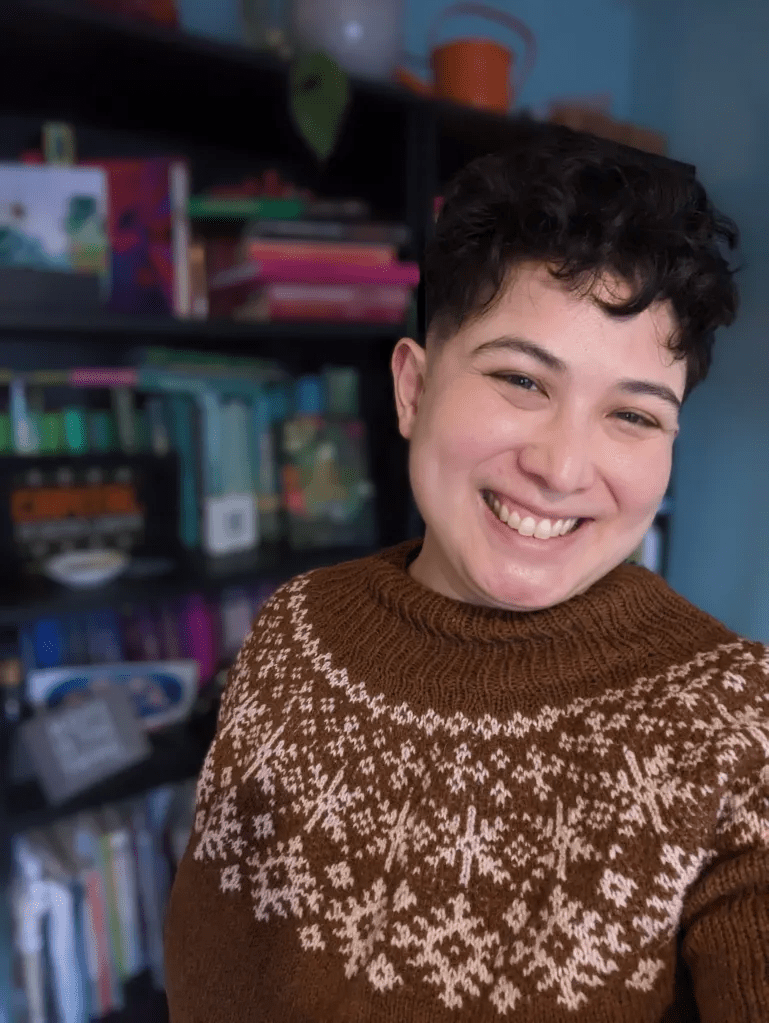
[Description of photo below: With tousled dark hair, Élaina wears a brimming smile and one of her knitted creations embellished with an intricate design of her making. In the faded background of the shot, a bookcase can be seen. On the top shelf of the bookcase, sits a watering can. Piles of books and decorative greeting cards can be seen scattered on the shelves below.]
ÉLAINA: Looking back now, I was exceptionally well supported by individuals in positions of authority, even though I did not then have the language of disability and advocacy. I live with ME/CFS, a chronic condition that is difficult to both diagnose and treat. I found people who believed me; yet I am acutely aware that there were no institutional protocols to support disabled students. In other words, I got lucky; in any other circumstance, the rigidity of an ableist system would have spat me out and I would not be here today.
I was particularly struck by what Nic Cottone says about “orphan diseases” that elude treatment, since that is basically what ME/CFS is. Nic said:
Because pain is inherently mediated by social meanings—meanings shaped through evaluative judgments about the “badness” of pain and disability and bound up with histories of violence against disabled people—we develop an account that situates pain within the broader political and social conditions that give rise to these meanings and structure the violence: colonialism, ableism, medical racism and sexism, and capitalism. To take a concrete example of the latter, one of my chronic pain conditions is classified as an “orphan disease,” which is the term used to describe rare conditions for which no viable pharmaceutical market exists to justify investment in research or the treatment (at least from the standpoint of producing surplus value).
ÉLAINA: Emily, I met you through Long-COVID advocacy. Long COVID is one of the multisystemic conditions that biomedicine is not incentivized to study. To take a leaf from Nic Cottone, what do you think are the social conditions that give rise to our collective understanding of Long COVID?
EMILY: All the numerous social conditions to which Nic Cottone refers are implicated in our collective understandings of Long COVID. Long COVID, like ME/CFS and many other “medically unexplained illnesses,” is underdiagnosed among racialized communities. The variety of forms of Long COVID range from acquired asthma to ME/CFS and POTS, thus folding in many “orphan diseases” that are already marginalized in medical research and dismissed in ordinary ableist discourses. Furthermore, Long COVID is attached to the COVID-19 pandemic as event and to the erasure—by governments and publics—of the ongoing nature of the pandemic. Thus, people with Long COVID often are reduced to symbols that stand in as metonym, as unwanted reminders of the traumas of 2020-2022 for nondisabled people, who wish to embrace the ableist push back to work that governments around the world engineered, the “sociological production of the end of the pandemic” (Death panel podcast).
Nic’s comments about orphan diseases put into relief how disabled people are generally cleaved into two groups according to their perceived “severity”: namely, divided into, on one side, disabled people who are perceived to be slackers—that is, ”barely” affected, failed workers—and, on the other side, disabled people who are considered to be objects of care and thus parts of the economy in another sense. (In this regard, I am alluding to the work of Jasbir Puar). Even among disabled people living with Long COVID, for example, I am positioned as a failed worker due to the ableist conditions of employment at higher educational institutions, while individuals whom I know are now “bedbound” and thus get reduced to ”mere” objects of care in public discourse and in social treatment.
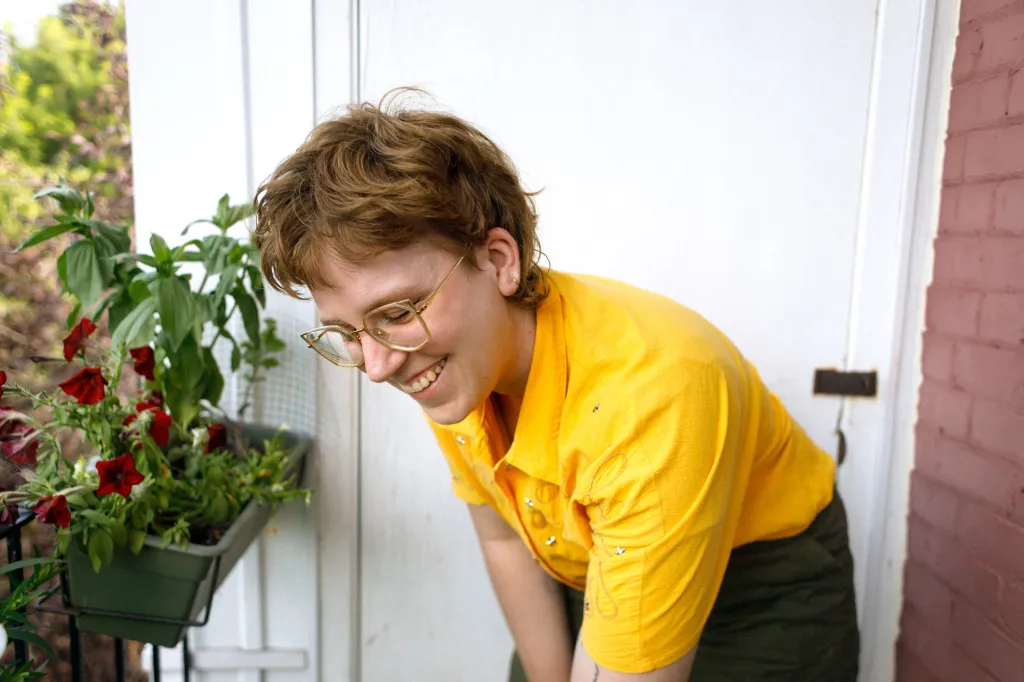
[Description of photo below: It’s summer. Emily, who is standing on their balcony beside a flowerpot of petunias, is bent towards the camera and laughing. Photo credit to Laurence Philomene.]
EMILY: In his interview, Raymond Aldred noted this ableist reductionism, pointing out that the agency of disabled people with caregivers is often denied, as the caregiver’s wishes, desires, and preferences are transposed and effectively override the perceived autonomy of the disabled person. In one place in his interview, Raymond remarked:
…it becomes problematic when we treat caregivers as mere extensions of disabled people, because this conflation can lead us to mistake the caregiver’s preferences for the preferences of the disabled person, or vice versa. When this sort of mistake happens, we risk overlooking instances where we have overridden the disabled person’s autonomy. Therefore, while caregivers may support and facilitate agency for people with disabilities, it’s important to recognize that each person—both the individual with disabilities and their caregivers—maintains their distinct perspectives, desires, and sense of agency. The challenge lies in fostering genuine relational support while preserving the distinct autonomy and voice of the individual with a disability.
EMILY: Shelley, how do you think that this binary portrayal of disabled people—namely, as either not-disabled-enough struggling workers or as too-disabled objects of care—plays out in professional philosophy and departmental politics?
SHELLEY: Emily, that’s a great question. As the question and Ray’s cited remarks suggest, the force of this binary understanding of disabled people can be recognized by considering how the binary coalesces and takes shape in practices produced in a host of domains, including at all levels of philosophy and of the university and academia more broadly. The historical and ongoing exclusion of disabled philosophers from the discipline and profession and the marginalization of critical philosophical work on disability are only the tip of the iceberg. Our exclusion is nevertheless required to preserve the binary in which, paradoxically, disability is represented as natural and hence philosophically uninteresting, though nondisabled philosophers, especially nondisabled bioethicists, are preoccupied with disability, or rather with one conception of it, as well as considered the moral and epistemic authorities about it.
Most nondisabled feminist philosophers seem to be genuinely perplexed by, and even averse to, the question of how to generate feminist work that robustly incorporates disabled people, the apparatus of disability, and ableism, work that would consequently decenter them within feminist discourse. Their puzzled and indeed frustrated political and epistemological perspectives about critical philosophical work on disability arise in part, I would argue, from the binary assumption that continues to condition much feminist thinking, a binary assumption that Ray’s remarks defy: namely, that a fundamental aspect of “women’s” oppression is that they are burdened with the (inevitable) care/burden of (genderless) disabled people.
The binary representation of disabled people as not disabled enough or too disabled lurks in a host of domains within philosophy and across the university: it constitutes eugenic arguments about MAiD and other eugenic arguments in bioethics; it structures policy about “accommodations’ for disabled students; it subtly conditions the responses of editors to requests for extensions; and it mandates the requirement for extensive medical documentation from untenured and otherwise precarious disabled faculty to secure sick leaves (both paid and unpaid), room and scheduling reassignments, enrollments caps, and other benefits afforded with less effort to (tenured) nondisabled faculty. These strategies and mechanisms of the neoliberal university and the apparatus of disability, when taken in combination, create a hostile and vindictive environment in which all disabled people must struggle to survive.
In their philosophical work on responsibility, Mich Ciurria has been concerned with how binary representations of disability and construction of double-binds limit options and life-prospects open to disabled people (among others) and the alleged impartiality that conditions much philosophical argument, especially the arguments of liberal philosophers. In Mich’s interview, she said:
As you know, Shelley, professional philosophers have been far too complicit in systems of oppression, either by taking the wrong side or by presenting both sides as legitimate….The term both-sidesism is typically applied to media outlets that try to be “impartial” at the expense of taking a stand on life-and-death issues like Palestine, transphobia, and immigration….Nonetheless, philosophers persist in arguing—often dispassionately and abstractly, as Plato and Kant would advise—about whether we, as persecuted minorities, should be allowed to exist… Cisgender, nondisabled, white men ponder these questions with cool detachment, as if solving a jigsaw puzzle, rather than deciding whether oppressed people should live or die, participate in public life, or disappear from it altogether.
In part, these debates are about whether a given culture (trans, queer, disabled…) should be allowed to continue to exist—that is, they are about cultural genocide. Debates about whether trans people should be allowed to play sports or use the bathroom, for instance, are not abstract philosophical questions and ensuing discussions about the nature of gender; rather, these “debates” are attempts to police trans people’s bodies and control trans culture. Like debates about immigration, these “debates” are pretexts for intensified policing. When Trump spoke about deporting undocumented immigrants in 2024, his real goal was to create the largest police force in American history—one capable of arresting political dissidents across every social group. Debates over trans people’s existence are masked justifications for policing dissidents. These “impartial philosophical debates” are prolegomena to carceral creep.
SHELLEY: Élaina, what is your response to Mich’s provocative remarks in this excerpt from their interview and the issue of impartiality and both-sidesism in particular?
ÉLAINA: Mich puts their finger on the core contradiction of the centrist “both-sidesism” position: its pretention to unimpeachable theoretical neutrality—the “I’m just asking questions” weaponised naiveté—while taking active steps to change the material conditions of marginalized people for the worse. “Debates” over “controversial ideas,” when they are spearheaded by the people most preoccupied with keeping their power of dominion, are never without consequence. To be epistemically cavalier is the privilege of the few and a vice heralded as a virtue. Being able to speculate “for fun” about the existence of trans people is designed to impress debate bros who care more about the sanctity of a mythic free public forum of ideas; it was never meant to be transformative, to make the world a better place.
Mich, rightfully, calls out Plato for his worship of the Ideal. Many Ancient Greeks also thought of theory as intrinsically linked to pursuit of the good life, as praxis. Ideas are powerful, they have effects, and there is no such thing as “pure theory,” at least not when discussing Earthly existence. I suspect that, as disabled philosophers, all three of us have had to examine arguments against the existence of disabled people with our students.
Speaking for myself, that experience is never neutral, nor do I think that I would be a better philosopher if I actively dissociated from the structure and the content of the arguments presented. I think, on the contrary, that the labor that I must expend to critique and assess ableist and eugenic arguments that target my own right to live has allowed me to understand the complexity and selectivity of thought, that is, enabled me to notice how we, as humans, choose to respect or disrespect certain ideas and concepts for complex social and political reasons.
Caroline Christoff clearly explains the inevitably political nature of philosophical argument in her Dialogues on Disability interview. Consider these remarks by Caroline:
Disability is a category that is generally thought to be intrinsically bad. So, if I want to fairly represent the debate about disability to students, I must question the badness of my own personhood to students. In other words, this pedagogical practice is a form of additional emotional labor that I, as a disabled person, am forced to confront when teaching this material that a nondisabled person does not have to face when they teach it. More generally, some people’s rights are assumed in today’s world, while the rights of others must be argued for. While there are many fantastic cis white male philosophy professors, they will never be required to present arguments that attack their own rights to be in the classroom. Other people must. When these people talk about the abortion debate, the American civil rights movement, or other social issues, they are talking about their own bodies. I wanted to write something about the disparity in this experience and how it affected me. […]
I suspect all philosophers would admit that some ideas are morally repugnant, generally the ones meant to justify sexist and racist positions. Most would agree that scholars who attempt to publish these ideas should generally not be given opportunity to give invited talks nor likely hold academic positions. The reason for this conclusion is simple: morally repugnant arguments are also specious arguments. A philosopher who holds these ideas is considered a bad philosopher. Arguments about the moral worth of disabled people are perceived differently, however; that is, they are clearly not yet considered to use the same specious reasoning as arguments about gender or race. This discrepancy carries with it the obvious implication that disability as a category is normatively distinct from other social categories such as gender or race.
ÉLAINA: Emily, how do you interpret Caroline’s claim that arguments about the moral worth of disabled people are not treated as specious?
EMILY: Élaina, thank you for drawing out this thread from Caroline’s interview. I do think, unfortunately, that a significant portion of academic philosophers continue to defend morally repugnant views, even about race and gender, without viewing them as specious. I think, in particular, that the selection from Mich’s interview and your own comments, Élaina, highlight how arguments about gender focused upon trans people are still tolerated and treated as non-specious in many academic circles, not only in popular, or non-academic ones. Whereas morally repugnant arguments about cis people and gender are often understood as “bad philosophy,” the same cannot be said with respect to arguments about trans people. Despite excellent scholarship from trans philosophers on trans existence, embodiment, and identity (for example, go here, here, and here), such work remains marginalized and sidelined in favour of more mainstream, bad faith interpretations.
I do agree, however, with Caroline’s assertion that arguments about the moral worth of disabled people are largely not treated as specious, suspect, or fallacious. For me, this quotation from the interview does not imply that disability is the one exception to an alleged proscription against repugnant philosophical arguments, but rather enables us to recognize alliance between the ways that disabled people and trans people (which are not mutually exclusive groups) get mobilized within philosophical argumentation and to examine how these arguments are legitimized.
To me, the most interesting question to pursue here is what happens when certain arguments focused on bodies/identities are widely described as “specious” while others are not? Both you and Caroline point to the kinds of discursive work that is enacted both upon and among disabled scholars when we teach, write, and engage with arguments against our existence and worth. I think that some of the rationale behind this division, that is, one explanation for why both trans and disabled existence are still regarded as legitimately “up for debate” is due to the shadow of impairment upon embodiment. If both being disabled and being trans are, consciously or unconsciously, understood as fundamental impairments, questions about our worth are, and will continue to be, legitimized.
In her interview last October, Karin Boxer suggests that the way the term disability is used and understood by the masses is largely in line with conceptions of impairment, despite attempts in philosophy of disability, disability studies, and human rights documents to disentangle impairment and disability:
For better or worse, I think that we need to acknowledge that, thanks in part to the influence of the ADA, the referent of the term disability in ordinary usage has changed. The term disability, rather than referring to inabilities to engage in particular activities—which is what both the original WHO model and the social model variously refer to as disability—has come to refer to what both models referred to as impairment. Bearing in mind this conceptual and linguistic change and the sort of social change that we would like to see, I want to propose that we define disability as a historically marginalized functional difference that affects the way that a person accomplishes tasks of daily living. […]
I think that we still need a term to refer to particular activity limitations, as well as a separate term to refer to the specific activity limitations that are the products of society—that is, to what the social model referred to as disability. To mark this distinction, I refer to the former as “disablement” and the latter as “disenablement”. One nice thing about this terminology is that it allows us to say that one can have a disability without being disabled by it (because it is fully accommodated or society has been made accessible) and that all forms of oppression can be disenabling.
EMILY: Shelley, you have written extensively—especially in your monograph Foucault and Feminist Philosophy of Disability—about the way in which the distinction between disability and impairment collapses, how impairment is naturalized, and that impairment itself is a part of the apparatus of disability. What do you think of Karin’s assertion that disability in legislation, accommodations, and ordinary usage in general is interpreted as impairment? Do you think that (as Karin suggests) proliferating and fine-tuning the philosophical terms that we use is one way to refuse this naturalization of disability?
SHELLEY: Thanks for these provocative questions, Emily. Karin seems to be suggesting a move away from the bipartite impairment/disability distinction of the British social model of disability to a tripartite distinction popular with late twentieth-century American disability movements, where the term disability referred to “functional” limitation in daily activity. Like Karin, disability theorists continue to propose and debate how they should employ language to signify the phenomena that shape disabled people’s lives—experientially, phenomenologically, socially, materially, and politically. These propositions and debates make bona fide metaphysical assumptions and commitments, demanding to be recognized as elements of the growing field of social metaphysics and critical ontology.
My argument that disability is an apparatus of force relations, rather than a personal attribute or individual characteristic, defies ontological assumptions that many philosophers of disability make. Indeed, as you might have read on social media, Emily, I want to push back against the generation of additional categories to refer to disabled people and disability. The argument that disability is an apparatus is one facet of this push. So, too, is my conviction that we should refer to ourselves in a more uniform way; that is, I maintain that we should refer to ourselves, all of us, as disabled, where the term disabled signifies a shared political identity rather than a personal characteristic or inherent attribute of individuals. In short, I believe that we need to move away from the proliferation of categories and the performative personification of diagnoses that divide us.
Am I suggesting that we return to a homogeneous understanding of the constitution of ourselves and our subordination, an understanding that terms such as neurodiverse, mad, and chronically ill were mobilized to complicate and expand? No, I think rather that these terms and appeals to the putative diagnostic realities—in short, impairment—that they prop up have been expedient heuristics for some (though not all) communities of disabled people. Yet they have outlived their initial purposes and are now counterproductive. They limit, for instance, the extent to which (the apparatus of) disability and ableism can be understood as co-constitutive with (among others) race and racism, gender and anti-trans, and age and ageism. Think of the incredibly wide range of bodies, experiences, self-perceptions, self-understandings, political commitments, and social practices that the term trans encompasses and promotes. It’s only one word, yet it serves well the variety of populations that identify with it, fosters solidarity between and within them, moving their lives away from the medicalization that has confined and pathologized them. That’s what the term disabled should be enabled to do.
Given that Foucault is a foremost philosophical influence on me for this argument, I suspect that Will Conway, whom I interviewed in November of last year, would endorse my views on disability and identification in this regard, or at least be very sympathetic to them. In Will’s interview, he wrote these inspiring remarks about Foucault’s impact for his analyses of disability:
Without Foucault’s work, mine would simply not exist. I engage with philosophy primarily because of my encounter with Foucault. He provided for me not just a method, but an ethos—a way in which to comport myself towards the issues that I confront in my work. When it comes to disability, Foucault’s work has given my own its contours….[W]e can state and examine—how disability is historically constituted and situated, that is, disability is not a transhistorical a priori that stands beside, like a mirror, to the normal, so-called able-bodied, subject; nor is it some dialectical relation or undecidable differentiation. Disability is rather both a discursive formation and an object of discourse. […]
On the other hand, Foucault gives us the tools to understand how disability is a technology of governance, explicitly showing in lectures such as Psychiatric Power, Abnormal, and Birth of Biopolitics how this government operates. Your explication of Foucault in these regards is an element of your monograph on him and feminist philosophy of disability that is generally overlooked. As you show, Foucault elucidates the means through which abnormality is established, problematized, and dealt with accordingly.
SHELLEY: I am thrilled that my work on Foucault and disability has been so influential in Will’s own thinking about disability through Foucault. Will’s understanding of Foucault and of my work is perspicuous, poetic, and nuanced. I have learned a lot from him about both Foucault’s work and my own. Will is well apprised of the institutional and professional structures that continue to marginalize and even exclude critical attention to Foucault, a disabled and gay man in philosophy who wrote about topics—including disability, race, abnormality, and sexuality—that few philosophers have regarded as the appropriate subject matter of philosophy, demonstrating how certain problematizations of these seemingly transparent topics undermined taken-for-granted knowledge.
Emily, I associate your work on disability with a sense of ingenuity like Will’s, exemplified in your groundbreaking teaching. In your interview with me in December 2025, Emily, you made these remarks about teaching at a CEGEP:
“Madness, Mental Illness, and Emotional Distress” is the first course that I designed for CEGEP students. My aim was to indirectly provide students with a partial genealogy of madness. […] By the end of the course, they discover that they have unique skills in philosophy of psychiatry, philosophy of psychotherapy, and have a greater critical knowledge of the roles of “psy-” institutions in some historical periods and in the North American present. […]
In my ethics course, students begin by learning about the general dismissal of disabled knowledge and expertise in philosophy, framed by the famous essay Harriet McBryde-Johnson wrote, in which she details her interactions with utilitarian Peter Singer. We examine utilitarianism and consequentialism, Kantian deontology, and social contract theory in turn, looking at specific implications for disability. […] Following this critical overview of ethical theory, students analyze the strengths and weaknesses of the social model of disability, elaborate intersectional understanding of disability’s relationship to race and gender, examine the current state of Medical Assistance in Dying (MAiD) policy and legislation in Canada, and are introduced to disability justice. Students read significant portions of Disability Visibility: First-Person Stories from the Twenty-First Century, edited by Alice Wong, which comprises short and accessible texts from disabled authors….
One key assignment of the course has students perform an accessibility audit of a physical location of their choosing. Students engage in a kind of integrated, active phenomenological experience that changes their viewpoint and assumptions about the place that they chose. The assignment pushes them to think about the impossibility of perfect access, why certain environments or services ought to be accessible in the first place, what kinds of modifications might be made to ensure access, and the universal design / retrofitting binary.
I have been deeply motivated to broach these topics at the CEGEP level. For many students, attendance at the CEGEP constitutes an important transitional period for their life, whether it is the transition between high school and university, the training period for a technical career, or upgrading education later in life.
SHELLEY: Emily, your CEGEP courses are importantly unique in the context of Canadian philosophy. Nevertheless, your courses are offered outside of a philosophy department. What do you think are the most significant and impenetrable obstructions—structural, conceptual, professional, philosophical—to the incorporation of courses like yours in a philosophy department in Canada?
EMILY: Thank you for this question, Shelley, which reflects many of my everyday concerns.
In the Humanities department at my CEGEP, most of the instructors have a background in philosophy—some with a M.A. in philosophy and many with a Ph.D in philosophy—and thus operate like trained philosophers, with many of the advantages and disadvantages of disciplinary norms of behaviour. (The CEGEP offers only a few philosophy courses which only two faculty members teach.) A smaller portion of the Humanities teaching faculty come from disciplines such as literature, film theory, and geography. As such, the dominance of old-school philosophical thinking still reigns.
For example, many of my colleagues teach classical Socratic dialogues and argumentation formation, although it is not required by the institution. Some of my colleagues carry strong prejudices against teaching feminist philosophy, viewing it as unnecessarily ideological in nature. These discipline-wide assumptions and prejudices come up directly in the cases of faculty-hiring committees, curriculum-review committees that analyze each new course, and in pedagogical discussions. I have had colleagues suggest, for example, that allowing students to step out of the classroom to use the washroom during an exam is unwarranted, and that all students should be able to “control their bodily functions” for the duration of any in-class assessment. This rather old-school view, influenced by Cartesian dualism, reflects a general divorce from embodiment. I have also had colleagues advise me, during my sick leave, to simplify and cut down on my course content, to go for more “basic ideas,” to sacrifice what is most philosophically stimulating for me for the sake of operating as a drone for the institution.
Courses such as mine are nominally celebrated at the CEGEP—colleagues who are friendly to interdisciplinary work and continental philosophy have applauded my integration of these topics. As I noted above, however, many of my direct colleagues carry ableist ideas about what both students and faculty can do. The institution, as I noted in my interview, is immovably hostile to the idea of online learning, despite potential gains for disabled students and faculty.
To return to your question, Shelley, there are several barriers to the incorporation into formal philosophy departments of courses like the ones that I have designed. Philosophy of disability and philosophy of madness/psychiatry/psychotherapy are usually absent in philosophy departments’ course offerings; or, if they are present, they exist as third- or fourth-year classes for students who have done some foundations in “canonical” philosophy. Thus, these courses are seen as additions, supplements, rather than as places to begin thinking philosophically.
I cannot express how sad and false this is, how sad and false it is that so few post-secondary institutions in North America have permanent offerings of courses on these topics, that these topics are restricted and gatekept from students. What I have seen in my courses is that it is entirely possible to, say, give students an introductory course in ethical theory that introduces them, robustly, to philosophy of disability.
Whether or not courses on these topics are offered usually comes down to individual faculty willingness. So, I think that hiring processes feed greatly into this downstream effect of excluding philosophy of disability from philosophy departments. Or perhaps it is a recursive movement: there are few courses on philosophy of disability, so it remains a marginalized topic, so there is no need to hire a philosopher who works primarily on critical philosophical work on disability, so there are fewer courses…. For example, my former doctoral program at McGill offers no courses on philosophy of disability, with no specialists on the topic, though they are happy to promote a M.A. in Bioethics program and employ many bioethicists.
I think my courses, and very many courses on philosophy of disability, demonstrate a kind of engaged philosophical method that is marginalized in the culture of the discipline. Overall, philosophy departments still live within the “culture of justification” that Kristie Dotson describes, contrasted with the “culture of praxis.” Élaina, you critically reflect upon this contrast in your interview when you say:
The way that I understand it, a “culture of praxis” invites philosophers to acknowledge a diversity of approaches to philosophising within the discipline. More than that, however, the existence of a culture of praxis would mean that the discipline embraces those of us who want to explore the messiness of engaged philosophy that blurs theory and practice. In my work, this blurring manifests as my exploration of epistemic authority in the very practical process of podcast production and in the way that I organise academic events to centre the care of disabled people.
Like many other early career and disabled researchers, I have no employment stability. One of the ways that I cope with this precarity psychologically is to filter my activities and commitments through the question: How is this activity or project contributing to a life-giving research culture? Ultimately, if tomorrow, I am no longer able to contribute to academia, I want to know that I have done my best to make the experience better for the next disabled woman of colour.
Since our last interview, I have leaned harder into being a crip killjoy in the tradition of Sara Ahmed’s feminist killjoy. It can be exhausting and tense to always be the one to publicly critique the ableism of my industry, but I know no change comes without resistance. Being a crip killjoy has brought me closer to people with whom I want to be in community and to whom I want to be accountable. Sometimes, crip refusal is the shape that my philosophical praxis takes, but this crip praxis of refusal has not been a lonely experience for me. What we often forget is that refusing to engage in certain cultures, be they at work or in social settings, frees you up to connect with the world in a different way.
EMILY: Élaina, you mention “crip refusal” in this portion of your interview; but I would like to prompt you to say more on this idea. What do you think is the power of crip refusal with respect to both the rejection of harmful ableist norms and the generation of space for (as you refer to them) “life-giving” projects and cultures? How can we think about refusal as both a negative and critical movement (not undermining its potential) as well as a space-maker?
ÉLAINA: This is an interesting question for me to answer in the wake of receiving yet another job rejection. For me, crip refusal means taking an active role in something that is imposed on us: rejection, exclusion, denial. An ableist society disciplines its denizens to seek approval in normalcy, in slotting in smoothly as a cog in its machinery. The expected reaction to being excluded is a desire to do whatever it takes to be accepted. The way that I understand it, crip refusal can be a pivotal breaking moment and/or a practice.
For example, the day that I refused to attend a conference because it did not meet my access needs was a moment of crip refusal. Two things were true at once: One, I was being discriminated against by the organisers of an inaccessible event that was important for my career development; and two, I made a conscious choice not to bend my bodymind past its breaking point. With any kind of refusal comes an absence and disabled scholars can often feel a pressure to “represent”. I propose that we should hold the “both/and” of the importance of having disabled people (as active crip killjoys or not) in ableist mainstream spaces to push for change and the necessity of crip4crip spaces where we can dream and experiment. Because we are all constrained by limited time, space, and energy, room for life-giving projects and cultures sometimes require that we refuse able-normative activities and practices.
To take an example that I give in my interview, my podcasting work to translate Annah, Infinite—a book about, among other things, the rage of existing in a pained body that medicine refuses to believe—is only possible because, over the years, I have eschewed conventional scholarly activities to, instead, develop my podcasting practice in relation to the communities about which I care. In an industry that operates on the disabling premise of “publish or perish” within strict guidelines of what counts as quality research to funding bodies, podcasting has allowed me to carve out a space where I can, with my disabled peers and elders, dialogically investigate how to design anti-ableist working frameworks, cripping research to bend to our bodyminds in a way similar to how Alison Kafer says that crip time bends to us.
In other words, in a world where we are pressured to “add value,” a practice of crip refusal can give us the tools and the framework to ask ourselves how we can participate in generative and not merely “productive” endeavours. While no one can refuse everything all the time, my experience with crip refusal has brought me to thinking of ways in which my labour, my scholarship, can also be recreational and lifegiving. I don’t need to wait for permission.
At its core, crip refusal is about claiming crip needs and desires as valid and worthy of attention, of being attended to, of being tended to in the face of an ableist world. For a Kantian interpretation of this sort of crip (at)tending to, we can turn to Sara Ellenbogen’s interview:
I outline my position on respect in “What Does Rationality Have to Do with Respect? Recommendations from a Philosophical Counselor with Lived Experience of Bipolar Disorder for Engaging with Psychotic Patients,” a paper that is forthcoming in Philosophical Practice later this year. In the paper, I argue that what it means to treat a person—in Kantian terms, a rational being and, in Donald Davidson’s terms, a rational animal—with respect is to treat them in the way that we ourselves expect to be treated, that is, as we ourselves expect to be treated given our status as members of the social world that we inhabit as rational beings, beings who understand reasons. What we expect is to have our wishes treated as important rather than as necessarily overriding considerations; that is, we wish to have the importance of our wishes acknowledged. The norm which dictates that we should give someone our reasons for why we choose to do what they do not want us to do (when we make these choices) licenses this expectation.
By making it explicit that we have reasons, we show that we are not acting in this way simply because we want to do so and have the power to do so. What underlies this norm is a very widely held worldview that no human need is more important than any other; that, in principle, no human need deserves more than another to be fulfilled. No human being, just as a person, is more important than any other. Put differently, what underlies this norm of ours that licenses our sense of entitlement to respectfulness is belief in the ideal of egalitarianism.
ÉLAINA: Shelley, this installment of Dialogues on Disability is an anniversary edition of the series and therefore marks yet another year in which you archived the work of disabled philosophers and the barriers that we have faced in academia and continue to face. How does this experience shape the way that you respond to Sara Ellenbogen’s claim that “What we expect is to have our wishes treated as important rather than as necessarily overriding considerations; that is, we wish to have the importance of our wishes acknowledged”?
SHELLEY: Élaina, what a fantastic question. The past year of the series ended with a reprise of last year’s anniversary installment in which Robert Chapman and Mich Ciurria interviewed me to mark the tenth anniversary of the series. Over the course of the decade in which the series has run, I have—by virtue of attending to disabled philosophers—become both indisputably and intimately aware of the extent to which disabled philosophers are considered unworthy and not respected in the discipline and profession, are actively disrespected, and even disdained, especially if we refuse to acquiesce to this mistreatment, whether exacted on ourselves or on other disabled philosophers.
In her interview, Sara did precisely this: that is, she put into stark relief the disregard and lack of respect that various disabled philosophers have confronted in the Philosophy Department at the University of Toronto (U of T) and, in doing so, she refused to acquiesce to this conduct. By doing so, furthermore, she implicitly summoned other disabled philosophers to likewise refuse that they (we) are unworthy of equal respect while putting nondisabled philosophers on notice for their ethical, political, and professional misdeeds.
I should note that in the aftermath of Sara’s interview several disabled philosophers (faculty and students) contacted me to express their appreciation for Sara’s remarks and to affirm that her experiences of disrespect and disregard, as well as the consequences of them, mirror the disrespect, disregard, and consequences thereof that they themselves experienced or witnessed in the U of T Philosophy Department.
Let me, therefore, underscore that one of the most vital outcomes of the Dialogues on Disability series has been the emergence of a cadre, or community, of disabled philosophers, who, like Sara and both of you, are unwilling to allow their exclusion and disparate mistreatment to remain individualized, internalized, personalized, and depoliticized. They/we know that they/we deserve equitable attention. By repeatedly demanding to be attended to, rather than obediently retreating, we consistently remind nondisabled feminist and other “progressive” philosophers that although they emphasize the urgency of inclusion and diversity in philosophy, they seldom do little more than pay lip service to an anti-ableist future.
Instead, they continue to organize and participate in conferences that exclude disabled philosophers. They continue to support and promote professional associations that tokenize disabled philosophers. They continue to implicitly or explicitly endorse claims according to which women philosophers are equally underrepresented in philosophy. They condescend to us, mansplain us, appropriate our work, and continue to deny us livable employment in the profession.
Nor do these philosophers acknowledge their historical and ongoing complicity in the (infra)structural violence inflicted upon us. They want neither to know about this structural injustice, nor be expected to act upon the knowledge, say, by challenging the practices of their colleagues or changing their own. For they are fearful; they are fearful of each other and thus must persistently reassure each other; and they are fearful of us and thus must incessantly clamour over us. For we are the untenured, unaffiliated, unemployed, and precariously employed faculty with respect to whose actions and complaints the fading (and faded) promise of sustainable employment has ceased to operate as a disciplining constraint, no longer restraining us and holding us captiv(e)(ated) in word and deed. On the contrary, while they are fearful, we are fearless. We (must) refuse to defer. I refuse to defer (obviously).
Élaina and Emily, I hope you will agree that it seems fitting to end this eleventh-anniversary installment of the Dialogues on Disability series on a defiant note. What a tremendous pleasure it has been to collaborate with both of you on this anniversary edition of the series. As always, I have both learned from and been motivated by the insightful and transgressive remarks that you make throughout this installment. I sincerely thank you for taking the time to help me compose this addition to the Dialogues on Disability archive.
Let me note that last week The Oxford Encyclopedia of Disability Studies—a mammoth project to which all three of us contributed articles and whose Philosophy and Theory of Disability Area I curated and edited—was launched. The peer-reviewed articles that the encyclopedia comprises will appear online on a rolling basis. Élaina contributed an outstanding article on “Ethics of Care and Disability;” Emily contributed a superb article on “Temporality and Disability;” and I contributed an awesome article on “Feminist Philosophy of Disability.” Katie Staal at Oxford has now asked me to act as the Area Editor of Philosophy and Theory of Disability for the Oxford Bibliographies in Disability Studies and to consider editing an Oxford handbook on feminist disability studies/feminist philosophy and theory of disability. So, there is lots of new (feminist) philosophy of disability online and on the horizon!
Before I close this long and lively anniversary installment of Dialogues on Disability, I want to convey my deepest thanks to all my Dialogues on Disability interviewees from the past year who entrusted me with their stories and shared their experiences and knowledges with all of us. Their courage makes the series possible.
The generosity and care of the faithful and committed Patreon supporters for Dialogues on Disability make the series possible too. Without their commitment to the series, my conversation with Élaina and Emily would likely not have taken place.
Finally, I want to end this anniversary installment by extending thanks to everyone who has tuned in to Dialogues on Disability during the eleven years in which the series has run thus far. Together, we are changing philosophy and academia more generally.
Readers/listeners are invited to use the Comments section below to respond to our remarks, ask questions about the interviews that we’ve highlighted, and so on. Comments will be moderated. As always, although signed comments are encouraged and preferred, anonymous comments may be permitted.
The entire Dialogues on Disability series is archived on BIOPOLITICAL PHILOSOPHY here.
From April 2015 to May 2021, I coordinated, edited, and produced the Dialogues on Disability series without any institutional or other financial support. A Patreon account now funds the series, enabling me to continue to create it. You can contribute your support for these vital interviews with disabled philosophers at the Dialogues on Disability Patreon page here.
_______________________________________________________
Please join me here again on Wednesday, May 20 at 8 a.m. EST for the one hundred and thirty-fourth installment of the Dialogues on Disability series and, indeed, on every third Wednesday of the months ahead. I have a fabulous line-up of interviews planned. If you would like to nominate someone to be interviewed (self-nominations are welcomed), please feel free to write me at s.tremain@yahoo.ca. I prioritize diversity with respect to disability, class, race, gender, institutional status, nationality, culture, age, and sexuality in my selection of interviewees and my scheduling of interviews.

